
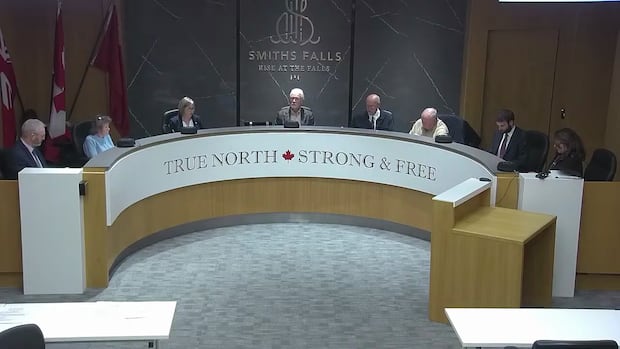
After vulgar remarks were caught on a hot microphone and led to the suspension of two councillors in Smiths Falls, Ont., earlier this month, legal experts are questioning whether elected officials can penalize their peers without due process.
That raises “significant concerns,” according to Douglas Judson, a former municipal councillor and lawyer who practises municipal law.
“I think the suspension might very well be illegal,” Judson told CBC.
‘Shot and pissed on’
The meeting was wrapping up on Jan. 5, when Coun. Jay Brennan, who had been attending virtually, uttered profanities that were heard on the livestream. The remarks have since been removed but were shared on social media.
“That f–ker should be shot and pissed on,” Brennan could be heard saying after the meeting ended. He later apologized publicly.
These kinds of comments would likely breach a council’s code of conduct, but an integrity commissioner would typically make such findings.
Instead, after an in-camera session on Jan. 12, council announced it had suspended Brennan from council and committee meetings for 45 days, with pay. Coun. Stephen Robinson was also suspended for 15 days with pay for texting Brennan during that meeting.
 Coun. Jay Brennan, left, and Coun. Stephen Robinson, right, were suspended by their peers earlier this month without an investigation into their alleged misconduct. (Town of Smiths Falls)
An investigation by an integrity commissioner would have been an “unwise use of taxpayer money,” the town’s chief administrative officer Malcolm Morris told CBC, calling the facts “self-evident.”
But Judson says there are good reasons why councillors should not be able to penalize each other.
“You could imagine all the political shenanigans and misconduct that would take place if councils by majority rule could suspend their members — people who are independently elected,” he said.
‘Incredibly unhealthy’
Municipalities in Ontario are required to retain the services of an independent integrity commissioner. They’re tasked with investigating complaints against elected members and officials and can recommend penalties or remedial measures such as apologies when they find breaches of a code of conduct.
The Municipal Act allows a municipality to impose penalties on a member “if the [integrity] commissioner reports to the municipality that, in his or her opinion, the member has contravened the code of conduct.”
Can the council actually do that?I’m not sure that it necessarily can.- John Mascarin, integrity commissioner
The town council’s code of conduct states that the Municipal Act “authorizes” council to impose penalties like a reprimand or suspension without pay “if so desired,” should a member contravene the code.
That clause does not specify that it can only happen through the integrity commissioner process, though clauses before and after specify the watchdog’s involvement.
The code also outlines an informal procedure for complaints against members who may have breached the code of conduct. That section does not explicitly state that council has the power to suspend a member, with or without pay.
It’s unclear which process council followed to carry out the suspensions or how it decided on those sanctions, and Mayor Shawn Pankow did not provide clarification.
 Shawn Pankow is the mayor of Smiths Falls. (Matthew Kupfer/CBC)
But Judson maintains that such sanctions against a councillor must come after an integrity commissioner has investigated the allegations and presented their findings.
“The code of conduct has to be compliant with the Municipal Act,” he said.
It would be “incredibly unhealthy” for councils across Ontario to pursue unilateral decision-making without an independent investigator involved, Judson said.
“The point of this is that council itself doesn’t go around punishing one another.”
Town doubles down
In an email, the Smiths Falls CAO said the sanctions imposed on Brennan and Robinson were “within the Council’s authority based on legal advice the Town received from our practicing solicitor.”
Morris noted that council had not docked pay from the councillors, as “suspending remuneration is not within Council’s authority.”
He also cited the section of the Municipal Act that states the powers of a municipality “shall be interpreted broadly so as to confer broad authority.”
But Judson said that such clauses do not give council “power to unilaterally discipline or suspend a duly elected member of council.”
The suspended councillors have legal options, Judson said, including challenging the decision or seeking an injunction to halt the suspensions. The case could also face judicial review at divisional court, highlighting a potential Charter claim relating to freedom of expression, should elected members be “de-platformed” from their duties.
Brennan and Robinson did not respond to questions from CBC.
At Monday’s council meeting, an email from Brennan was read aloud. He informed council that he plans to donate 45 days’ worth of his salary to help paint the local Heritage House Museum.
In response, Coun. Chris McGuire raised concerns about the possible tax deductions of that donation, and reflected on how council handled the suspensions — without involving the integrity commissioner.
“I guess in hindsight it goes to show … it’s better to follow the process even if [the informal route] seems like it’s an easier way to deal with it,” McGuire said.
WATCH | What was said at council Monday about the suspensions and donations: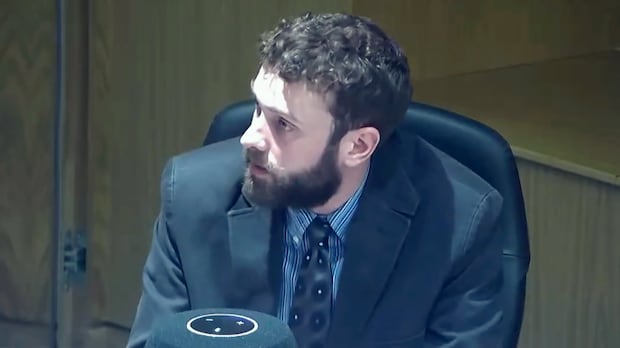
Smiths Falls councillor raises concerns over handling of hot-mic suspensions
After a hot-mic situation this month, two councillors in Smiths Falls, Ont., were suspended by their peers without an integrity commissioner investigation. On Monday, as one of the suspended members announced they’ll make a donation from their pay, one councillor reflected on how council handled the penalties informally, without due process.Integrity commissioner weighs in
The town’s integrity commissioner Tony Fleming said he cannot comment on this matter.
John Mascarin, an integrity commissioner for more than 75 other Ontario municipalities, said while municipalities may have authority to take action against members who act inappropriately, this case strikes him as outside the norm.
“That is so unusual. I find that a little extraordinary,” Mascarin said. “Can the council actually do that? I’m not sure that it necessarily can.”
Mascarin said there is some precedent for councillors sanctioning their peers. In 2013, amid then Toronto mayor Rob Ford’s crack cocaine scandal, his council voted to strip his mayoral powers and cut his budget without an investigation by the city’s integrity commissioner.
Mascarin noted that council can vote and pass remedial or corrective measures, and impose them on members. For example, a municipality’s procedural bylaw could allow a member to be expelled from council chambers for being unruly.
Punitivie measures for breaching the code of conduct are different, however.
WATCH | What does an integrity commissioner do?:
What does an integrity commissioner do, anyway?
Ahead of a municipal election next fall, CBC’s Acton Clarkin takes a look at the role of the municipal integrity commissioner.
He added that preventing councillors from performing their elected duties such as speaking with constituents can become problematic.
“I think the municipality had possibly the right idea, but I think it may have gone out offside,” Mascarin said. “A penalty can only be imposed if an integrity commissioner reports and finds a contravention.”
Bill 9 to standardize codes
A bill currently before the Ontario legislature could help clarify and standardize rules, said Judson.
Bill 9 would give municipal councils power to remove misbehaving members, but only following local and provincial integrity commissioner investigations and a unanimous council vote.
It also seeks to standardize codes of conduct, which are currently created by each municipality.
While the bill has its critics, Judson believes that standardizing codes of conduct could help smaller municipalities that struggle with resources and expertise make their codes procedurally sound.
“I think it’s important the government act on that now,” Judson said.
A third reading of the bill was ordered last October but the Legislature doesn’t reconvene until March.
The province’s Ministry of Municipal Affairs and Housing did not answer CBC’s questions about the Smiths Falls suspensions and Bill 9, nor did it clarify whether councils may unilaterally suspend peers.
The ministry directed questions to local municipalities, saying codes of conducts are their responsibility.