

Shutterstock
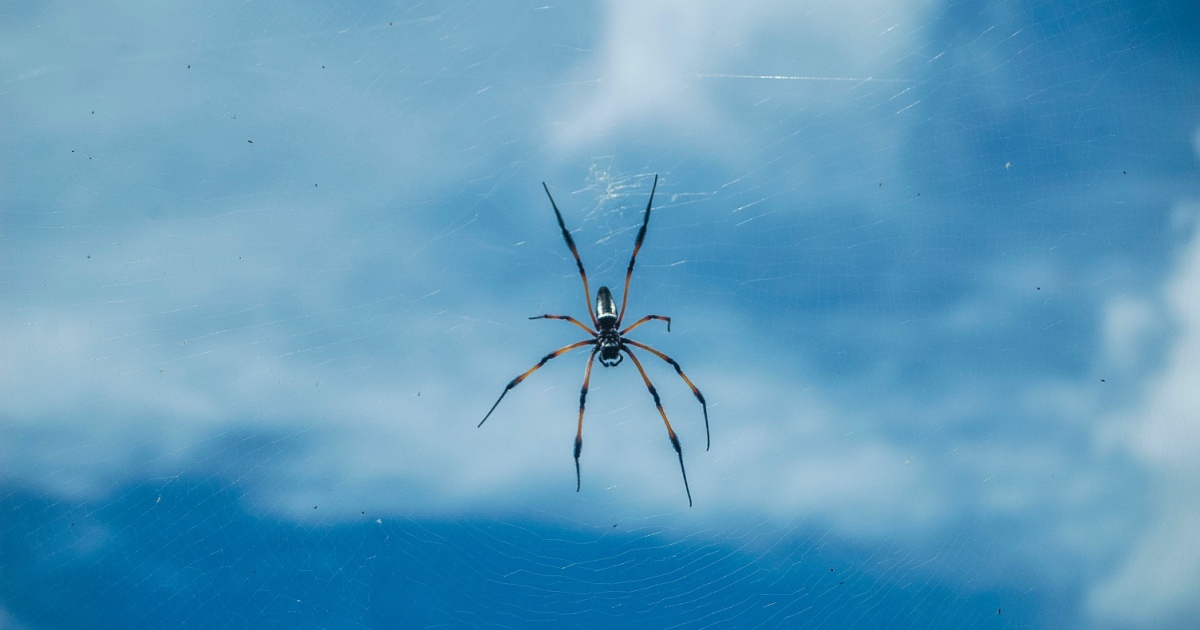
Spiders are incredible creatures, having evolved to dominate just about every environment. Some species burrow underground to live, others live in caves, and still others have developed ways to ‘fish’ from the water (or even walk on the water).
Of course, you’ll also find spiders up in the trees, in homes, and just about everywhere else you can think of.
At least they haven’t learned to fly, right?
Wrong.
Some species of spiders, called salticids, can fly using a technique called ballooning. This is where the spider produces silk that functions like a parachute, allowing the spider to take off. You can see it in action on this clip from BBC Earth:
For a long time, most people thought that the spiders would make the silk piece and use it to catch the wind, which would lift them off the ground. Other people thought that they were able to detect and harness thermal changes in order to fly.
According to a 2018 study, however, neither of those things is accurate.
It was found that these spiders could fly even when there was no wind at all or any type of thermal activity.
The scientists monitored the spiders and found that just before they took off, the spiders would stretch their abdomen as high into the air as possible, and then they would suddenly take off.
Shutterstock
Eventually, they were able to figure out that the spiders could detect electric fields and use them to generate the lift they needed. When the researchers removed all electromagnetic fields from an area, the spiders could not fly.
In a statement about it, lead researcher Dr. Erica Morley said:
“Previously, drag forces from wind or thermals were thought responsible for this mode of dispersal, but we show that electric fields, at strengths found in the atmosphere, can trigger ballooning and provide lift in the absence of any air movement. This means that electric fields as well as drag could provide the forces needed for spider ballooning dispersal in nature.”
So, if you happen to be paragliding or engaging in other types of flying, thinking that you are safe from spiders, think again. They might be up there sharing your airspace, riding those electromagnetic waves.
If you thought that was interesting, you might like to read a story that reveals Earth’s priciest precious metal isn’t gold or platinum and costs over $10,000 an ounce!
Categories: ANIMALS, NATURE/SPACE
Tags: · ballooning, electricity, electromagnetic waves, flying spiders, science, silk, single topic, spider, spiders, top