
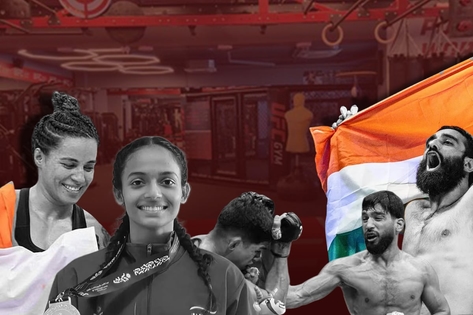
Shriya Satam is seventeen years old. On the first day in Bahrain for the Asian Youth Games, she broke her phone. For the next five days, she had no access to social media, no Instagram, no distractions. She did not care. She was there to fight.
In the girls’ 50kg Traditional MMA final, she lost to Kazakhstan’s Amelina Bakiyeva via arm submission in the first minute. But the silver medal she brought home was historic: India’s first-ever female MMA medal at a multisport continental event. Veer Bhadu had won bronze in the boys’ 80kg the day before. These were not personal victories alone. They were proof of concept.
“When we went for the Bahrain Youth Asian Games, the entire team was funded by the Indian Olympic Association,” says Nikhil Kunder, president of the Mixed Martial Arts Sports Federation of India. “Everything: the airfare, internal travel, hotel, food. They gave blazers, tracksuits, shorts, t-shirts. Any fighter coming from a poor background didn’t have to buy anything.”
This is relatively new. For most of Indian MMA’s short history, fighters paid their own way, sought sponsorships that rarely materialised, and watched federations pocket government funds meant for them.
Something has changed. The question is whether the change will last.
The Turning Point Nobody Expected
In May 2025, the Olympic Council of Asia confirmed MMA’s inclusion in the 2026 Aichi-Nagoya Asian Games. Six medal events. For the first time, MMA medals would count towards India’s national tally. In a country where Asian Games medallists receive government jobs, state pensions, Khel Ratna awards, and brand endorsements worth crores, this opens a new pathway where upskilling and training is not haunted by the injury-related fear of “What if I fail?”
The sport once dismissed as “cage fighting” now has a pathway to legitimacy that cricket took decades to build. India’s seventh-place finish at the 3rd Asian MMA Championship in China—one gold (Rekha Chaudhary), four bronze, top-eight recognition among twenty-one nations—would have been a footnote two years ago. Now it is a credibility marker. Indian fighters are internationally competitive. However, the infrastructure to support them is not.
This is the central tension: India has the fighters. It lacks everything else.
The Talent Pool
Currently, over 90 per cent of fighters come from backgrounds full of challenges. Their families not supporting them is a normal story. Looking after themselves in such circumstances becomes a whole new challenge. Sometimes parents are not even aware that their children are fighters.
“One of our own fighters, Santosh Yadav, comes from a very small village in UP, Uttar Pradesh. His mother had no idea for the first two years that her son is a national champion in MMA. Two-time national champion. After two years, when he won for the second time and went back to his hometown, that’s when he told his mother that he is a fighter,” said Kunder.
Imagine being a two-time national champion and your own mother not learning about this achievement from television.
The talent pool expands across North India and the Northeast: Uttarakhand, Haryana, Delhi, Arunachal Pradesh, Nagaland, Mizoram, Manipur. The Northeast, with its long tradition of combat sports and the psychological toughness that comes from lives already full of struggle, produces fighters disproportionate to its population.
Fighters from these regions, Kunder observes, “are already fighting so much in life that fighting inside the cage doesn’t feel like anything to them.”
But here is the structural problem. While fighters come predominantly from tier II, tier III, and tier IV cities, the training infrastructure—quality gyms, sports science facilities, qualified nutritionists—exists almost exclusively in Delhi, Mumbai, and Bangalore.
A promising teenager from Arunachal’s Tawang, Uttarakhand’s Uttarkashi, or Chhattisgarh’s Bastar must relocate to access anything resembling international-standard training. While academies make money from metro kids who can afford memberships and personal training fees, the talent pool mainly comes from places like Bastar, Pulwama, and Uttarkashi.
This geographic mismatch of resource allocation and talent availability is a recurring fundamental barrier to Indian MMA.
How This Barrier Feels
Nutrition remains the single biggest technical constraint. MMA fighters train five or more hours daily; they need both carbohydrates for energy and protein for recovery. Despite Indian food being highly suitable for such requirements, individual athlete-based minor tampering regarding timings and amounts is what separates a pro-athlete from an average one.
Outside metros, affordable sports-science-backed nutrition systems simply do not exist. Fighters from smaller regions do not have access to supplements, sometimes quality food, or basic dietary guidance.
Career spans in combat sports complicate this further due to their short length. Unlike cricket or tennis, where athletes can compete into their late thirties, MMA fighters face a narrow window—typically their mid-twenties to early thirties—to establish themselves. Recovery from injuries, career planning, and the financial burden of continuous training compound the challenge.
In this short span of time, talented athletes have to arrange resources, sponsors, media glitz, and local support, as well as ensure that they face quality opponents day in and day out to prepare for multinational tournaments. For any athlete to succeed, the challenge in practice sessions must be at least 10 per cent higher than the tournament requires.
For a cricketer wanting to bat against bowlers bowling at 140 km per hour, his eyes need to be trained for 150 km per hour deliveries. Similarly, a fighter aiming to win at the Asian level must train daily at a level closer to the UFC than to the national circuit. In MMA, adaptation occurs not at parity but at surplus: surplus pace, surplus resistance, surplus pressure.
Consider Varun Sanyal’s situation at the Asian Championship. He faced a Chinese opponent whose pro MMA record stands at 20 wins and 4 losses—the number one lightweight in China, ranked second or third in Asia. Varun, by contrast, was an amateur with far less experience.
“It really feels different when you fight a fighter of that calibre. Given that Varun was an amateur and much less experienced, it creates a lot of difference. I will appreciate one thing: he survived all the rounds, fought till the end, did not get finished, did not give up. He protected himself well because fighters don’t want serious injury that leads to a long layoff. That’s a good fight IQ,” said Kunder.
Fight IQ—the ability to survive, to protect yourself, to lose without being destroyed—separates fighters who have careers from fighters who have moments. Varun lost on points. He walked out healthy, ready to compete at the May qualifiers in Kazakhstan or Uzbekistan. But fight IQ cannot close the gap with opponents who train at world-class camps, who have strength and conditioning coaches, who do not worry about their next meal.
For Suchika Tariyal, the challenge was different. She faced what the delegation has formally described as officiating bias against a Chinese opponent who had already lost her first bout; she deserved gold but received bronze. India’s tally could have been higher.
Indian fighters are close, but they are not there yet. One of the reasons lies at the federation level.
The Federation Wars
Indian MMA’s federation landscape is fragmented. Multiple bodies claim authority: MMA India (IMMAF-affiliated), FMMAI (formerly GAMMA India), AIMMAF, and MMAFI. Each claims legitimacy. Each has affiliations and fighter rosters. Each accuses the others of everything from incompetence to outright fraud.
The result, as a 2025 CSRI report noted, is that “India’s MMA scene is mired in confusion with multiple federations battling for official recognition.” The Indian Olympic Association has yet to recognise an official federation. At least three organisations have approached the IOA seeking recognition.
For fighters, this creates impossible situations. Existing bodies demand exclusive loyalty, limiting growth. When a fighter affiliates with one organisation, they may be barred from competing in events sanctioned by another.
Amidst this spectacle, the Mixed Martial Arts Sports Federation of India (MMA-SFI) entered the fray with continental affiliation from the Asian Mixed Martial Arts Association, which is recognised by the Olympic Council of Asia. At the global level, it is affiliated with the Global Association of Mixed Martial Arts (GAMMA). It has also been successful in securing funding from the Indian Olympic Association—a stepping stone towards official recognition by the Ministry of Youth Affairs and Sports.
This is contingent on the establishment of state-level bodies, a process expected to advance at a conference scheduled for February 2026. However, this trajectory has not been without contention. Rival federations have initiated litigation challenging MMA-SFI’s recognition, leading to proceedings in the high courts. The disputes have been accompanied by allegations and counter-allegations of harassment against officials of rival bodies.
“Now the only thing remaining is the state bodies. In February—19th–20th are the dates fixed—we have organised a conference where we are inviting different state representatives and will be granting affiliations,” said Kunder.
Kunder describes a case in which fighters from Bastar were sponsored by the government for the world championship. The federation made the government pay four lakhs each. The entire money went to the federation; the athletes got nothing.
Without ministry recognition, fighters have no regulatory recourse. They can complain, or they can quit.
Why Recognition Matters
Ministry recognition—and eventually IOC recognition—would transform Indian MMA overnight.
First, it creates a safety net. Asian Games medallists receive government support and stipends from both central and state governments. A fighter who doesn’t make the UFC but wins bronze can still secure their future. Without recognition, that option doesn’t exist.
Second, it unlocks corporate sponsorship. Currently, brands provide token support: a tub of protein that lasts ten days. After Shriya Satam’s silver medal, a JSW representative approached her about comprehensive sponsorship—signing her, funding her training, shifting her to their facility. The hiccup was that the sport isn’t IOC-recognised. They couldn’t proceed. When recognition comes, major corporations like JSW, Reliance, and Tata will enter aggressively.
Third, it enables regulatory authority. Only a recognised federation can draft rules, register fighters, and prevent the exploitation that has defined Indian MMA. “Once that happens, you are legally powerful to draft the rules and regulations that need to be followed, just like any other federation. Only then will the sport be regulated and fighters will not be mistreated, will not be cheated,” said Kunder.
The Stars Who Made It
Indian MMA has produced genuine talent despite the system, not because of it.
Anshul Jubli, now thirty-one, from Uttarkashi—once a mathematics teacher to survive—became only the second Indian to sign a UFC contract after winning the Road to UFC tournament in February 2023. He received a fifty thousand dollar Performance of the Night bonus for his TKO of Indonesia’s Jeka Saragih. His Instagram following exceeds half a million. UFC India posts featuring him generate significant engagement on their regional social media.
Puja Tomar from Muzaffarnagar became the first Indian—male or female—to win a UFC fight in June 2024. “This win is for all Indian fans,” she said afterward. “I want to show the world that Indian fighters are not losers. We are going to be all the way up.”
Owais Yaqoob, twenty-six, from Pulwama in Kashmir, trains at Khabib Nurmagomedov’s gym in Dubai and recently won at BRAVE CF 98 in China with a first-round TKO. Once involved in stone-pelting, counselled back into the mainstream, he now wins internationally and runs Lion’s Den Martial Arts Academy in Pulwama, where dozens of youth train.
Among prospects: Sonam Zumba from Arunachal, training in Assam under coach Babadi Chaudhary; Nazareth from Mizoram, who knocked out his ONE Championship opponent in nineteen seconds. Kunder identifies Anshul as “one of the best fighters India has produced—if you look at his fighting style and the way he fights.”
The caveat is that without access to UFC-level camps, even elite talent hits a ceiling. Anshul’s February 2025 loss at UFC 312—a nineteen-second TKO—illustrates the gap. He will soon be travelling to the US to start his new training.
Learning From the Last Collapse
In 2012, Super Fight League was launched with Bollywood backing: Sanjay Dutt, Raj Kundra, dance numbers between bouts—everything that the Indian Premier League normalised was there. The first event drew three hundred thousand YouTube viewers. The second drew fewer than three thousand. The traditional wisdom is that viewers thought it was pro wrestling; when they realised it was real fighting, many were put off.
By 2014, fighters complained of unpaid purses and contracts held by officials that athletes never saw. The promotion collapsed. One key lesson from that collapse is that spectacle without structure doesn’t survive. The current ecosystem was built by survivors of that collapse.
Matrix Fight Night, founded in 2019 by the Shroff family—Tiger, Krishna, and Ayesha—has conducted seventeen events, produced both current UFC-contracted Indian fighters, and streams on Disney+ Hotstar. Unlike SFL, MFN has shown its inclination to emphasise fighter development over celebrity glamour. “We’re showing them that MMA can be a legitimate, sustainable career in India,” Krishna Shroff has said.
The Road to UFC
The UFC wants India. Their India page generates massive engagement. The market potential is obvious. What’s missing is the depth of recognised fighters at the top level and a recognised federation with full government backing. UFC events require national body sanction. Without ministry recognition, India cannot formally host a UFC event.
“Once we have that level of talent,” Kunder says, “UFC will probably look at hosting its first-ever event here. It always happens through the national body. The government has to get involved.”
Brazil dominates UFC because it built an ecosystem: quality gyms in every city, a culture that valorises fighters, pathways that don’t require leaving the country. Fighters like Anderson Silva, Amanda Nunes, and Charles Oliveira emerged from that ecosystem. India has the fighters. It lacks the ecosystem.
Most of the Indian MMA fighters are not the children of privilege. They are children of struggle, looking for a way out. Will India build a system around its fighters, or let the momentum dissipate again?
The pieces exist: fighters with genuine toughness, metro infrastructure waiting to expand, corporate interest contingent on recognition, government programmes ready to fund medallists.
What’s needed is the will to assemble them. That is one skill India can claim expertise in.