
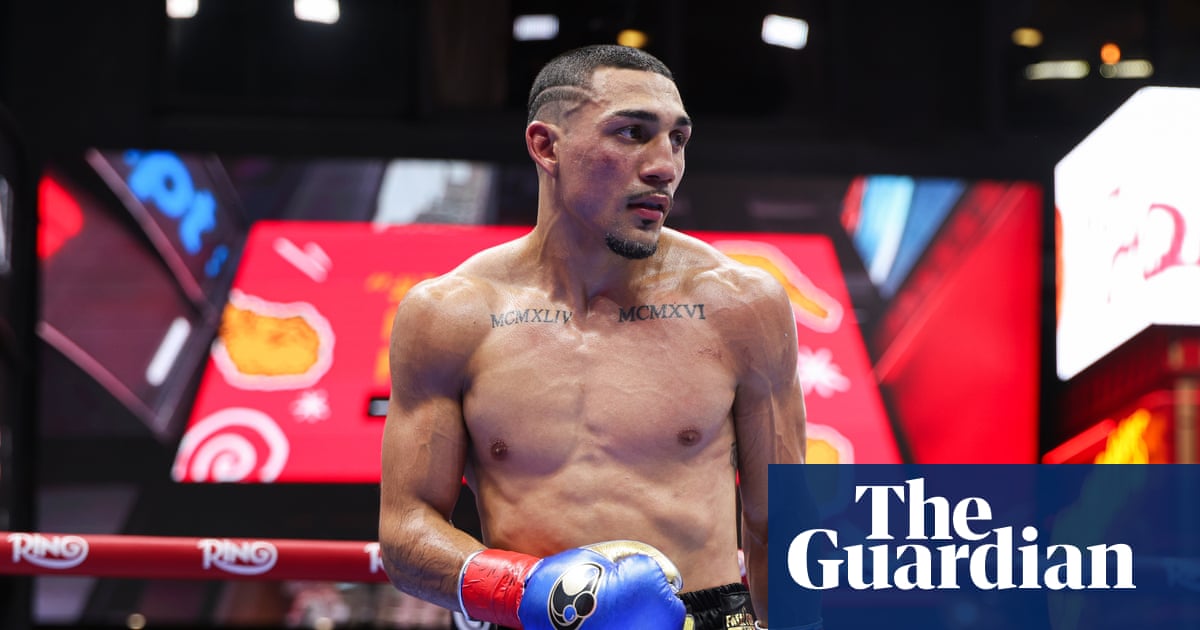
Teófimo López’s boxing career has unfolded in untidy extremes, and few places have captured those contradictions like Madison Square Garden. It’s the building where he boat-raced Richard Commey inside two rounds to win his first world title aged 22, saw his fast track to superstardom abruptly derailed as a heavy favorite, then returned two years later to dismantle Josh Taylor as the underdog and stamp himself as a two-division champion. Now on Saturday night, when he defends his junior welterweight title against Shakur Stevenson in a clash of arguably the two best American fighters active today, the Garden may finally make it clear which version of López is here to stay.
“It’s the magnitude of it all,” says López, one of boxing’s most charismatic and mercurial personalities, filling my screen with warmth and effortless third-person bravado during the final days of his training camp in Hollywood, Florida. “Who’s going to really set the tone for the sport? You’ve got Shakur Stevenson, who wants that baton, and you’ve got Teófimo López who believes he’s the better representation for boxing.”
He adds: “My goal is to make boxing great again and you can only do that by giving the fans what they want. This is the biggest fight you can make today and we both deserve credit for making it happen.”
His view of Saturday’s matchup has a ring of hyperbole, but it may even be true. Stevenson, a three-weight champion at 126lb, 130lb and 135lb from Newark, New Jersey, and the finest defensive virtuoso of the current generation, is making the short trip across the Hudson with the reputation of a fighter whose style has yet to be fully tested. His impeccable command of distance and tempo has made one elite opponent after another look hesitant rather than hopeful, while no one in 24 paying bouts has yet succeeded in dragging him into prolonged discomfort. By contrast López, a former unified 135lb champion and the lineal world title-holder at 140lb since overwhelming Taylor in 2023, has built his brand on forcing moments of truth: thriving in those flash points where the structure and geometry of a fight break down and instinct takes over.
That contrast helps explain both López’s wide appeal and inherent unpredictability. Born in Brooklyn to Honduran parents and raised in Florida, he turned professional as a teenager on a contract with Top Rank Promotions after narrowly missing out on representing the United States at the 2016 Olympics, where he competed for Honduras instead. He then rocketed up the lightweight ranks on a blend of concussive power, showmanship and an almost nuclear self-belief, taking his place on the world stage with a one-punch destruction of veteran Mason Menard in his 11th fight, also at the Garden. No shrinking violet when it comes to harsh language, he’s leaned in to the role of provocateur from those earliest days, his nickname (“The Takeover”) a nod to his disruptive career ambitions.
Teófimo López’s showmanship has made him one of boxing’s most visible stars today.
At 28, López has already lived several careers inside one. Toppling the imperious Vasiliy Lomachenko in 2020, then boxing’s pound-for-pound king, should have been a coronation. Instead it marked the start of a discordant second act: a shock loss by split decision to the unheralded Sydneysider George Kambosos Jr off a 407-day layoff that chased him from the division, two muted performances on arrival at 140lb, then a sudden return to form against Scotland’s Taylor. That oscillation between confidence and confusion – a nagging tendency of fighting up or down to his competition – has become the accepted narrative of his career even as he disputes the premise. “Of course there are going to be moments where you do look vulnerable,” López explains. “That could possibly be from just the mentality point of myself. But my résumé speaks volumes in the sense that I always aim for the tougher opposition.”
It’s true. When the challenge feels tallest – when the opponent is elite and the stakes unmistakable – the chaos around López has often given way to clarity once the bell sounds. His focus tends to sharpen rather than fray in those moments, a pattern that may bode well for Saturday night, when he goes off as a near 3-1 longshot against Stevenson.
Much of that volatility has roots far beyond the bright lights. López grew up in the orbit of a father who is both his trainer and his loudest advocate, a man shaped by a family history marked by violence, loss and upheaval stretching back generations. Boxing became a stabilizing force early. López was six when he first bled in the gym, needing stitches after a training accident, and he has often said the sport came to him faster than to most – drills learned in days rather than months.
This is the biggest fight in boxing and we both deserve credit for making it happen
He insists the wild swings in form that have defined him belong to the past. “I just want to show the consistency that is coming out of Teófimo moving forward,” López says. “You’re not going to see any of these hiccups any more. Anything that has haunted me from the past, I’ve let all those things go.”
That turbulence has spilled beyond the ring, taking the form of a long list of controversies, many of them of his own making. López has spent extended stretches inactive, publicly feuding with his promoter and conducting many of his battles on social media rather than inside the ropes. He has drawn condemnation for rage-baiting with racist remarks in interviews and the odd hard-R on livestreams, erratic online behavior and inflammatory comments about opponents, while personal upheaval – including a protracted divorce and reported splits with his management team – has only compounded the instability. The pattern is familiar: flashes of brilliance followed by extended drift, with López often his own toughest opponent. “I’m not a racist, all right!” he tells me, flashing a wide smile and mock-serious indignation. “I’m not a fucking racist!”
Stevenson presents a different kind of examination. A silver medalist at the 2016 Rio Olympics, the 28-year-old southpaw is thought to be boxing’s purest technician at the moment, an exacting craftsman whose discipline and patience have rarely come under meaningful duress, drawing cautious if credible comparisons to Mayweather and Crawford. López respects that foundation, but he also believes it comes with limits. “It’s like with construction workers: some things ain’t always going to go as the blueprint,” he says. “You’ve got to be creative in there. You can’t just throw the same things over and over. And I don’t see that creativity in Shakur, at least not yet.”
That belief, that discipline eventually creates its own constraints, sits at the heart of Saturday’s encounter. Stevenson’s advantage has never been about dominance in the obvious sense. It is about anticipation, about staying just far enough ahead of the contest that opponents begin reacting rather than initiating. The danger, for anyone facing him, is that patience can begin to feel like passivity.
Asked where he believes Stevenson is least comfortable, López does not hesitate. “Everywhere,” he says, before turning to the paths that shaped them. “I was with Top Rank. We were stablemates. They cherry-picked every opposition for Shakur. Teófimo didn’t get that treatment. I had to learn on the job.”
Rather than dwell on grievance, López frames the difference as formative. He sees himself as a product of exposure rather than insulation: a fighter who learned by being placed in difficult situations early and often. On Saturday, he believes those experiences will make the difference.
Teófimo López, right, lands a block on Arnold Barboza Jr during last year’s junior welterweight title fight in Times Square. Photograph: Cris Esqueda/Golden Boy/Getty Images
The past few years have forced López to confront himself as much as any opponent. He has spoken openly about periods of depression and self-doubt, including a crisis that followed his breakthrough win over Lomachenko and unfolded amid promotional turmoil and more than 400 days of inactivity. Becoming a father in 2021 marked a turning point, giving him a sense of perspective that now runs alongside his ambition rather than competing with it.
Despite their shared promotional lineage, López says he never viewed Stevenson as an inevitable rival. “It just happened,” he says. “I’m not one to back down from a competitive fight. Now we’re here, and I can’t wait to show him that I’m really about my business.”
What López wants understood, above all, is that he believes his presence serves a broader purpose. “I’m really good for the sport,” he says. “I’m good for the next generation that’s to come. I don’t want this for me. I want this for the ones coming after me.”
That sense of responsibility has deepened since he became a father. Asked if parenthood has changed how he views winning and losing, López answers without hesitation. “Being a father, you already won,” he says. “Everything else is just adding more water to my cup.”
His son, Teófimo López V, now four, has altered how he thinks about the image he presents, both inside the ring and out. “I can’t be out here looking like a bad representation,” he says. “Not just for him, but for all the other young kids that are looking up to me.”
If López is to upset the odds and retain his title, it will not be because the fight dissolves, but because he bends it to his will. The intrigue on Saturday lies less in who has the cleaner technique than in whether discipline or disruption yields first. Boxing rarely offers matchups at the elite level where both fighters can plausibly claim to reveal something fundamental about the other. This is one of them.
Asked what he hopes his son understands one day about him as a boxer, López’s answer lands with atypical gravity, drawing on the philosophy that has shaped both the arc of his journey and the nature of Saturday’s scrap. “You’ve got to fight for what is right,” he says. “If you ever get a route to choose easy, choose hard. You get the better experience from choosing hard rather than easy.”