
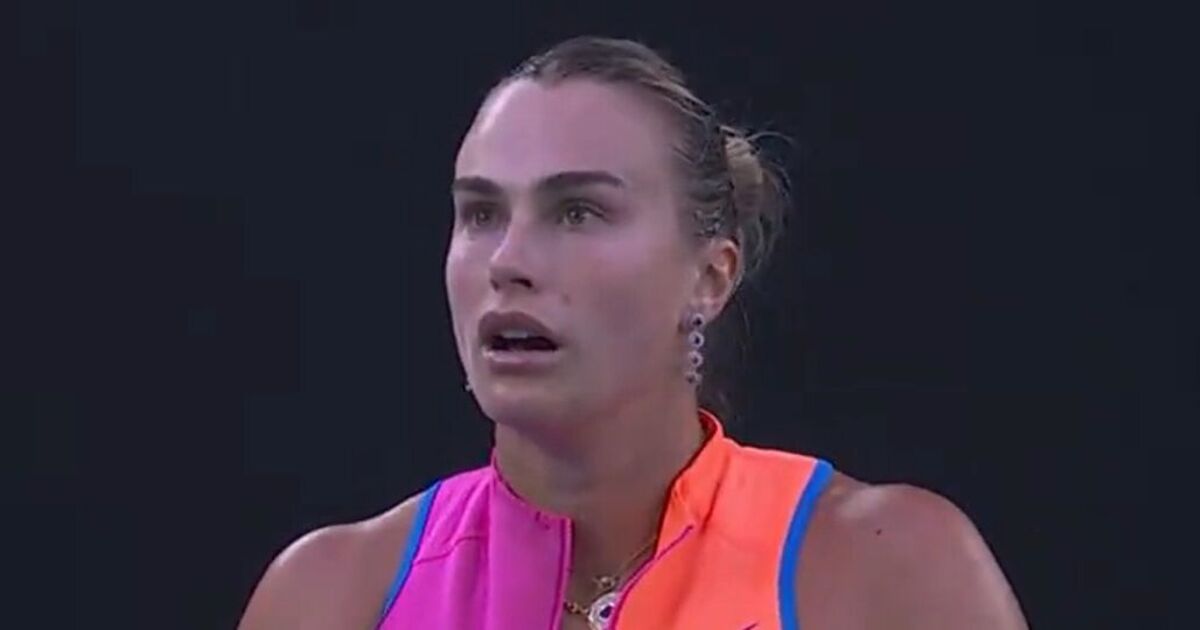
Aryna Sabalenka was penalised for hindrance during her Australian Open semi-final against Elina Svitolina after not making a typical sound, according to umpire Louise Azemar Engzell. The world No. 1 still won the game, but did not take kindly to the call and asked for a video review of the incident; however, the decision stayed the same.
Engzell said: “On the video, you go, ‘ah ah-ya!'” Sabalenka still disagreed, countering by asking: “How many players do it different?” The umpire was not having any of it, though, and responded: “It’s hindrance, it’s a hindrance to me because you didn’t make the normal sound.”
The annoyance stemmed from Sabalenka appearing to make a different noise after believing she had mis-hit her shot out of bounds. However, the return landed on the court, so much to the two-time Melbourne champion’s surprise, the noise came before Svitolina had to hit a shot.
Rule 26 of the International Tennis Federation (ITF) Rules of Tennis covers hindrance. It states: “If a player is hindered in playing the point by a deliberate act of the opponent(s), the player shall win the point.”
The rules also say: “However, the point shall be replayed if a player is hindered in playing the point by either an unintentional act of the opponent(s), or something outside the player’s own control (not including a permanent fixture).”
Therefore, umpire Engzell determined that the change of noise was a deliberate act by Sabalenka, as they did not replay the point. That is why the world No.1 took such umbrage with the call, with it costing her the first point of her second opportunity to break Svitolina.
Sabalenka still won the first set 6-2 despite going 15-0 down in the fourth game because of that hindrance call. She led 2-1 at the time and took game four despite being penalised, breaking Svitolina for the first time. After holding serve from then on, the top-seed broke her opponent again in the eighth to take the set.
Svitolina responded in the second set, breaking Sabalenka in the opening game and then holding her serve to go 2-0 up. However, the top seed won the next five games, breaking her opponent in the fourth and sixth games.
Despite the Ukrainian responding in the eighth by holding serve to extend the match a little longer, Sabalenka ended it on her service match, to win 6-2, 6-3 and reach a fourth consecutive Australian Open final. The four-time major champion will play either Elena Rybakina or Jessica Pegula on Saturday.
Sabalenka won her first two finals in Melbourne, but lost to Madison Keys last year. However, the world No.1 has yet to lose a set at the Australian Open since that defeat.