
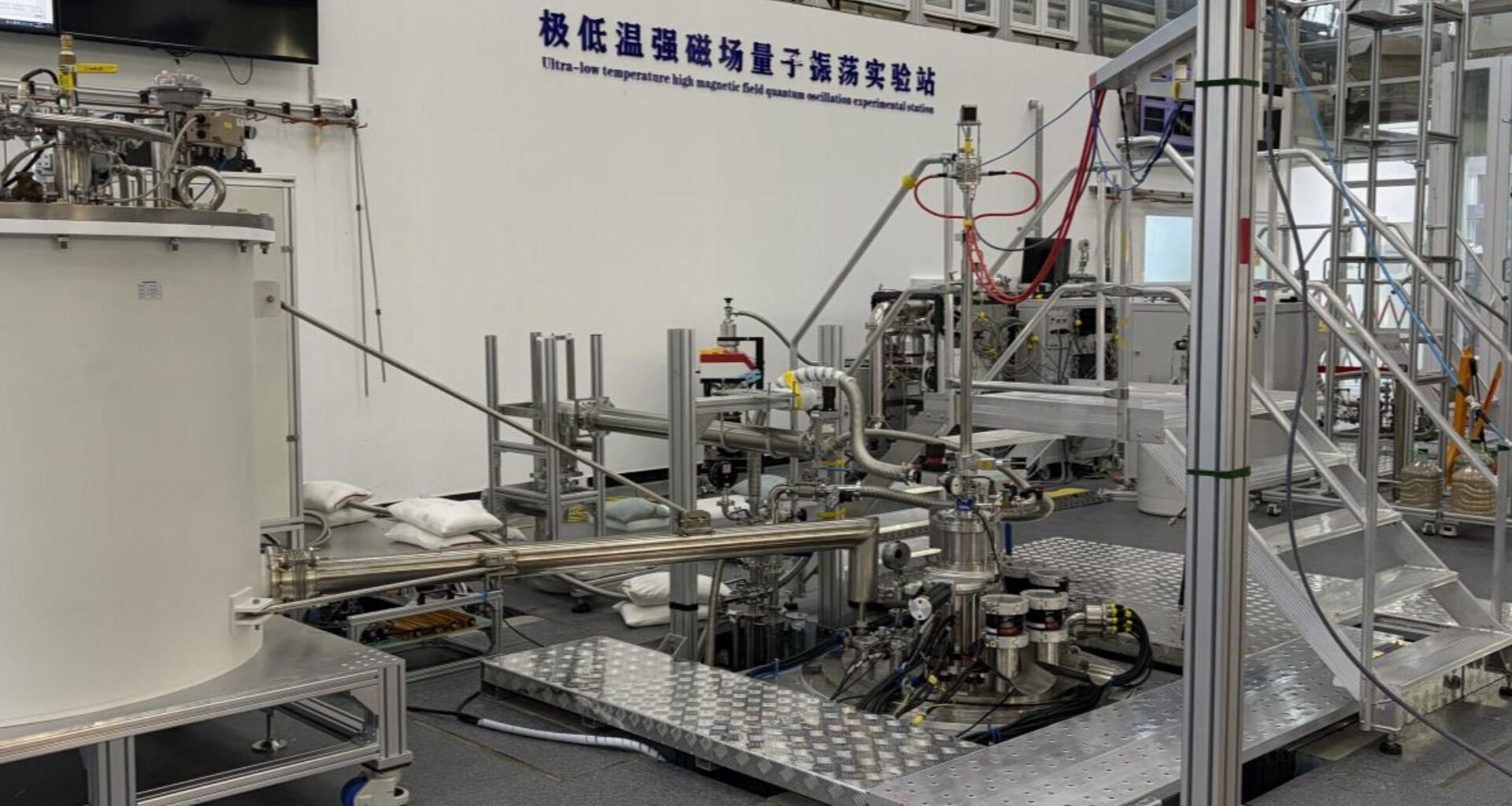
China has set a new benchmark in extreme magnet science after researchers built the strongest all-superconducting user magnet ever.
On Tuesday, the Chinese Academy of Sciences announced that a new magnet reached a central magnetic field of 35.6 tesla at a national experiment facility in Beijing, marking a global first for this class of research equipment and opening fresh possibilities for high-field science.
The experiment was carried out at the Synergetic Extreme Condition User Facility, a major platform designed to host scientists from China and abroad.
The result places the country among the leaders in high-temperature superconducting technology and gives researchers access to magnetic fields far beyond what is available in conventional laboratories.
A record magnet built for open research
The new magnet is an all-superconducting user system, meaning it relies entirely on superconducting materials to generate intense magnetic fields with minimal energy loss. It provides a usable bore of 35 millimeters (about 1.38 inches), allowing experiments to be conducted directly in the field.
The magnetic intensity achieved is roughly 12 to 24 times stronger than that of a hospital MRI scanner and more than 700,000 times stronger than Earth’s natural magnetic field. This scale of performance is essential for studying how materials behave under extreme conditions that cannot be replicated otherwise.
Designed as a shared research tool, the magnet has already been opened to domestic and international users. According to the Chinese Academy of Sciences, it is intended to support frontier experiments in materials science, life sciences, and other fields where strong, stable magnetic environments are critical.
Engineering effort across CAS institutes
The development was the result of close cooperation between multiple research bodies under the Chinese Academy of Sciences. The Institute of Electrical Engineering led the design, manufacturing, and system integration of the superconducting magnet itself. At the same time, the Institute of Physics focused on addressing technical challenges in system health monitoring and precision measurement for high-temperature superconducting components.
Earlier versions of the system reached lower field levels in 2023. Since then, researchers have upgraded materials, optimized structural design, and refined manufacturing processes. These changes allowed the team to push performance higher without reducing the bore size, a key requirement for user experiments.
The achievement signals that China now has internationally advanced capabilities in applying high-temperature superconductors to large-scale scientific instruments.
Stability that enables demanding experiments
Beyond raw strength, stability, and reliability, the value of an all-superconducting user magnet lies in its ability to deliver high performance. Such systems operate at extremely low temperatures, where electrical resistance drops to zero. This allows them to maintain uniform magnetic fields for long periods while consuming relatively little energy.
“For example, it can stably maintain its maximum magnetic field for more than 200 hours, and can be well integrated with extreme experimental conditions such as ultra-low temperatures and high pressures,” said Luo Jianlin, a researcher from the Institute of Physics under CAS, as reported by the Global Times.
“This enables a wide range of experimental measurements, including nuclear magnetic resonance, specific heat, and magnetostriction, greatly meeting the needs of the research community,” he said.
A national facility with global impact
The magnet is installed at the comprehensive research facility for extreme conditions in Huairou Science City, on the outskirts of Beijing. The infrastructure passed national acceptance in February 2025 and brings together ultra-low temperatures, strong magnetic fields, ultra-high pressure, and ultrafast optical systems in one location.
Operating alongside other platforms at the site, the new magnet will help scientists probe the microscopic world of matter and accelerate discoveries tied to advanced instruments, medical technologies, energy systems, and transportation.
“Strong magnetic fields are an important tool for studying materials. They help scientists better understand high-temperature superconductors and quantum materials, and also play an important role in the precise analysis of biomolecular structures and the development of medical technologies such as magnetic-targeted therapy, contributing to disease diagnosis and treatment,” Luo added.