
Space scientists have long warned of an apocalyptic scenario: the collision of two satellites in Earth’s orbit, creating space debris that triggers a domino effect of further collisions, potentially rendering low Earth orbit unusable.
This model of a chain reaction of satellite collisions was proposed as far back as 1978 by NASA scientist Donald Kessler, and is also known as Kessler Syndrome, a theoretical, cascading scenario where the density of objects in Low Earth Orbit (LEO) becomes so high that collisions between debris and satellites trigger a chain reaction.
Each collision generates more debris, creating an uncontrollable, exponential increase in space junk that could render Earth’s orbit unusable for generations.
While the nightmarish scenario has haunted space scientists for decades, the exponential increase in satellites over the last few years has lent these fears new urgency.
Kessler Syndrome is no longer just a theoretical model, but is already forcing companies and nations to implement drastic changes in the orbits of their satellites.
A research team from China has claimed that a recent near-collision between a Chinese satellite and one of SpaceX’s Starlink devices has forced the US company to change the orbit of over 4,000 of its satellites.
As of January 2026, SpaceX’s Starlink constellation has approximately 9,500 active satellites in orbit. This means that the near-fatal incident has forced the company to change the orbit of nearly 40% of its satellites.
The incident occurred last month on December 10 when the two satellites passed within about 200 metres (656 feet) of each other.
A satellite launched from northwestern China had a near-miss with a Starlink satellite in Low Earth Orbit (LEO).
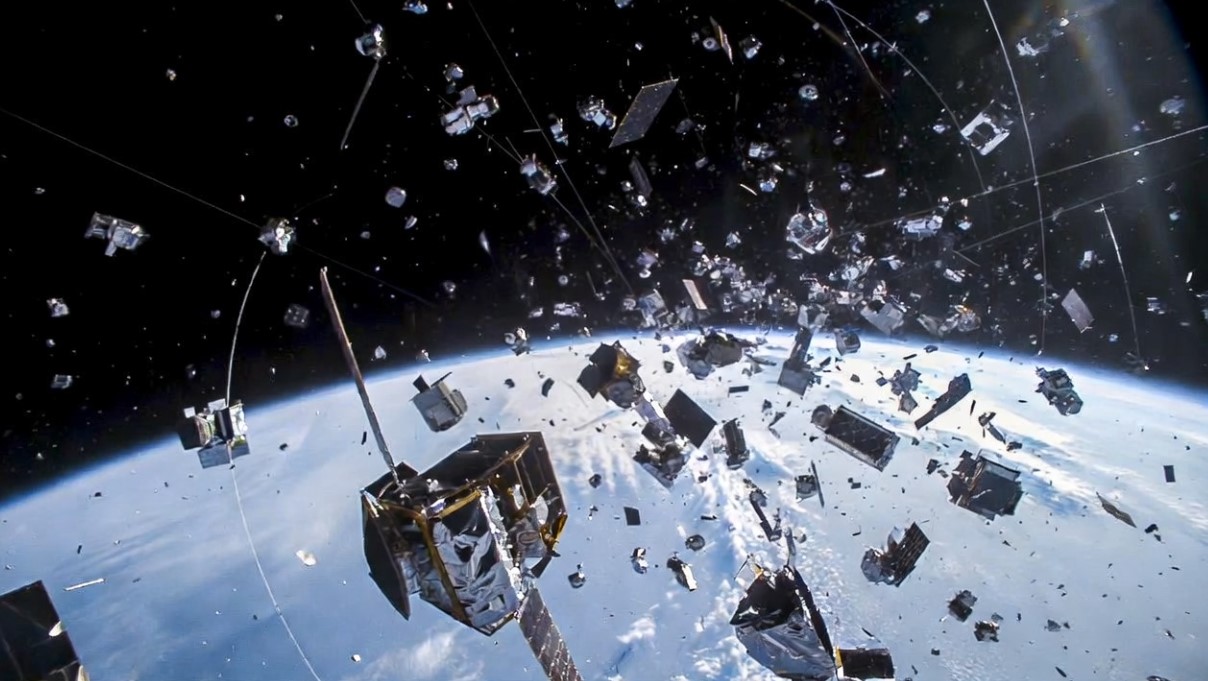 AI Image of Kessler Syndrome.
SpaceX’s vice president of engineering, Michael Nicolls, spoke about the incident, highlighting how China’s lack of information sharing increases the risk of satellite collisions in space.
“When satellite operators do not share ephemeris for their satellites, dangerously close approaches can occur in space. A few days ago, 9 satellites were deployed from a launch from the Jiuquan Satellite Launch Center in Northwestern China.
“As far as we know, no coordination or deconfliction with existing satellites operating in space was performed, resulting in a 200-meter close approach between one of the deployed satellites and STARLINK-6079 (56120) at 560 km altitude. Most of the risk of operating in space comes from the lack of coordination between satellite operators – this needs to change,” Nicolls wrote on X on December 13.
Nearly three weeks later, on January 1st, Nicolls further informed that the company planned to lower nearly half of its more than 9,000 operational internet satellites from an orbit of about 550km (340 miles) above the Earth to 480km to “increase space safety”.
“Starlink is beginning a significant reconfiguration of its satellite constellation focused on increasing space safety. We are lowering all Starlink satellites orbiting at ~550 km to ~480 km (~4400 satellites) over the course of 2026.”
This will reduce the “aggregate likelihood of collision,” he added.
Through these manoeuvres, Nicolls also sought to portray Starlink as a responsible company that is taking proactive measures to ensure space safety.
“These actions will further improve the safety of the constellation, particularly with difficult-to-control risks such as uncoordinated maneuvers and launches by other satellite operators.”
Starlink is beginning a significant reconfiguration of its satellite constellation focused on increasing space safety. We are lowering all @Starlink satellites orbiting at ~550 km to ~480 km (~4400 satellites) over the course of 2026. The shell lowering is being tightly…
— Michael Nicolls (@michaelnicollsx) January 1, 2026
Though Nicolls did not suggest any connection between the two events, according to the researchers from the Chinese Academy of Sciences’ Institute of Software, even though no collision occurred, “the close call was still unsettling and directly triggered Starlink’s decision for large-scale orbit lowering”.
The team said the Chinese spacecraft involved was a high-resolution Earth-imaging satellite that launched alongside eight other payloads on board a Kinetica-1 rocket that day.
In an article published on January 29 by commentary outlet Space and Network, the team said it used the institute’s mega-constellation research platform to identify the orbital device, built by Chang Guang Satellite Technology, the Hong Kong-based South China Morning Post reported.
Designated as 2025-292A or 66993 by the US Space Force for tracking purposes, the satellite’s “initial set of orbital data was generated just under 14 minutes before the close approach, leaving SpaceX with little time to detect the risk,” the researchers wrote.
Notably, Starlink satellites are designed to autonomously avoid other objects using onboard systems and Hall-effect thrusters, which use electric and magnetic fields to accelerate propellant.
However, these dodging maneuvers require advanced data-sharing about upcoming satellite launches.
Starlink has in the past raised concerns about the lack of data sharing by other countries, particularly China and Russia.
“Effective collision avoidance in space relies on consistent data sharing and reliable communication among spacecraft operators, but data sharing challenges persist,” SpaceX said in its filing to the US Federal Communications Commission (FCC).
“International coordination adds another layer of difficulty, especially with Chinese and Russian operators that often do not share ephemerides or contact information despite operating a significant portion of manoeuvrable satellites.”
Ephemerides are datasets that provide information about a particular satellite’s trajectory, velocity, and position at specific time intervals.
The Chinese research team also said that Starlink’s move could help “burnish the company’s image as a responsible operator.”
The researchers noted that the move came amid “growing concerns over the safety risks posed by massive satellite constellations.”
Starlink already has nearly 9,500 satellites in LEO and plans to launch another 2,500 for the initial phase. In the coming years, the number of Starlink satellites in LEO could rise to 34,000.
Similarly, SpaceX has launched nearly 11,000 satellites so far. SpaceX aims to launch 42,000 satellites and has FCC approval to launch 7,500 more Gen 2 satellites, doubling its Gen 2 allowance to 15,000.
China has often criticised Starlink’s rapid expansion, saying that its thousands of satellites pose operational hazards and congest shared orbital resources, increasing the risk of collisions.
Beijing has underlined the danger posed by these massive satellite constellations, citing two near encounters with the Tiangong space station in 2021.
Starlink’s move to bring nearly half of its satellites to a lower orbit of 480 km above Earth’s surface will also make its satellites safer, as many countries are deploying large constellations in the 500-600 km band.
“So for Starlink satellites, orbits around 480km are somewhat safer than those around 550km,” the Chinese research team wrote.
However, they warned that lowering more than 4,400 satellites at once can also increase the risk of collisions.
However, it must be noted that while China is criticizing Starlink for congesting orbital resources, it is itself planning to launch thousands of satellites in LEO over the next few years.
China’s state-backed Guowang low-Earth-orbit constellation, operated by China Satellite Network Group, plans to launch approximately 13,000 satellites to provide global broadband internet.
Similarly, India, Russia, and the EU are also planning to launch hundreds of new satellites in LEO over the next few years.
As Earth’s orbit becomes increasingly crowded, near-miss incidents are set to rise further, raising the spectre of Kessler Syndrome, where even a single accident could trigger a chain reaction, resulting in the loss of thousands of satellites and rendering Earth’s LEO unusable for generations.
To avoid such a nightmarish scenario, the world needs to enforce global standards, mandate the sharing of ephemerides data, and perhaps also consider imposing orbital fees.
Furthermore, there should be strict rules for the end-of-life disposal of satellites and for the removal of active debris from orbit.
Earth’s orbits are a critical shared resource that must be rationed democratically and equitably to avoid conflict.
Nitin is the Editor of the EurAsian Times and holds a double Master’s degree in Journalism and Business Management. He has nearly 20 years of global experience in the ‘Digital World’.
Connect with the Author at: Nytten (at) gmail.com
Follow EurAsian Times on Google News