
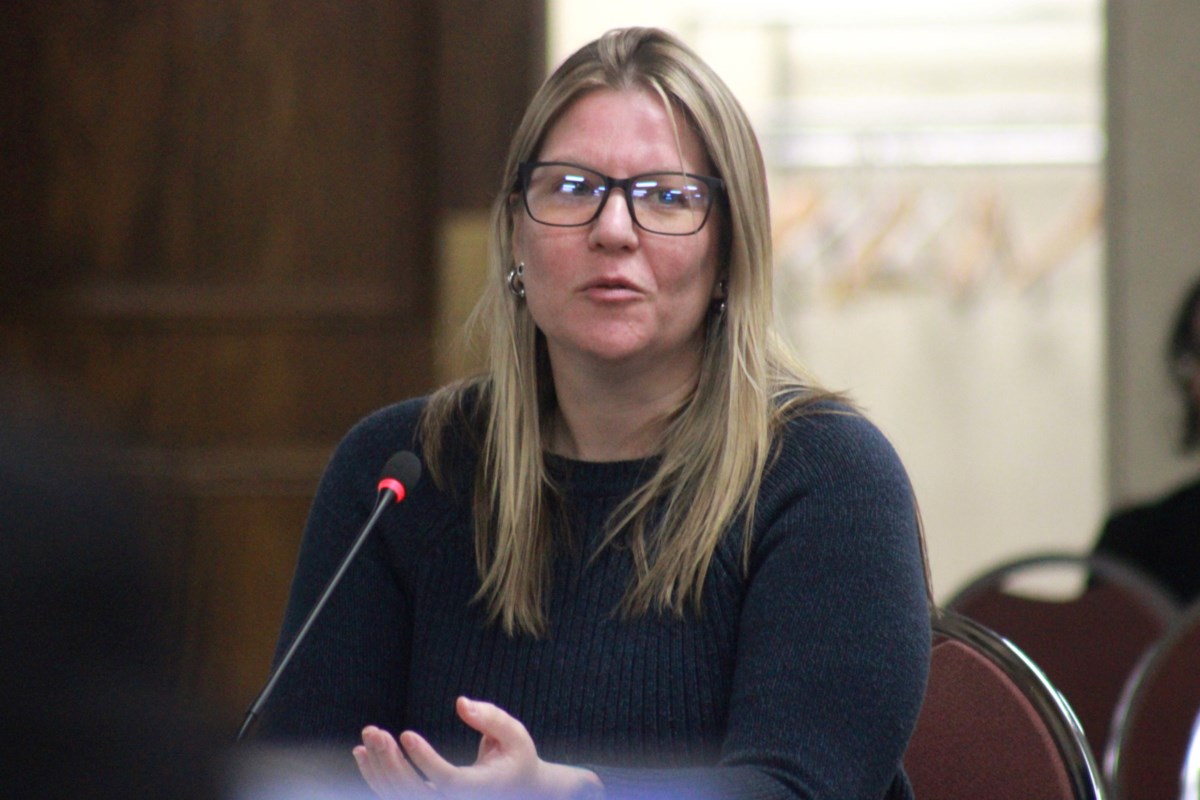
LifeLabs’ decision to close their Sudbury laboratory will harm patient care, a Medical Laboratory Professionals Association of Ontario representative told provincial officials in Sudbury
Asked whether LifeLabs’ claim that closing the Sudbury laboratory won’t impact patient care makes any sense, medical laboratory technologist Jessie Clelland offered a decisive “no.”
“It’s going to be detrimental to this community,” she said. “This will affect so much more than just the lab sector, it will affect all of health care. The right thing to do is keep these centres open for testing.”
Clelland, who serves as manager of the Canadian Blood Services Donation Centre in Sudbury, spoke on behalf of the Medical Laboratory Professionals Association of Ontario during a pre-budget consultation with the province at Sudbury’s Days Inn on Thursday.
At issue is this spring’s planned closure of the LifeLabs laboratory in Sudbury, where medical samples taken at LifeLabs centres throughout the region are tested.
The closure will put 40 technologists out of work and require time-sensitive samples collected locally to be tested in laboratories in Mississauga and Toronto.
Whether it’s due to highway closures or flight delays, Clelland said it’s inevitable that there will be delays in getting local test results which will have a trickle down effect on health care.
Some people who require immediate results might clog up the emergency department at Health Sciences North, she said, while others will face other hardships such as re-testing when samples spoil due to delays in transportation.
“Some people may drive an hour or more to get their blood collected,” she said. “They’re sick, they need their results, they need their diagnosis, they need their treatment. Delaying that is not going to do any good.”
During Thursday’s meeting, Don Valley East Liberal MPP Adil Shamji, who is also a medical doctor, said it’s hard enough to get some people in for blood testing the first time around. If samples time out due to delays and the patient needs to return to deliver a sample again, he said they might forgo medical testing altogether.
“The north has always been treated differently,” Clelland said, adding that LifeLabs would never dream of closing down a laboratory in southern Ontario as they’ve planned on doing in Sudbury.
“If they do move forward with closing all of these community labs, then they need to invest in labs elsewhere,” Clelland said. “They need to invest in the hospital labs, because these tests need to be performed.
Of medical diagnoses, she said 70 per cent are based on lab results.
As such, she added, “You limit the number of labs, you’re limiting health care.”
During the ensuing discussion, Nickel Belt NDP MPP France Gélinas argued that the local lab’s closure became a possibility when the government privatized the service.
LifeLabs was subsequently sold to an American company, she said, “Who made it clear that there’s more money to be made by closing the site in Sudbury and moving it to Toronto for the only reason, to maximize their profit, not to help us.”
On this front, Ontario Federation of Labour president Laura Walton noted that even when privatization takes place, the province can add safeguards to protect services to a degree.
“You’re using taxpayer dollars that are going to LifeLabs to perform these tests, and because LifeLabs doesn’t feel like they’re getting enough money, they’re going to take the service away,” she said.
The province should impose requirements on companies such as LifeLabs, she said, describing some provisions which could have prevented the local laborator’s closure as: “You must provide services in the north, you must ensure that we are using Ontario workers to get this work done. We must be ensuring that we’re giving back to the communities.”
Progressive Conservative MPPs were largely mum on the LifeLabs closure, apart from Peterborough—Kawartha MPP Dave Smith accusing opposition members of hypocrisy.
“I find it interesting that you’re now advocating that you need to keep LifeLabs open here in Sudbury when, at Queen’s Park, they’re advocating that we need to close down those facilities,” he said.
“Who’s saying that?” Sudbury NDP MPP Jamie West said before being silenced for speaking out of turn.
Given that both West and Gélinas have been outspoken advocates in Queen’s Park for keeping the Sudbury LifeLabs laboratory open since the impending closure was brought to their attention in December, Sudbury.com asked Smith for more context during a break in meetings.
“Their policy at Queen’s Park is that we need to be closing all of the privately owned clinics, whether it’s a laboratory clinic or a doctor-owned surgery clinic,” he said, adding that there’s a “disconnect” between this and calling for LifeLabs to remain open.
These comments are “nonsensical,” West told Sudbury.com, describing Smith as deploying “strawman nonsense.”
“There are times for partisan call-outs, but this is an important issue,” West said. “As a party, we’re not in favour of privatizing health care and making it more expensive for fewer services, that’s true, but we’re not in favour of no services.”
On this front, he added, “We’d rather have a private system than no system at all.”
Although she spoke to the LifeLabs issue when asked about it, Clelland’s chief reason for attending Thursday’s meeting was to advocate for $6 million over three years to hire 130 preceptors to train 1,300 students to alleviate a demand for medical laboratory technologists, assistants and technician training across the province, “especially in rural and northern labs.”
Tyler Clarke covers city hall and political affairs for Sudbury.com.