
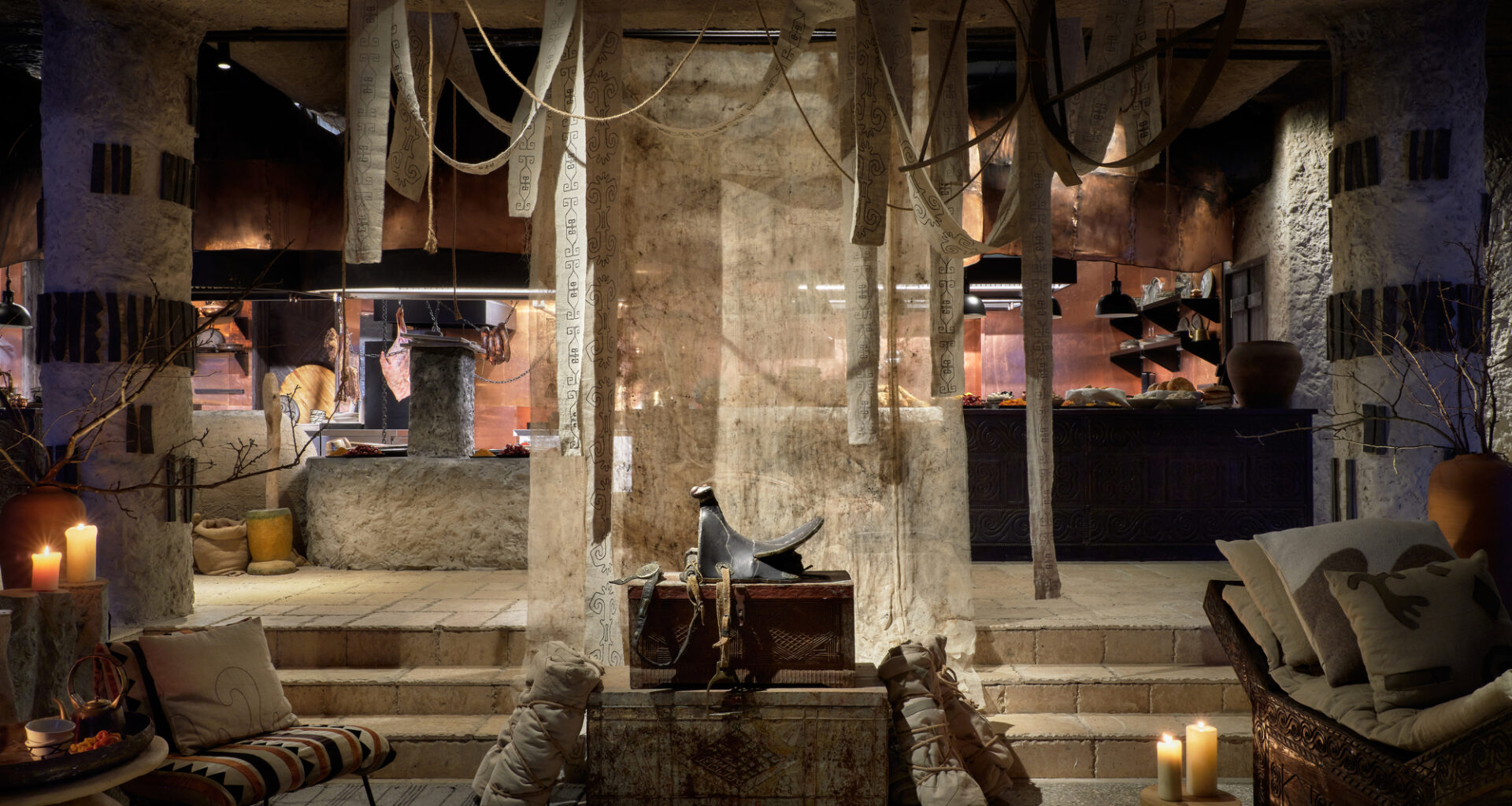
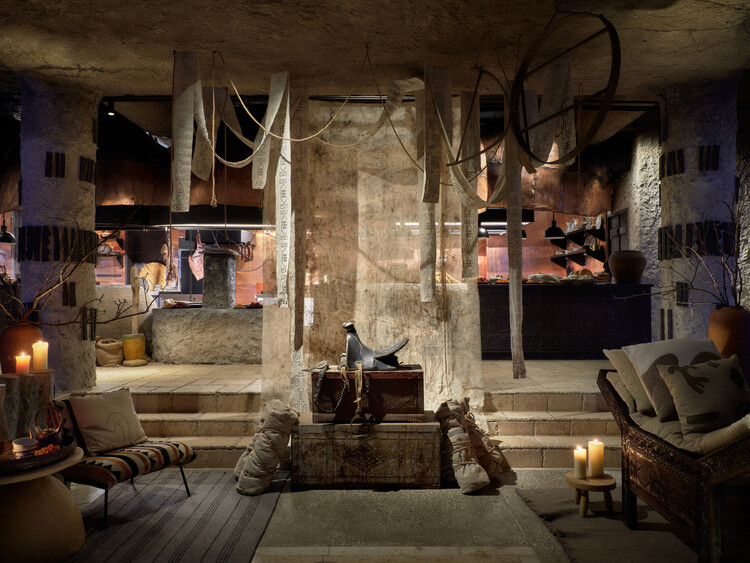
 Auyl Restaurant. Photo © Damir Otegen, Yulo Khan, Zarina Zoman, Sergey Kuchin
Share
Or
https://www.archdaily.com/1038159/inside-contemporary-kazakhstani-architecture-exploring-the-work-of-naaw
Selected as one of the winners of ArchDaily 2025 Next Practices Awards, NAAW represents a new generation of architectural studios reshaping contemporary practice in Central Asia. Founded in 2019 by Elvira Bakubayeva and Aisulu Uali, the studio operates at the intersection of research, interdisciplinary collaboration, and spatial experimentation, positioning architecture as a tool for reflection and an active agent in shaping contemporary Kazakhstani identity.
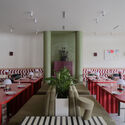

This dual ambition—questioning their own practice while contributing to a broader cultural discourse—frames each project as an evolving process, not a fixed outcome. The term “workshop” embedded in their name, New Almaty Architects Workshop, reflects this spirit of continuous testing and learning. Interiors become platforms for material research, atmospheric exploration, and critical self-evaluation. In a regional context where architectural discourse remains underrepresented internationally, their work emerges as a sustained effort to articulate identity through built experience.
This spirit unfolds across the studio’s work in ways that can be read through several recurring strategies and approaches to design.
Related Article 20 Practices Shaping the Future of Architecture: Winners of the ArchDaily 2025 Next Practices Awards 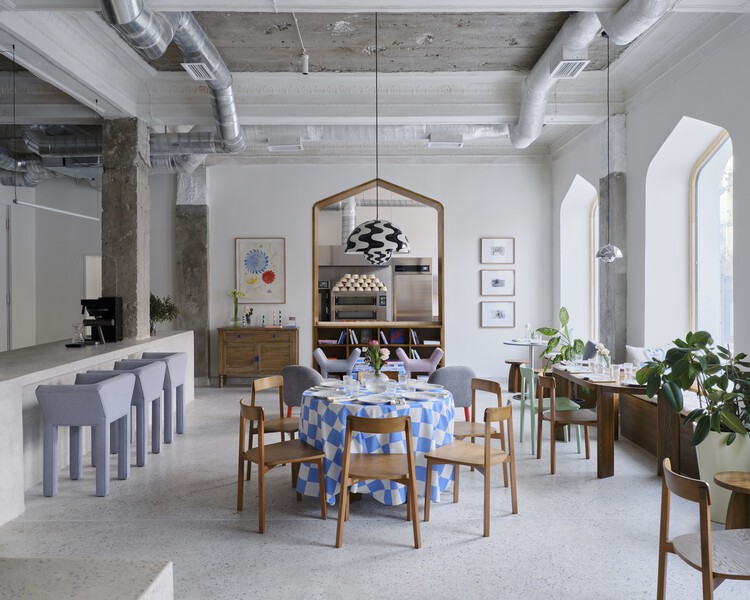 © Damir OtegenCuration and Collaboration
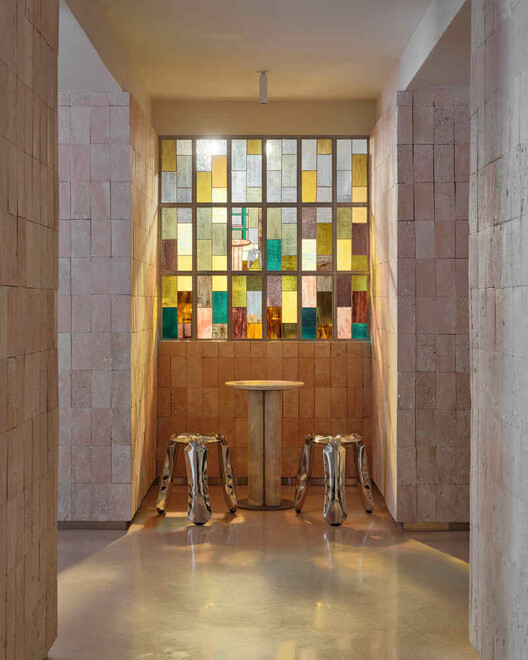
Curation and interdisciplinary collaboration shape the studio’s approach, extending design beyond spatial configuration to include custom furniture, lighting systems, graphic elements, and partnerships with local artists and craftspeople. These components serve as primary layers, integrated into a cohesive narrative where objects, textures, and spatial sequences interact to contribute equally to the overall experience.
Working in this way, interiors become open frameworks, continuously shaped by multiple voices and forms of expertise. The resulting spaces feel carefully composed, allowing everyday use to interact naturally with the curated design intentions.
 © Damir Otegen
 © Damir OtegenFemale Leadership and Professional Culture
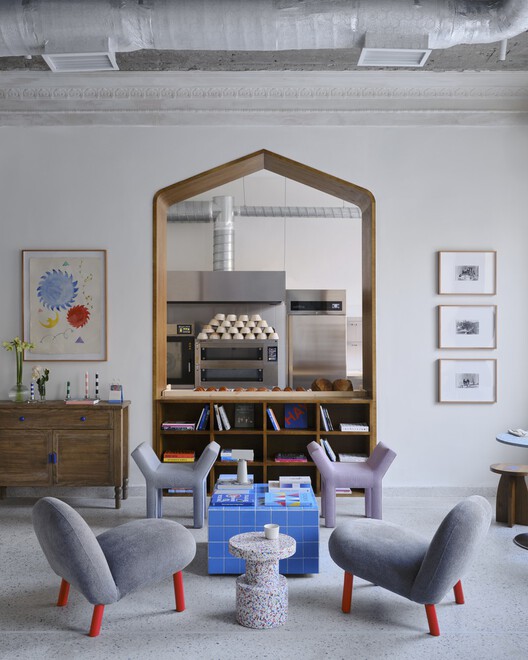
Quiet transformation shapes the studio’s collaborative structures and interdisciplinary teams, influencing interiors with attention to human scale, social interaction, and everyday use. Work is organized around shared authorship and long-term continuity, resulting in process and detail becoming as significant as the final spatial composition.
This approach privileges relational thinking over representational gestures, producing spaces that are attentive and responsive to people and context. Leadership manifests through sensitivity, careful orchestration, and the capacity to shape environments with subtlety and care—an understated power that quietly informs both professional culture and architectural experience.
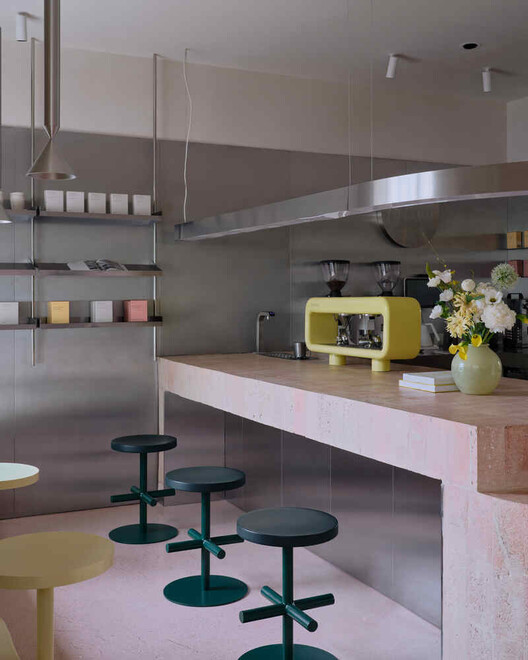 © Damir Otegen
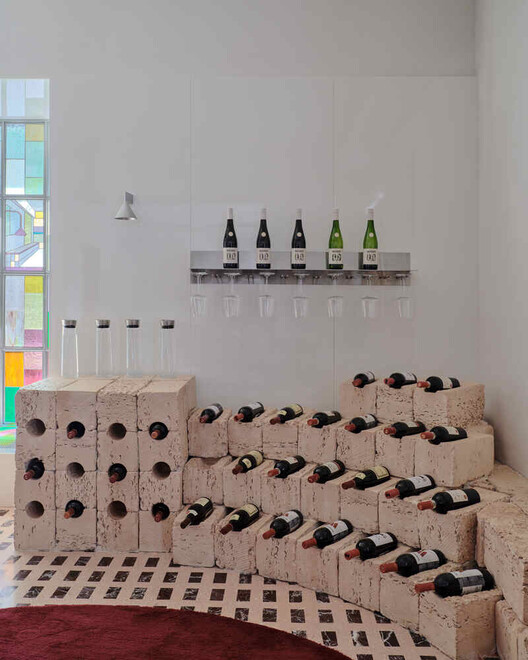 © Damir OtegenContextual Translation and Identity
Contextual translation and identity inform each project, where cultural references, historical layers, and global typologies are reinterpreted for contemporary use. Soviet-era architecture, European café conventions, and other international influences are filtered through local craft, materials, and spatial logic, balancing inherited memory with present-day requirements.
Materials, detailing, and organization mediate between past and present, creating interiors that resonate with history and contemporary life. Context guides design choices without prescribing them, and Kazakhstani identity is approached not as a fixed definition but as a process—explored, interpreted, and extended across spaces, sometimes taking on new dimensions in international contexts.
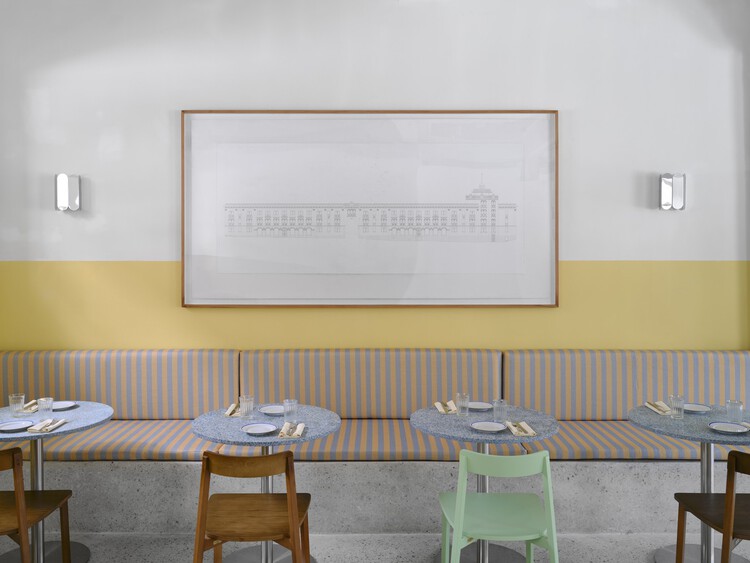 © Damir Otegen
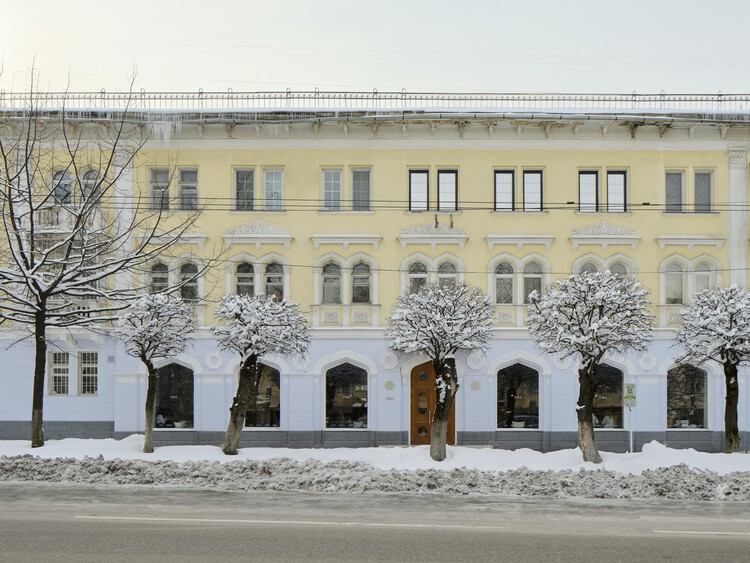 © Damir OtegenAtmosphere and Program
Atmosphere functions as a core design parameter, with light, materiality, acoustics, and spatial sequencing arranged to shape perception and experience. Daylight, color, texture, and furniture placement are carefully balanced to guide circulation, highlight interaction, and influence mood.
Temporal shifts are integrated into the design, allowing interiors to adapt from day to night and across different programmatic uses. Treating atmosphere as a deliberate strategy produces environments experienced as much through the senses as through use, where spatial conditions are calibrated to move beyond formal gestures.
 © Damir Otegen
 © Damir Otegen
These principles become most legible in the studio’s built work, where each project translates research, collaboration, and contextual sensitivity into distinct spatial narratives.
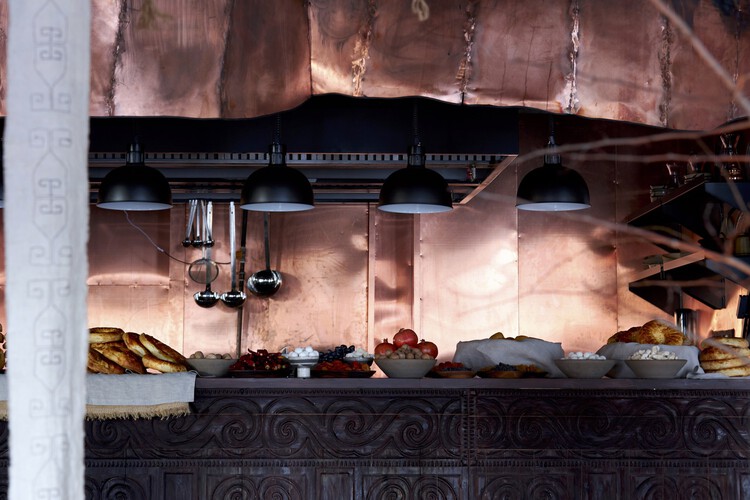
Located in Almaty and conceived as a contemporary reinterpretation of traditional dining culture, Auyl Restaurant occupies a historic building in the city. The open kitchen becomes a stage, where daylight, spatial sequencing, and the visibility of labor choreograph the experience of production and consumption. The interior mediates communal cooking traditions rooted in nomadic heritage while accommodating contemporary dining, turning architecture itself into a performative encounter.
 © Damir Otegen, Yulo Khan, Zarina Zoman, Sergey KuchinFika Café
Set within the TurkSib Railway Workers’ House, a Soviet-era building in Almaty, Fika Café engages directly with its architectural legacy. Heritage is negotiated with subtle precision, balancing original plaster, decorative elements, and Soviet national-style motifs as cultural artifacts with contemporary concrete and spatial interventions. This approach balances preservation and intervention across complex historical layers.
 © Damir OtegenBroche Coffee Shop
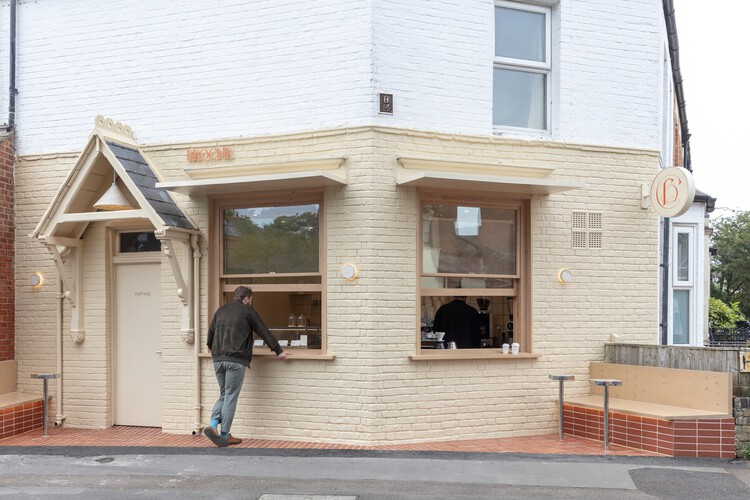
Situated at a corner in a historic Oxford neighborhood, Broche Coffee Shop responds to its protected context with subtle, site-specific interventions. Material experimentation, including the use of sustainable mycelium panels and custom finishes encountered through international design research platforms, transforms the interior into a compact laboratory, where everyday design choices function as platforms for testing spatial ideas and advancing architectural research.
 © Luke HayesPasta La Vista Bistro
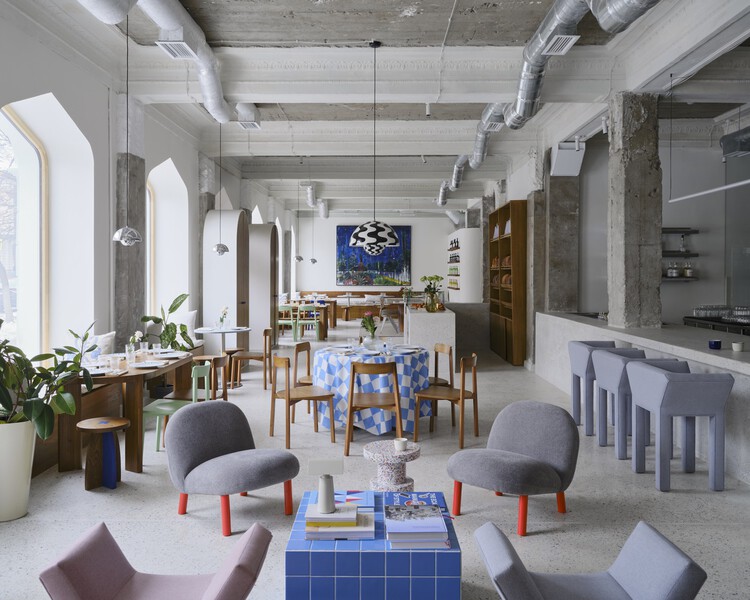
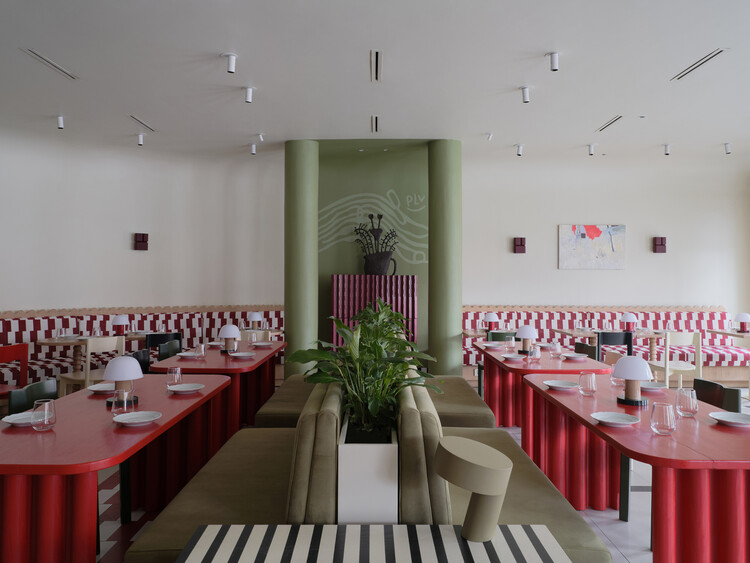
Drawing on Italian Memphis references, geometric patterns, and custom furniture, the interior filters global visual codes through local craftsmanship and manual finishes. Bold colors, artisanal detailing, and informal spatial arrangements create a refined and approachable atmosphere, producing a hybridized interior that negotiates contemporary global imagery with locally grounded production methods.
 © Damir OtegenSix Coffee + Wine Café
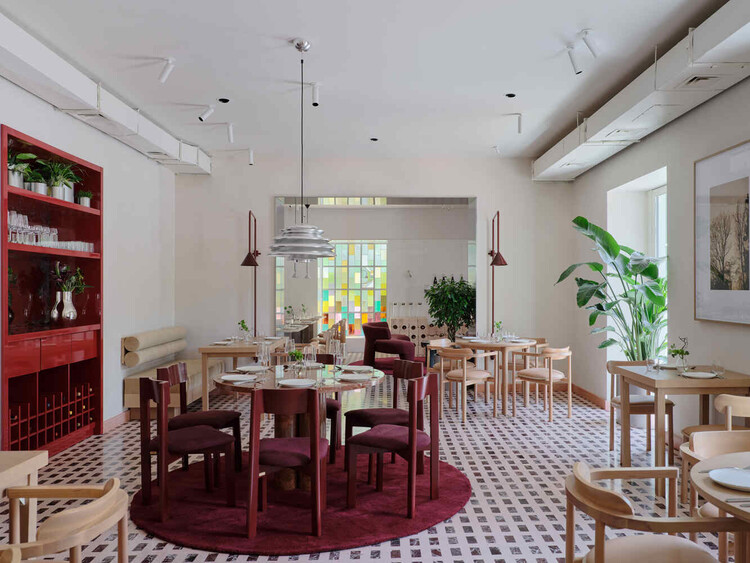
Spread across interconnected halls in Almaty’s historic center, the interior shifts softly from a morning café to an evening wine bar. Light, materiality, and spatial arrangement are modulated to respond to changing programmatic and social rhythms, demonstrating how architecture can adapt temporally as well as spatially.
 © Damir Otegen
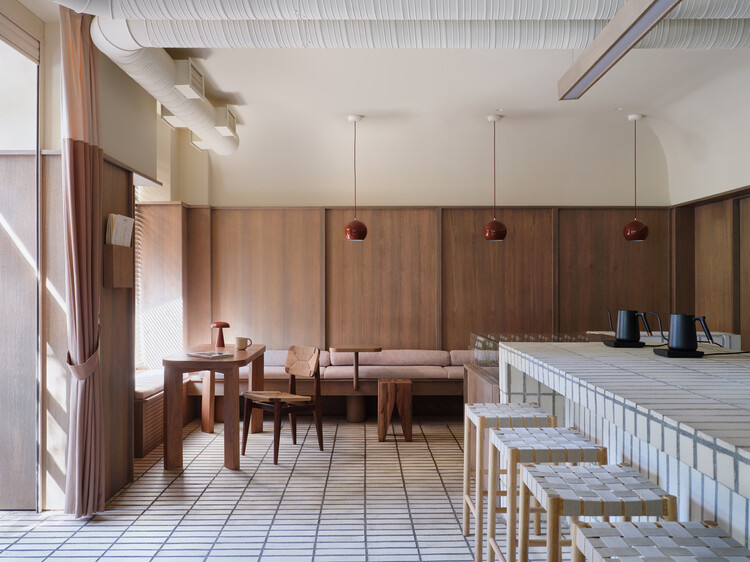
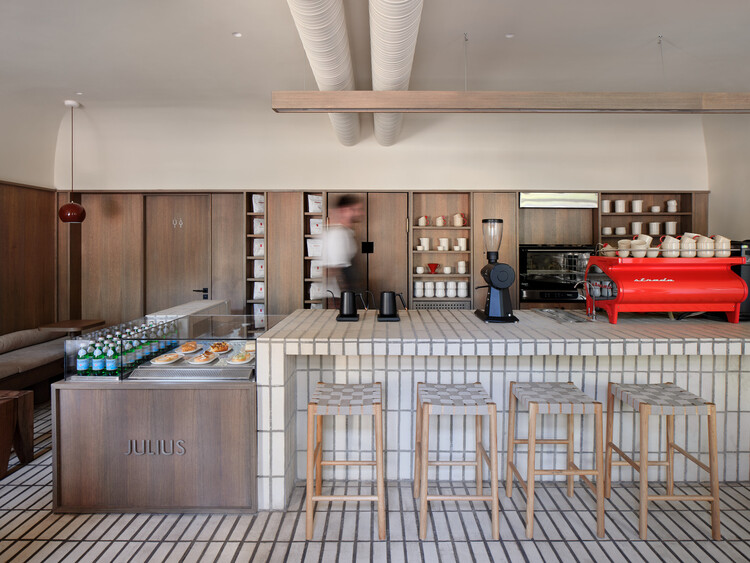
The interior embraces restraint, with a muted palette, gentle transitions, and understated detailing. This neutrality creates a quiet backdrop in which coffee brewing, conversation, and daily rituals take center stage. By letting human activity define the atmosphere, the design transforms ordinary interactions into a curated spatial experience.
 © Damir Otegen
This article is presented by Buildner. As sponsor of ArchDaily’s 2025 Next Practices Awards, Buildner—the world’s leading architecture competition organizer—helps architects get what they enter competitions for: recognition, opportunity, and progress.
Exercise your creativity now: the Buildner UNBUILT Award 2026 is open to all, with a €100,000 prize fund. Submit your unrealized designs and celebrate your creativity now.