
Unlock the Editor’s Digest for free
Roula Khalaf, Editor of the FT, selects her favourite stories in this weekly newsletter.
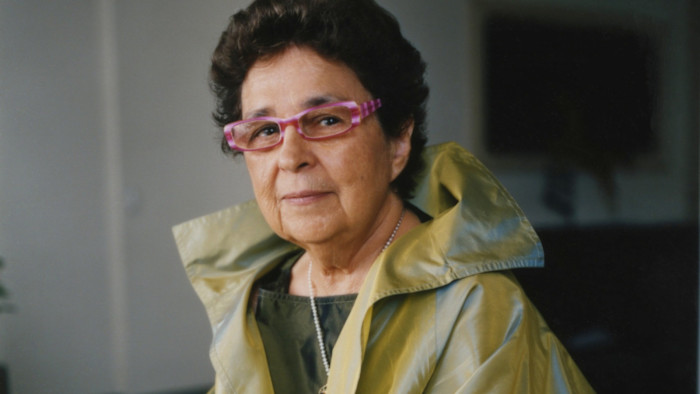
Marian Goodman, one of the first women to break the glass ceiling of New York’s art dealing scene, has died at the age of 97.
The gallerist is remembered as pioneering in terms of the artists she championed — including the radical German titans Gerhard Richter and Joseph Beuys and the thorny Belgian conceptualist Marcel Broodthaers — while retaining an old-school, artists-first and market-later approach. It was a far cry from the prevailing New York fashion for thrusting abstract expressionism. Goodman’s subsequent charges reflected a life-long appetite for the challenging, the activist photographer Nan Goldin and subversive prankster Maurizio Cattelan.
Through a relentlessly commercial postwar period, selling was not her immediate priority. “Marian’s head was always tilted with an ear towards the artist. That was her default position and what seemed to give her the most pleasure,” says the London gallerist Sadie Coles.
Born Marian Ruth Geller in 1928, to Jewish-Hungarian parents in New York, her introduction to art came through her father, a passionate collector of the modern American colourist Milton Avery. Goodman studied history at Boston’s Emerson College and in 1949 married (later divorced) William Goodman, a civil engineer, with whom she had two children who survive their mother.
Rebellious and determined, Goodman was among a group of women in 1956 who challenged the New York urban planner Robert Moses’s plans to expand the parking lot at Tavern on the Green in Central Park, forcing him to build a playground instead.
In 1963, she took on another challenge and chose to go to graduate school, studying art history at New York’s Columbia University. Here, she said, she was the only woman in her class and recalled that “a teacher told me that I wasn’t the kind of person that museums and universities were looking for”.
Undeterred, in 1965 Goodman co-founded Multiples Inc, an art publishing business to, she said, “make art available to all, at the highest level”. Her taste for the European avant-garde prompted the leap to go it alone. In 1977, when female leaders were few, she opened the Marian Goodman Gallery on East 57th Street with a Broodthaers exhibition and the broader aim of introducing her cherished European artists to an American audience.
The gallery moved to West 57th Street in 1984, in a fourth-floor space for 40 years, despite competitors’ restless moves to districts such as Chelsea and, later, the Lower East Side.
Such staying power mirrored Goodman’s approach to her artists. She distanced herself from the competitive jostling of New York’s growing gallery scene, telling the New Yorker in 2004 that “I saw dealers running after artists, then throwing them out and going on to the next. I was afraid it was contagious.”
Geographic expansion remained on the cards, and in 1995, Goodman was one of the first overseas galleries to open in Paris. Awards from France include the Légion d’Honneur, given to Goodman in 2013. She opened too in London, with an acclaimed 2014 exhibition of three bodies of work by Richter, but in 2020 made the decision to close the UK space, thanks to the double-punch of the Brexit vote and Covid-19 pandemic.
In New York, Goodman’s belief in her artists and commitment to building their museum support were paying off and her gallery ranked among a handful of the most influential. The market followed suit — Richter became the priciest living artist to sell at auction three times between 2012 and 2015, culminating when a signature squeegee-dragged abstract sold for £30.4mn (though Jeff Koons has since pipped him).
Unlike most gallery owners, and indeed many small business owners, Goodman had made concrete succession plans. In 2021, she promoted five longtime directors to partners (one has since left), to “carry forward the mission that I have worked so hard to achieve”.
In the newly created role of chief executive, Goodman remained a presence, though some of her old-guard artists, including Richter and Goldin, subsequently moved on. Others have since joined the roster, including the provocative performance artist Andrea Fraser and, more recently, co-representation of the estate of Ana Mendieta, who has a solo exhibition at London’s Tate Modern later this year.
In 2023, Marian Goodman Gallery opened in Los Angeles, while in New York, the partners have moved downtown with the times, opening with Goodman’s blessing in a vast, five-floor, former warehouse in Tribeca in 2024.
“Marian was a deliberate decision maker who taught us that the best approach is often to protract or pause a conversation in order to come to the ideal conclusion,” says Emily-Jane Kirwan, partner at Marian Goodman Gallery. “We learnt by her example in how tirelessly she worked and how seriously she took her responsibilities toward the artists; her joy when spending time with them was infectious . . . before museum exhibition openings or departing for a long trip she would encourage us to rise to the occasion but also to ‘have fun!’”