
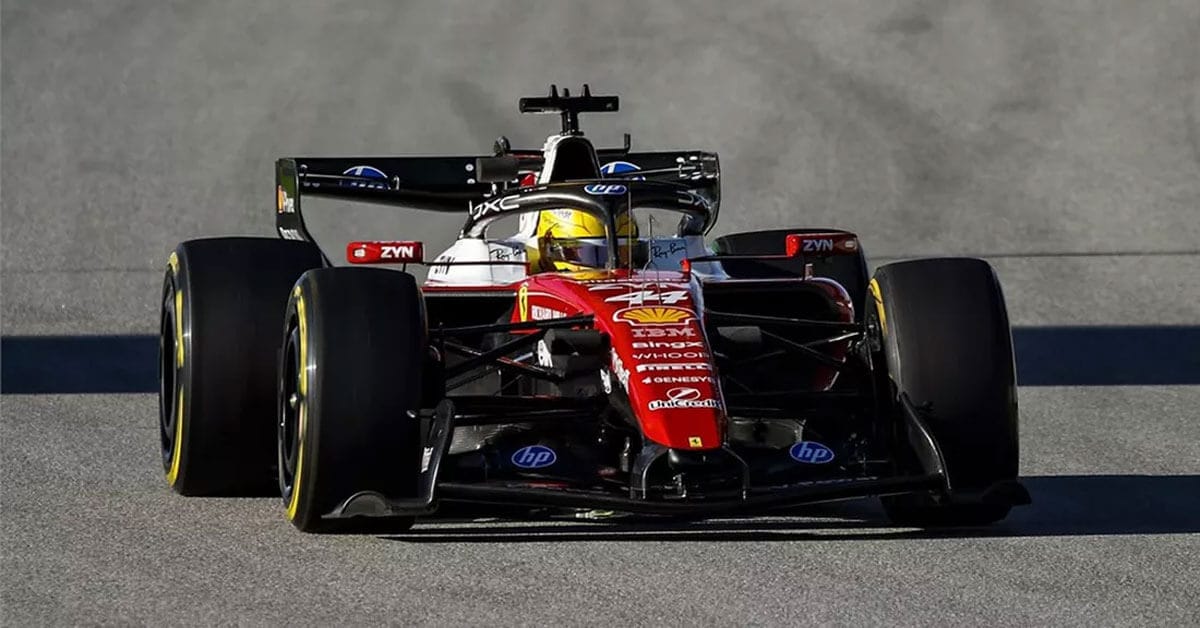
Lewis Hamilton may have topped the timesheets at the Barcelona shakedown test, but his headline lap did little to silence growing concerns within the F1 paddock about Ferrari’s 2026 car. Despite the Scuderia leaving Spain with encouraging data and strong mileage, rival teams have reportedly identified a potential weakness in the handling of the SF-26 that could become a talking point as pre-season testing continues.
Ferrari were one of the standout teams as the first pre-season test of the new 2026 Formula 1 regulations concluded on Friday evening. Hamilton attracted plenty of attention when he bolted on a set of soft Pirelli tyres late in the session and produced a 1:16.348 lap at the Circuit de Barcelona-Catalunya. That effort narrowly beat the previous benchmark of 1:16.445 set by Mercedes driver George Russell, allowing Ferrari to end the week at the top of the timing screens.
However, outright lap times were never the primary focus in Barcelona, particularly given the scale of the regulation changes coming into force for 2026. With new power units, revised aerodynamic rules, updated chassis designs and altered tyre specifications all introduced at once, teams largely prioritised reliability and data collection over raw pace. In that respect, Ferrari emerged from the test in a strong position.
Hamilton and Charles Leclerc completed a substantial amount of running in the SF-26, helping Ferrari register the second-highest total lap count of the test. Only Mercedes accumulated more mileage overall. Across the three days of running, Mercedes completed 504 laps, while Ferrari logged 438, making them the only two teams to exceed 100 laps on each day of the test. Haas, meanwhile, recorded the highest single-day total with 191 laps, ahead of Mercedes on 183 and Ferrari on 174.
Despite this solid foundation, there is a widespread belief among Ferrari’s competitors that the handling characteristics of the SF-26 could pose an issue. The team still has work to do to bring the car into its ideal operating window ahead of the next phase of pre-season testing in Bahrain, scheduled for February 11–13 and February 18–20.
For 2026, Ferrari have switched back to a push-rod suspension layout while simultaneously adapting to the all-new aerodynamic and chassis regulations. This combination appears to have produced a car that is not yet fully settled, at least in the eyes of rival engineers and observers.
Reports from the paddock suggest that multiple teams have independently reached similar conclusions after watching Hamilton and Leclerc on track in Barcelona. The general view is that the SF-26 currently looks difficult to drive, particularly in slower corners, and that its handling may represent the biggest drawback of Ferrari’s early 2026 package. While Ferrari are still at a relatively early stage of their development programme, the upcoming Bahrain tests are expected to provide more representative conditions and a clearer picture of the car’s true behaviour.

It has also been widely noted that Ferrari did not bring a fully representative version of their 2026 car to the Barcelona shakedown. Instead, the Scuderia opted to run a relatively basic specification, focusing on gathering fundamental data to validate their winter simulations rather than chasing performance through set-up optimisation. There is even a possibility that Ferrari will delay unveiling the definitive version of their SF-26 until much later in pre-season, or potentially as late as the opening race.
Given that the 2026 regulations represent the most sweeping overhaul in Formula 1 history, Ferrari’s cautious approach is seen as deliberate. With new engines, aerodynamic concepts, chassis rules and tyre constructions all introduced simultaneously, the team’s priority in Barcelona was to ensure correlation between simulation tools and real-world data. Bahrain, with its warmer temperatures and more representative race conditions, should therefore offer a more meaningful assessment of Ferrari’s true competitiveness.
Nevertheless, Ferrari’s aggressive design philosophy has not gone unnoticed. Rival teams have speculated that the SF-26 features an S-duct-style aerodynamic solution, while the FIA is also understood to be taking a closer look at Ferrari’s overall aero package. The Scuderia’s bold interpretation of the new regulations has already raised eyebrows across the paddock.
At the same time, concerns about the car’s handling continued to circulate throughout the Barcelona test. Hamilton, in particular, appeared to struggle in certain sections of the circuit, most notably at Turn 10. The seven-time world champion experienced a spin, several off-track moments and repeated instances of oversteer during his running, reinforcing the perception that the SF-26 can be difficult to manage at the limit.
While Ferrari have plenty of time to address these issues before the 2026 season begins, the Barcelona shakedown has ensured that attention is firmly focused on how quickly the Scuderia can tame their new car. As testing moves to Bahrain, rivals will be watching closely to see whether Ferrari can resolve the handling concerns that have already become a key talking point of the new F1 era.
Jan 31, 2026Maria Lombardi
Let other Scuderia Fans know about us


