
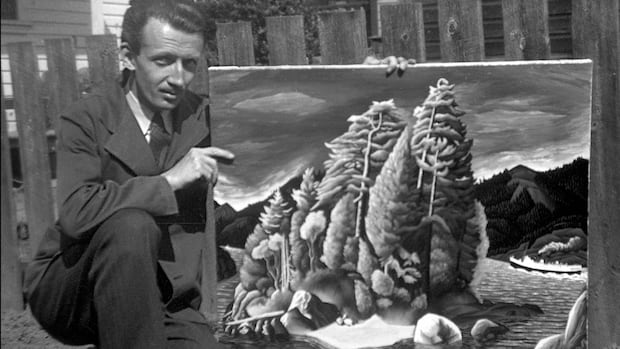
It’s like an image out of a strange dream, and yet Entrance to Howe Sound — a 1949 painting by E.J. Hughes — is unmistakably a picture of B.C.
The work depicts a turbulent coastal landscape, foregrounded by a titan forest which springs from a stony island. The trees’ brush-like boughs dominate the canvas, craning toward a smoky sky, and despite the shadowy atmosphere — marked by black craggy mountains and dark waters — the greenery glows with an almost radioactive sheen. It’s an eerily expressive scene, but off in the distance, there’s a sign of ordinary human life and industry: a steamship puffs along the water — the cheerful curve of its hull resembling a gleaming white grin.
For many years, Entrance to Howe Sound hung in a Vancouver Island home, but this November, the painting went on the block at the Heffel Fine Art Auction House in Toronto, selling to a private collector for $4.8 million.
The price tag made history. The sum was more than double Hughes’s previous sales record, and Entrance to Howe Sound is now the fourth most expensive Canadian artwork to ever be sold at auction. Only paintings by Lawren Harris and Jean-Paul Riopelle have pulled more on the secondary market.
That detail may leave many Canadians curious to understand Hughes’s legacy — and the seven-figure interest in artwork. In a timely turn of events, a new feature documentary can offer some insight.
WATCH | The Painted Life of E.J. Hughes, official trailer:
The film is The Painted Life of E.J. Hughes. Directed by B.C. filmmaker Jenn Strom, it premiered at the Vancouver Film Festival last October, weeks before the record-breaking auction of Entrance to Howe Sound, and it begins a Canadian screening tour Feb. 7 with a run at the VIFF Centre in Vancouver. (The doc, which was commissioned by B.C.’s Knowledge Network, will be available to stream at www.knowledge.ca after April 16.)
It’s a comprehensive biography of Hughes, whose 70-year career began on the cusp of the Great Depression. In the ’30s, Hughes was student at the Vancouver School of Art, now known as Emily Carr University of Art + Design. There, he was taught by Frederick Varley, and some years later, the young artist would be championed by another founding member of the Group of Seven, Lawren Harris, who recommended him for the inaugural Emily Carr Scholarship.
The film also explores Hughes’s experience during the Second World War. From 1940-46, he served as an official Canadian war artist, and the doc visits the Canadian War Museum in Ottawa for a look at his closely observed scenes of military life.
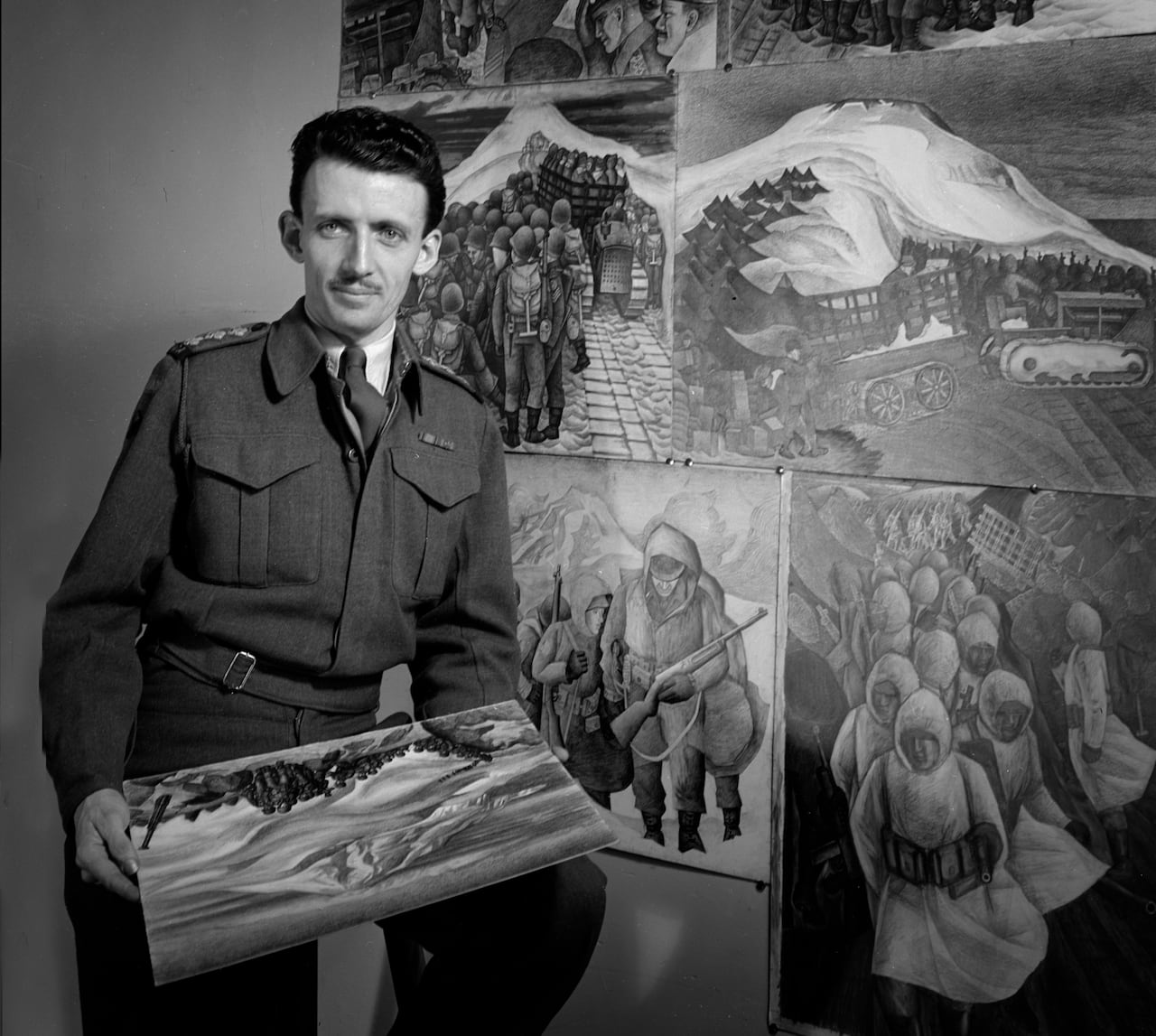 E.J. Hughes, Canadian war artist, seen in an archival photo from 1945. (Malak Karsh/Optic Nerve Films)
When Hughes’s army time ended, he and his wife moved to Vancouver Island, where he began painting the regional landscapes for which he’s best known. These picturesque scenes were wholly out of step with the times.
In the catalogue for Hughes’s 1967 solo exhibition at the Vancouver Art Gallery, curator Doris Shadbolt describes Hughes as an “eccentric” and something of an anomaly among his contemporaries. “Essentially a loner and a non-intellectual, he belongs to no school and will never found one,” she wrote. “But on the other hand his private revelation is of a kind to resist the wearing of time. He has created a permanent poetry of Canada’s Pacific coast.”
Abstract Expressionism was the movement of the day, and yet, Hughes was able to establish himself as a working artist, even while maintaining a secluded life in the rural village of Shawnigan Lake. As captured in the doc, a fateful encounter made his long career possible.
In 1951, Max Stern, owner of the Dominion Gallery in Montreal, was shown one of Hughes’s paintings while visiting Vancouver. Moved, Stern was determined to meet the artist, and after a long search, he turned up on Hughes’s doorstep to purchase every last artwork on the premises.
Before Stern said goodbye, he offered Hughes a contract. The arrangement allowed Hughes to support himself as a full-time artist, and over the decades, he produced hundreds of Canadian landscapes which were sold by the gallery. They are held by museum collections throughout the country, including the National Gallery of Canada, Winnipeg Art Gallery and Vancouver Art Gallery (which houses more Hughes than any institution).
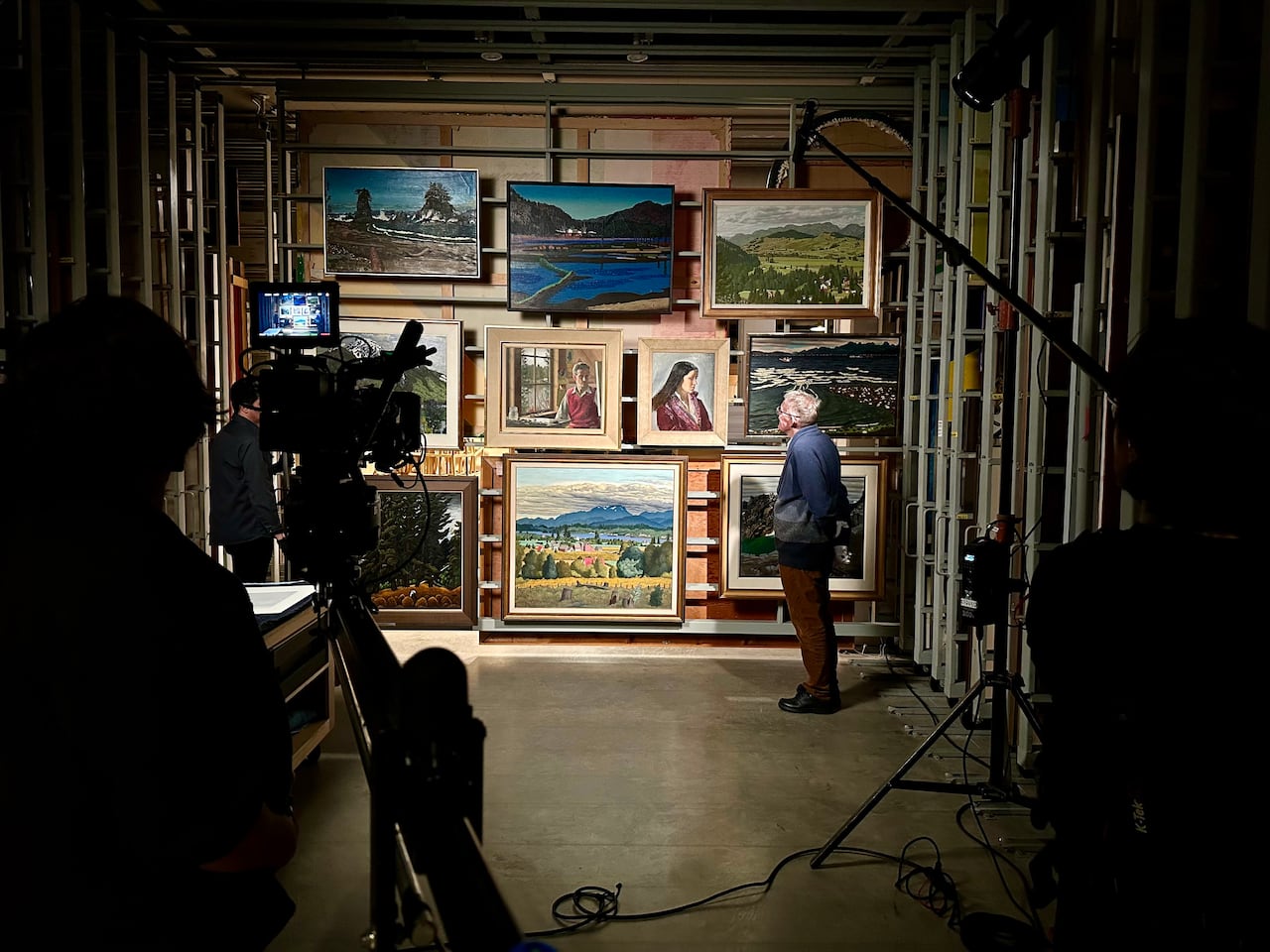 The Painted Life of E.J. Hughes takes viewers inside the Vancouver Art Gallery’s vault. In this behind-the-scenes photo, curator Ian Thom looks at Hughes artwork from the gallery’s collection. (Kevin Eastwood/Optic Nerve Films)
When Strom was growing up on the West Coast, the Vancouver filmmaker was familiar with Hughes’s work. She has a theory he’s “like a family member that everyone kind of seems to know in the province.” Even if you haven’t heard his name, you probably recognize his landscapes.
Strom’s past credits include Assembly, a hand-painted animated short for the NFB, and A Golden Voice, a profile of Haida artist Bill Reid. The Painted Life of E.J. Hughes is her feature debut, and she began pursuing the project in 2019 after reading a book by Robert Amos. A long-time arts writer for the Victoria Times-Colonist newspaper, Amos has authored five Hughes biographies and he contributed a wealth of archival material to the film, including audio interviews recorded by the artist’s long-time assistant, Pat Salmon.
“What I was really drawn to looking at Robert Amos’s books was the depictions of towns and places in B.C.,” says Strom, and during the making of the doc, she travelled to as many communities as she could, hunting for the views Hughes captured in his artwork. Her camera takes us to Revelstoke and Chilliwack, Rivers Inlet and Comox Valley — among many other destinations.
 Jenn Strom is the director of The Painted Life of E.J. Hughes. (Optic Nerve Films)
Equal attention is paid to the artwork itself, and the doc goes behind the scenes to view collections at institutions including the Vancouver Art Gallery and the B.C. Archives at the Royal B.C. Museum.
E.J. Hughes is renowned for meticulous detail, says Strom, and she was determined to capture “the draftsmanship and the brush strokes and tiny details” he’s famous for. “To do that, we had to go and find the actual paintings, and that scavenger hunt was a whole other thing.”
It’s possible to see Hughes artwork on public display; at the Audain Museum in Whistler, for example, a selection is always on view at the Barbeau-Owen Gallery. Still, the experience is rare, she explains. Hughes paintings “are often in collections, in vaults or they’re in private homes,” she says. But as luck would have it, several of those privately held works hit the market while the film was in production.
Although he passed away in 2007, the way his work is moving out into the world is alive and is unfolding as a story and it’s continuing to change and grow.- Jenn Strom, director of The Painted Life of E.J. Hughes
With Heffel’s cooperation, Strom was given access to paintings before they went to auction. The record-setting sale of Entrance to Howe Sound left her “gobsmacked” in November, but the director is fascinated by the “enigmatic value” of Hughes’s work, and how it’s connecting with viewers today.
“Although he passed away in 2007, the way his work is moving out into the world is alive and is unfolding as a story and it’s continuing to change and grow,” she says. “People are appreciating him more and more.”
David Heffel, president of Heffel Fine Art Auction House, saw the doc when it premiered at VIFF last fall, and he says it captures a true sense of who Hughes was as a character: introverted, charming, a consummate gentleman. (Heffel first met the artist in the late 1980s, and his company has championed Hughes’s work for several decades.)
Early in the doc, Heffel appears in an archival clip from another landmark auction, the 2004 sale of Fishboats, Rivers Inlet. Like the Howe Sound piece, it’s a painting from Hughes’s post-war period, and in a voiceover from a news report, it’s described as “the most important masterpiece of his career.” The original buyer acquired it for $150. That day in 2004, the work sold for $920,000 — then the highest amount for a living Canadian artist.
Hughes, by then in his 90s, was still living on Vancouver Island, and he answered an unexpected call from the auction house while the sale was transpiring. It’s a moment Heffel will always remember. “We brought him into the ballroom of about 350-plus people to share his enthusiasm and surprise as a result of that sale. It was priceless,” he says. “We will never have an opportunity to do something like that with an artist of that calibre again.”
In 2004, Hughes had already received the Order of Canada (2001), and a survey exhibition had appeared at the Vancouver Art Gallery the previous year. But the “golden era of the Canadian art market,” as Heffel describes it, was just beginning. “There hadn’t been very many paintings, probably fewer than a dozen, that had approached that million dollar price level in 2004,” he explains.
When Fishboats, Rivers Inlet was auctioned again in 2018, it sold for $2,041,250 — the previous record for a Hughes painting. Over the years, Heffel says the fervour among Hughes’s collectors has remained constant. “The passion has always been there, but the price of Hughes’s works has changed as other things in life become more expensive and rare.”
Of the top 10 Hughes sales recorded on the auction house’s website, the majority have found homes with private collectors, and according to Heffel, all but one work resides in B.C. “Most [paintings] seem to be making their way back,” he says.
“Hughes is a hometown favourite, but I think he also has the capacity to inspire viewers from around the world,” says Heffel. Still, it’s Hughes’s affection for B.C. that may have lent him such broad appeal, says Strom.
“There’s a story about where we’ve come from that is embedded in his depictions,” says the filmmaker. “He was really just capturing what he was seeing with an open heart. And we can all maybe relate to that.”