
With pitchers and catchers due to report league-wide in less than two weeks, spring training is almost upon us. That poses an issue for the remaining MLB free agents, especially those at the top of the market. It can be tough to establish a rhythm, especially earn in the season, if you’re a late addition in the spring. Just ask Blake Snell, whose bumpy first half with the San Francisco Giants in 2024 lives in infamy.
At this point, unsigned free agents are losing more than money due to teams’ hesitancy. It could cost them on the field, too. Let’s dive into the best free agents left and determine what exactly is holding teams back from signing them.
RHP Lucas Giolito
Boston Red Sox pitcher Lucas Giolito | James A. Pittman-Imagn Images
Fatal flaw: Health concerns
Lucas Giolito missed the entire 2024 season as he recovered from internal brace surgery on his right elbow. He returned and made 26 starts for the Boston Red Sox in 2025. On the surface, Giolito did his job: 3.41 ERA and 1.26 WHIP, with 121 strikeouts in 145.0 innings. But Giolito’s numbers under the hood were a bit more worrisome. His expected ERA (5.06) would qualify Giolito as one of the luckiest pitchers in MLB. In 2019, his lone All-Star season, Giolito’s strikeout percentage sat at 32.3 percent. Last season’s number: 19.7 percent.
His Stuff+ (which gauges the physical characteristics of a pitch) has been on a troubling decline, too:
Year
Fastball Stuff+
Slider Stuff+
Changeup Stuff+
2021
97
106
124
2022
84
100
117
2023
83
99
118
2025
80
95
110
Giolito has a solid track record overall, but he’s 31 years old, a year removed from major elbow surgery, an exhibiting clear regression across the board. His fastball, which sat in the 94-95 MPH range in his peak, sat around 90 MPH last season. His slider and changeup remain functional, but not the elite putaway pitches they once were.
The market for starting pitchers couldn’t be hotter, so Giolito should still receive a nice payday. But expect a short-term contract that accounts for the considerable downside risk. Durability, once a strength, is now a real gray area. Moreover, there’s just no telling if Giolito can plateau as a third starter, or if he ends up as more of a fifth starter-swingman type who’s untouchable once the postseason arrives. It doesn’t help that he’s less than two weeks away from missing valuable spring training reps.
DH Marcell Ozuna
Atlanta Braves designated hitter Marcell Ozuna | David Richard-Imagn Images
Fatal flaw: Glove
Marcell Ozuna was still productive last season, despite a fluctuating role and the overall bad vibes around the Atlanta Braves. He hit .232 with a .756 OPS and 113 OPS+, thwacking 21 home runs with 68 RBI in 437 at-bats. He posted a walk rate in the 98th percentile, taking more bases on balls (94) than he ever has before.
But here’s the rub: Ozuna is 35 and he’s exclusively a designated hitter. He restricts the lineup flexibility of any team that signs him. Unless there’s a coach who wants to brave the turbulent waters of Ozuna in right field at this stage of his career, Ozuna will need to occupy the DH slot night-in and night-out. That limits a team’s ability to flex other players into the DH based for rest or matchup purposes.
If Ozuna was coming off of his 2024 season, in which he posted a .925 OPS and finished fourth in NL MVP voting, that probably doesn’t matter. But when he’s 35 years old and exhibiting signs of imminent decline, it becomes hard to justify all the complications that come to dedicating your DH reps to Ozuna. He’s too good to sit on the bench as a situational hitter, but he’s not good enough to shoulder the load Atlanta has put on his shoulders. Expect a cheap one-year deal accordingly. Most contenders have more or less filled out their lineups at this point. Not many teams are looking for a middling DH with a history of off-field problems.
RHP Zac Gallen
Arizona Diamondbacks starting pitcher Zac Gallen | Robert Edwards-Imagn Images
Fatal flaw: Fastball decline
Arizona Diamondbacks righty Zac Gallen finished fifth in NL Cy Young voting in 2022 and third in 2023. Now, a few months removed from his 30th birthday, he’d be lucky to get two years and $40 million with how the market has landed. Odds are Gallen will prioritize a short-term deal with opt-outs, hoping to improve his stock and test the market again in 2027. That strategy carries risks of its own, of course, but Gallen’s 2025 season was a real head-scratcher.
He finished strong, which was a relief for interested teams, but clearly it was not enough to revive his reputation as a frontline ace. Durability is a plus, as Gallen is a safe bet for 30ish starts each year, but really: pitchers are never “safe” when it comes to injuries. Gallen’s velocity has ticked down ever so slightly in recent years, and his fastball — once a premium pitch — now is merely functional. A couple metrics, Stuff+ and Pitching Run Value, bear this out.
Year
ERA
Fastball Stuff+
Fastball Run Value
2022
2.54
112
18
2023
3.47
100
18
2024
3.65
95
-7
2025
4.83
98
-2
Gallen’s fastball is still his go-to pitch, and his most effective, but it doesn’t zip through the zone quite like it used to and Gallen’s command has suffered. He’s liable to get knocked around more. When the fastball isn’t so effective, he can’t set up his breaking and off-speed offerings as effectively. It has a cascading effect. There’s still a world in which Gallen rights the ship and gets back to something approximating an ace, or at least a No. 2 starter, but it’s hard to trust him at this point.
3B Eugenio Suárez
Seattle Mariners third baseman Eugenio Suarez | Steven Bisig-Imagn Images
Fatal flaw: Strikeouts
Eugenio Suárez put together an incredible season on paper: 49 home runs, 118 RBI with an .824 OPS and 126 OPS+. It was up there with his greatest individual campaigns. But it was also a tale of two diametrically opposed halves. Before the deadline in Arizona, he popped 36 homers with a .897 OPS and 142 OPS+ (that would’ve been a career high). After the deadline with the Seattle Mariners, he managed 13 home runs and 31 RBI in 53 games, but his OPS plummeted to .682 with a 94 OPS+.
Suárez is still a valuable hitter. He can change the calculus of a game with one swing, and he’s a major run-driver in the heart of a lineup. But there’s just so much unpredictability. The strikeouts are just not sustainable. His 26.8 percent strikeout rate with the D’Backs, but it was at least manageable. It spiked to 35.9 percent with Seattle after the deadline.
We are at the point in Suárez’s career where certain ballparks ought to be favored (Seattle… not one of ’em). He’s also 34, so the age factor is significant. He’s too volatile for a high salary and too old for a long-term deal. So what’s the market. Pitchers and catchers are about to support and the tangible reporting on Suárez’s free agency amounts to whispers and musings. He’s not a quality defender at third base and not many contenders are looking for a less-than-elite permanent DH (see: Ozuna, Marcell). So while Suárez is clearly the “best” infield bat left, he’s positionally restrictive and his production month-to-month is utterly unpredictable.
It’s hard to trust these inconsistent, high-K hitters in October, too, which is another source of concern. Suárez is still a useful player, at times even a transformative player. He just does not maintain that level of production consistently enough to earn the payday he probably wants.
LHP Framber Valdez
Houston Astros starting pitcher Framber Valdez | Jerome Miron-Imagn Images
Fatal flaw: Clubhouse vibes
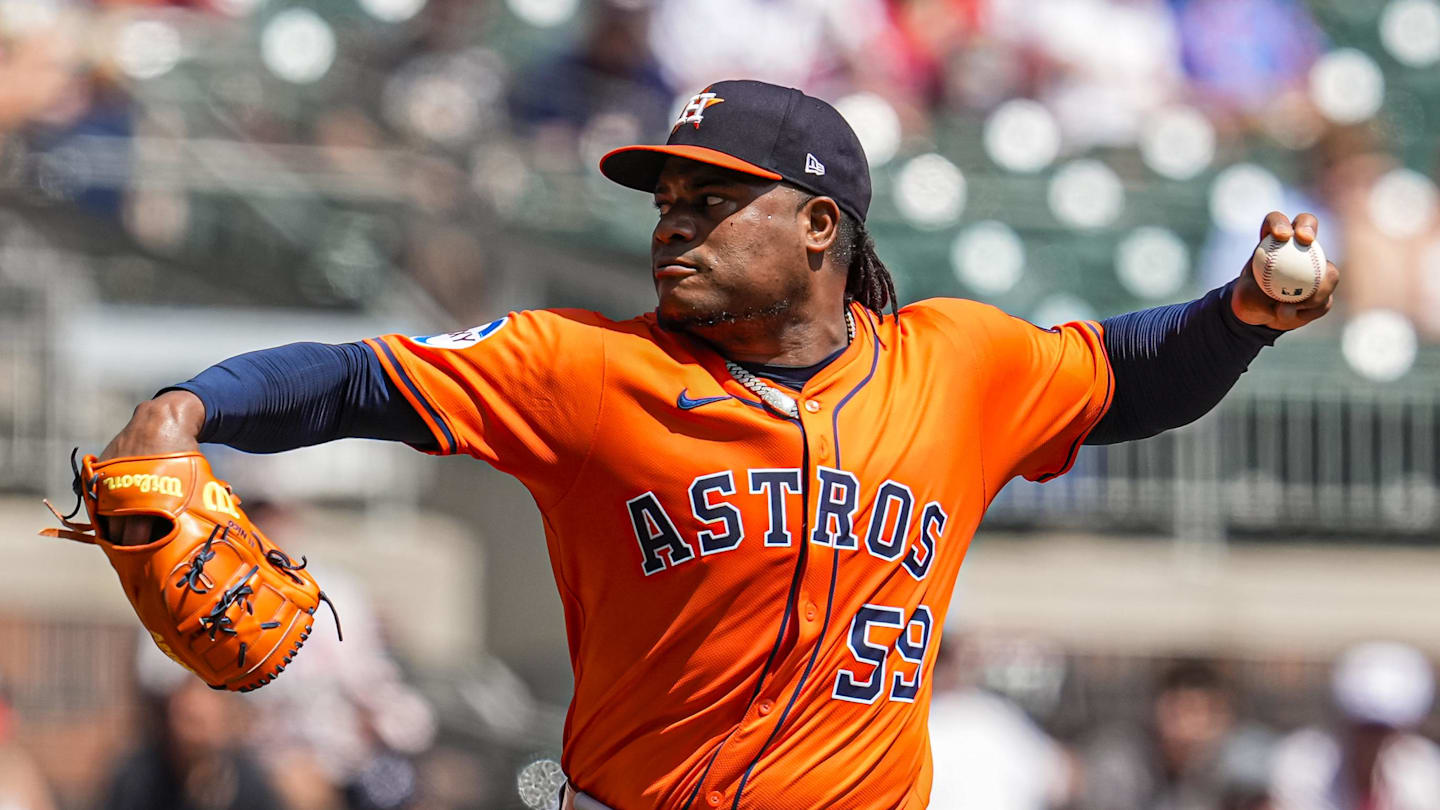
Framber Valdez is one of the most dependable workhorses in MLB. He has put together six straight campaigns with a sub-4.00 ERA, making at least 31 starts in three of his last four seasons. His success wavered a bit down the stretch in 2025, but he still put up a 3.66 ERA in 31 starts (192.0 innings). Valdez tends to show up and do his job, and he comes with plentiful postseason experience as part of the Houston Astros‘ 2022 World Series team. So why is he waiting so long to sign?
Well, there are multiple factors. Valdez is 32, so the prospect of a six- or seven-year deal is not innately appealing, even if his résumé is deserving of one. He’s also heavily reliant on pitching to contact and generating groundballs — a profile that does not always age well, and one suited better to certain ballparks and rosters than others. Perhaps the most obvious concern, however, is how Valdez fits into a clubhouse.
Valdez’s personality came under question this past September when he appeared to intentionally cross-up his own catcher. After shaking off a pitch call and giving up a grand slam, Valdez let out his frustration by drilling his catcher with a 93 MPH sinker — then skirting around an apology in the postgame media scrum.
Now, Valdez has tried his best to convince teams that was an isolated incident, but it’s hard not to feel like opposing front offices are weary of how Valdez might fit into a new locker room. The pitching market is hot. Ranger Suárez, a lefty with a comparable profile and comparable aging concerns, still got five years and $130 million. Valdez will get his bag eventually, but we know the importance of a full spring training for a pitcher. The clock is ticking, and Valdez is working against it.