
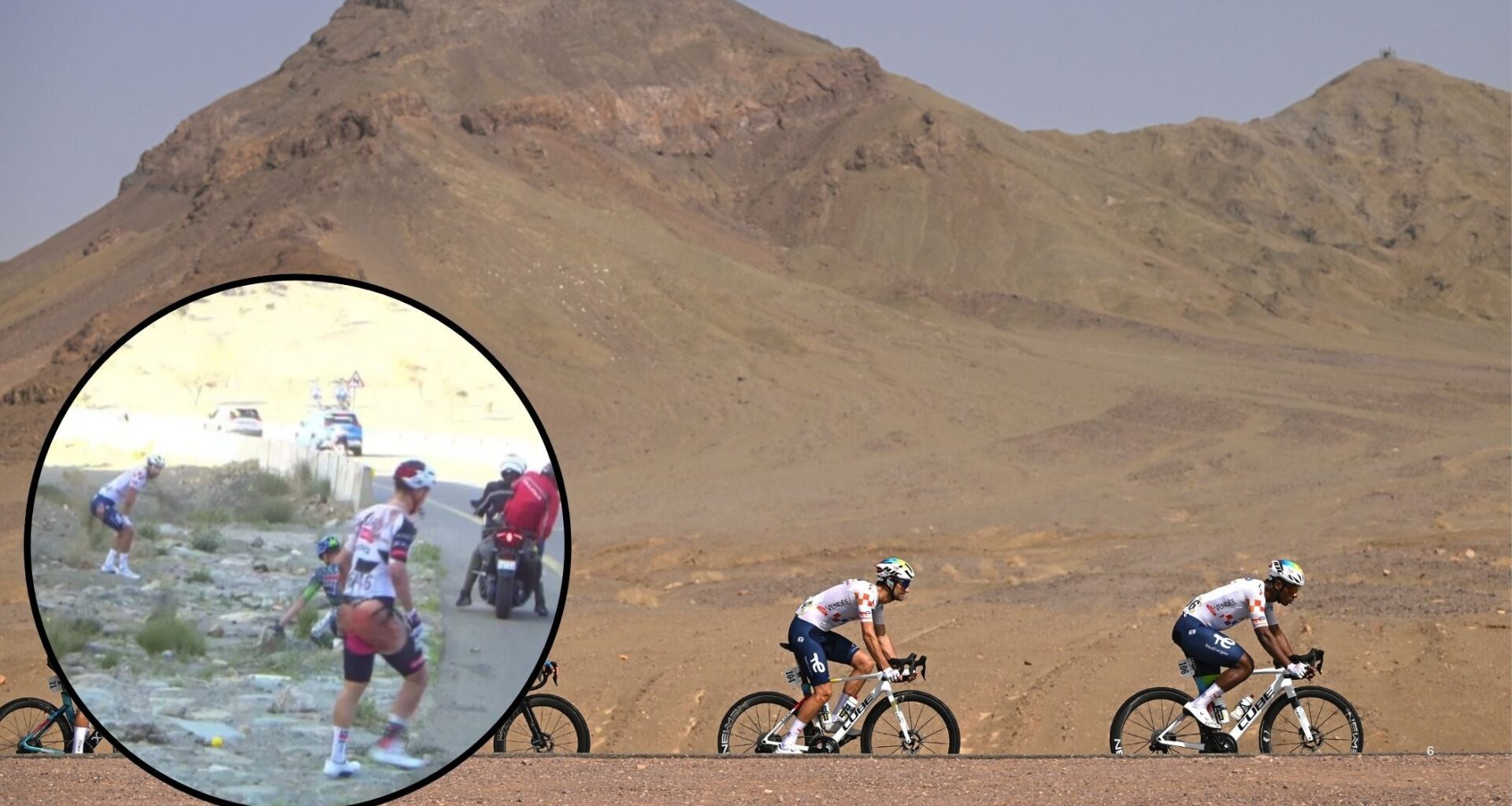
Horrific injuries reveal the brutal toll of crashing at 100kph just as the UCI pushes new safety measures for 2026.
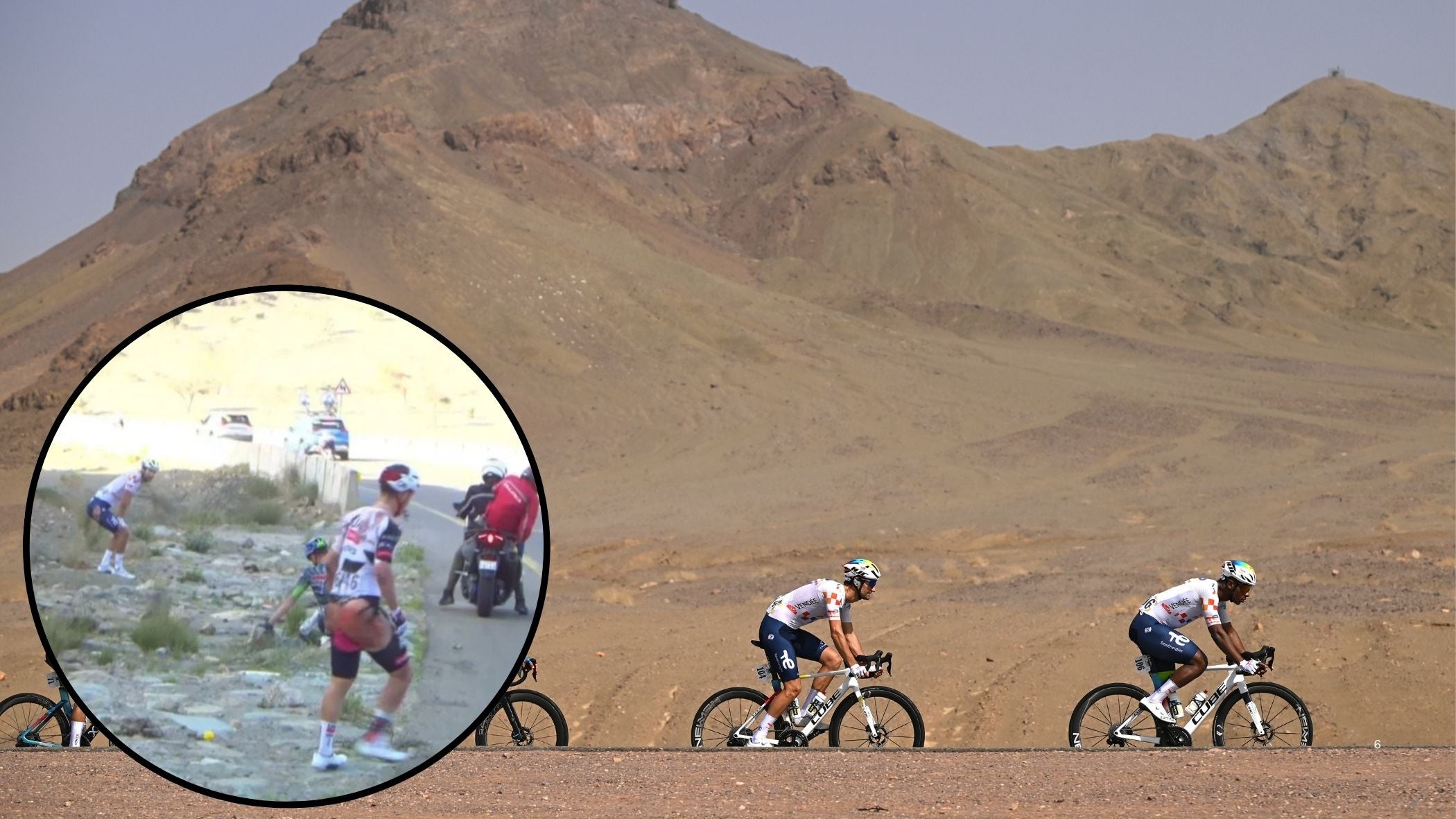
New details confirm the brutality of a high-speed crash at the AlUla Tour. (Photo: Getty Images/Velo)
Updated January 31, 2026 10:45AM
A horrific, 100kph crash at the AlUla Tour this week delivered an early-season gut check on the risks of crashing just as the UCI is pressing for improved safety measures coming into 2026.
Three riders — Fabien Grellier (TotalEnergies), Laurenz Rex (Soudal Quick-Step) and Davide Stella (UAE Emirates-XRG) — all hit the deck at extreme speed that left viewers wincing at the carnage.
The fallout is brutal as the full extent of the horrific injuries is being confirmed.
TotalEnergies said that Grellier did not break any bones and suffered what the team called “bruises and several deep cuts, requiring several weeks of rest.”
According to Der Telegraaf, however, the 31-year-old Frenchman was rushed to a hospital for emergency surgery to treat a torn anus.
Soudal Quick-Step confirmed that Rex broke three processus spinosus along his spine, but apparently does not require surgery.
Officials said Rex, who managed to finish the stage, is in “stable condition but will require several weeks of rest before beginning his rehabilitation.”
This has GOT to hurt 🤕
A blistering 106km/h descent inside the final 15km of Stage 3 caused a three-rider pile up of Laurenz Rex, Davide Stella and Fabien Grellier.
We hope all riders involved are ok 🙏#AlUlaTour | January 27-31 | SBS On Demand 📺 pic.twitter.com/tN2HVDbyyu
— SBS Sport (@SBSSportau) January 29, 2026
Stella — a 19-year-old from UAE’s development team — suffered horrific tears and cuts to his back and glutes, with the back of his racing bibs ripped open from the impact.
The Italian remains in a local hospital after undergoing surgery to clean out the wounds.
“Davide fortunately escaped serious injury given the severity of the crash but suffered heavy abrasions to his back and gluteal areas,” said UAE’s medical director Dr. Adriano Rotunno. “These required surgical cleaning, for which he remains in hospital under observation. He will aim to fly back to Europe in the coming days accompanied by a team doctor.”
High-speed crash ‘could have been a lot worse’
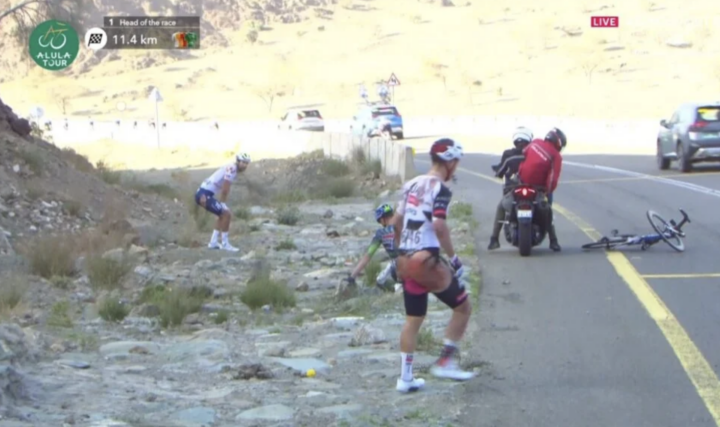 Video revealed the brutality of the high-speed crash. (Photo: Screen shot/X)
Replays showed riders crashing out of a sweeping righthander at high speeds topping 100kph.
Belgian daily Het Nieuwsblad reported that cyclists within the bunch thought it was a puncture that provoked the the worst crash so far in the early days of the 2026 racing season.
Riders crashed off the road and impacted on packed out rocks in a flat shoulder area, stopping just short of unpadded concrete barriers.
Picnic’s Fabio Jakobsen said he backed off on the same descent and told Het Nieuwsblad things could have been much worse.
“My computer already showed 106kph, and the guys in front of me were going even faster,” Jakobsen told Het Nieuwsblad. “I am happy that nobody slammed into the rock face on the side, because it could have been a lot worse.”
UCI seeks more data on airbags, tire failures, and aerodynamics
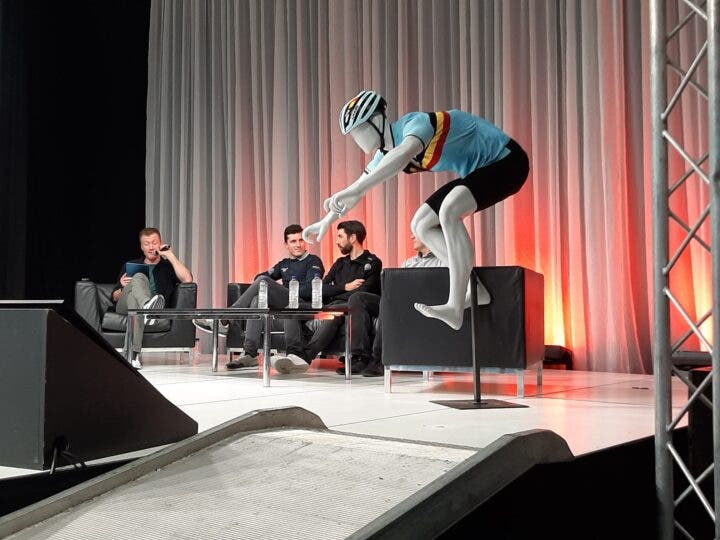 The UCI said it will study new airbag technology being developed by several projects. (Photo: Aerobag/Special to Velo)
The crash happened just as the UCI wrapped up semi-annual talks with teams, riders, and organizers, with safety dominating the agenda this week in Belgium.
The UCI confirmed Friday it will study the feasibility of airbag technology that’s starting to hit testing stages in what some believe could be a safety breakthrough.
“The UCI has decided to launch a call for expressions of interest concerning the development of airbags for cyclists, with the aim of protecting them in the event of a crash,” a press note read.
The cycling governing body said it will work closely with the handful of projects that are in the testing phase of airbag technology, a safety innovation that’s already being used in such sports as MotoGP, enduro, and alpine skiing.
Also read: Are yellow cards making racing any safer?
The UCI also said tougher course safety standards are in the cards for 2026, including standardized hazard signage and better protection at danger hotspots.
Former pro sprinters will be working with commissaires to help create safer conditions in sprint finishes.
It also green-lit studies into wheel and tire failures with Politecnico di Milano, and another one into crash dynamics and aerodynamics with Heriot-Watt University.
The UCI said it will use these studies to provide data-led solutions as part of its SafeR program.