
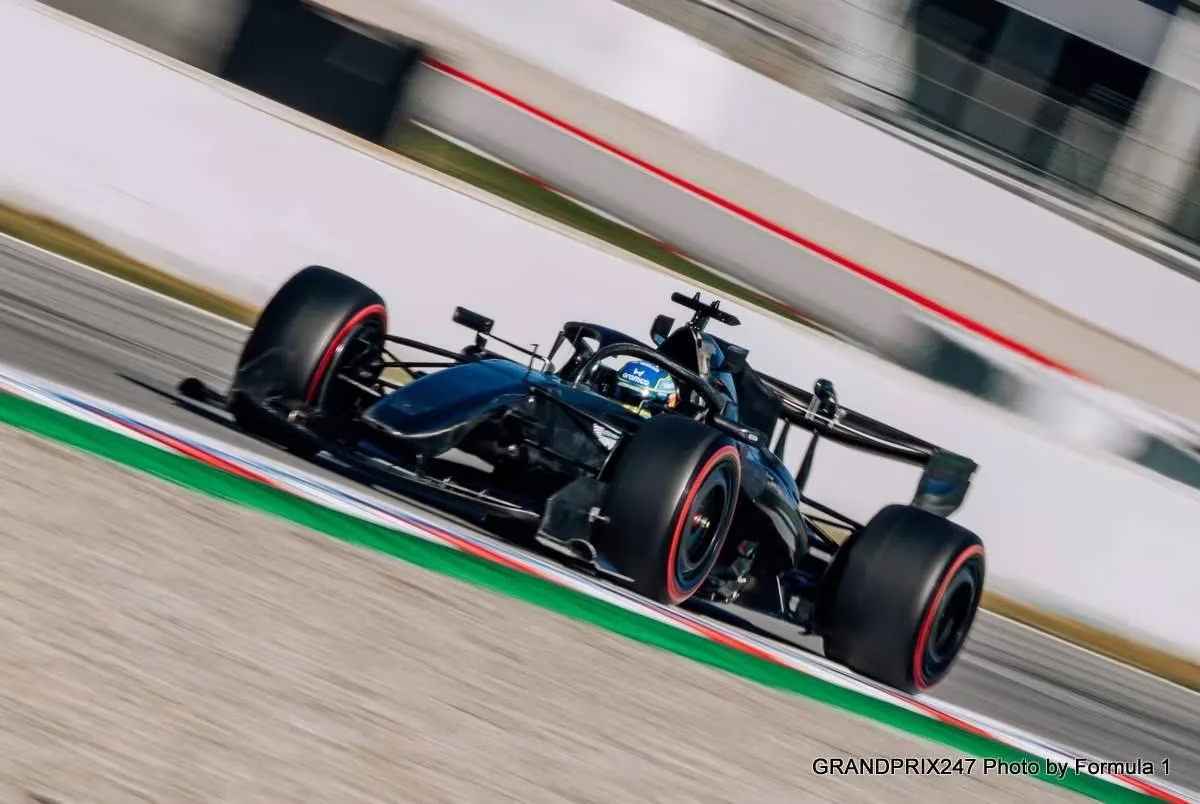

Aston Martin’s ambitions under the ownership of billionaire Lawrence Stroll are a moonshot to propel a midfield team to punch with the best at the front of the Formula One grid. State of the art facilities have been built in Silverstone costing hundreds of millions, along with the latest wind tunnel design and a host of ‘rocket science’ simulation tools.
The Canadian has also assembled a management dream team with Adrian Newey now leading the way as team principal, along with Andy Cowell and ex-Ferrari technical wizard Enrico Cardile. Cowell is credited as being the mastermind behind the all dominent Mercedes hybrid powertrain first launched in 2014, which won seven drivers championships and eight constructor titles for the Brackley based team.
Newey was originally recruited as the managing pattern for all things technical, although in a surprise late season announcement in 2025, he was promoted to team boss whilst Cowell moved across to become the linch pin between the team and Honda.
As an F1 technical whizz, Newey has repeatedly found himself in confrontation with those above him starting as early as in his formative years at Leyton House, resulting in “shouting matches” with Ian Keeble who doubted Newey’s radical diffuser design claims.
At both Williams and McLaren, Newey found himself at odds with the likes of Patrick Head and Ron Dennis and even in his nigh on twenty years at Red Bull, there were clashes with the team’s engine partner Renault along with team boss Christian Horner.
Now Adrian holds the keys to the Aston Martin kingdom, and for many it was no surprise Aston Martin were late to join the Barcelona pre-season test. Known for his reluctance to sign off a design until it is perfected, it is likely that Newey was responsible for the all new Aston Martin car arriving late in the day and completing just 54 laps, while Mercedes topped 500.
Yet when the AMR26 car was revealed late on Thursday afternoon, it made a significant impression on many of F1’s analysts. The unpainted black carbon fibre finish made some of the details difficult to read, but the concept of the car appeared to draw on details from the all conquering RB19 along with McLaren’s 2025 winning competitor.
“That will be key”: Hamiltons secret to winning ways return
The suspension was the talk of the virtual paddock, and Bernie Collins – ex Aston Martin head of performance – gave her thoughts on Sky F1’s review of the test. “Adrian Newey, the pure aerodynamicist, is pushing for downforce. He’s positioning the suspension in a way that is generating downforce, or reducing drag. One of those two is his main aim, and not, maybe, focused as much on the cornering performance from a mechanical side. And he’s forcing, maybe, the mechanical suspension into somewhere that other designers might not be happy to go.”
Whilst the design of the front wing supports, together with side pod size, diffuser profile and air box winglets are all interesting innovations, it is the suspension where the clever engineering is taking place. At the front the upper wishbone forward leg is placed as high as possible within the current chassis design rules.
However, the inboard pickup for the top wishbone rearward leg is much lower and further rearward than the other teams’ designs and to cut a long story short, this should give the drivers better feedback and less load on the steering in the slow speed corners.
Brundle lifts the lid on Red Bull’s secret trick
At the rear of the car is an even more radical solution to suspensions design, and as Bernie Collins explains unlike ever seen before the top wishbone is mounted onto the rear wing pillar.“The thing to say first off, is that each wishbone, for each wheel, top and lower wishbone, has two elements, a forward leg and a rearward leg, that sort of makes like a V-shape.
“Now, traditionally, on the front, they’re mounted to the chassis. On the rear, they’re mounted to the gearbox, traditionally. And there’s lots of reasons for that. The gearbox is a very strong member within the rear of the car. So, it brings more stiffness, for example, which is something that you tend to want. It tends to hold some of the internal suspension in there as well.”
“But again, this is an example of Adrian Newey pushing that design a little bit. This will be really tricky, technically, to get the rear wing pillar strong enough, but yet light enough, and to mount that bit of suspension on it. But he’s using that as like a lower element of a rear wing,” said Collins.
One of the problems facing Aston Martin is their car is said to be significantly over weight and the extra strength required to fit the wishbone to the rear wing supports. Yet the reason Newey is attempting this is to circumvent the new regulation which bans the traditional rear beam wing – sometimes called the “monkey seat.”
Did Mercedes really lead the way in Barcelona?
This lower rear wing element was used to create incremental downforce but with the FIA attempting to significantly cut downforce on the 2026 F1 cars, it was outlawed. Were the Aston Martin’s rear wishbone attached to the gear box as is traditional, the associated stay now masquerading as a beam wing, would sit much lower and fail to offer the aerodynamic advantage it does.
The loss of some 450 laps in Barcelona to Mercedes is not insignificant in the modern F1 era, when testing is restricted to a fraction of what it used to be. The AMR26 will return in two weeks time to the first of two tests to be held in Bahrain when Newey and Fernando Alonso will be hoping for a lot more track time and with some media coverage a better view of Newey’s radical new offering may be on view for all to see.
Whether the AMR26 is a genius design or a flop is a verdict that remains on hold. Honda too will be hoping to iron out some of the niggles they have been experiencing, with the team having lost a year on their rivals having initially decided to withdraw from F1’s new powertrain era.
The ‘private’ Formula One Barcelona test was awaited with huge anticipation as finally the biggest change in the sport’s technical design and power unit regulations manifest themselves in the all new cars for the coming F1 era. The test was not quite so private as the FIA anticipated with teams confirming their best lap times and distance covered each day at the Circuit de Catalunya.
Williams were conspicuous by their absence and after their best season in 2025 for over a decade, there were long faces back at base in Grove when the decision was taken to skip the first ore-season test. Reports emerged that the FW48 was as much as 20-30kg overweight and that the chassis had failed the FIA’s mandatory crash test.
Seven teams made day one of the pre-season outing, with both newbies Cadillac and Audi amongst the roster. Although McLaren had stated they intended to run on day two it was only Ferrari who made their debut on Tuesday as the mechanics of the papaya liveried car worked throughout the day behind the closed garage door…. READ MORE

A.J. Hunt is Senior Editor at TJ13 and a career journalist with experience in both print and digital sports media. Having trained in investigative journalism and contributed to several European sports outlets, Hunt brings rigour and polish to every article. His role is to sharpen analysis, check facts and ensure TJ13’s daily output meets the highest editorial standards.