
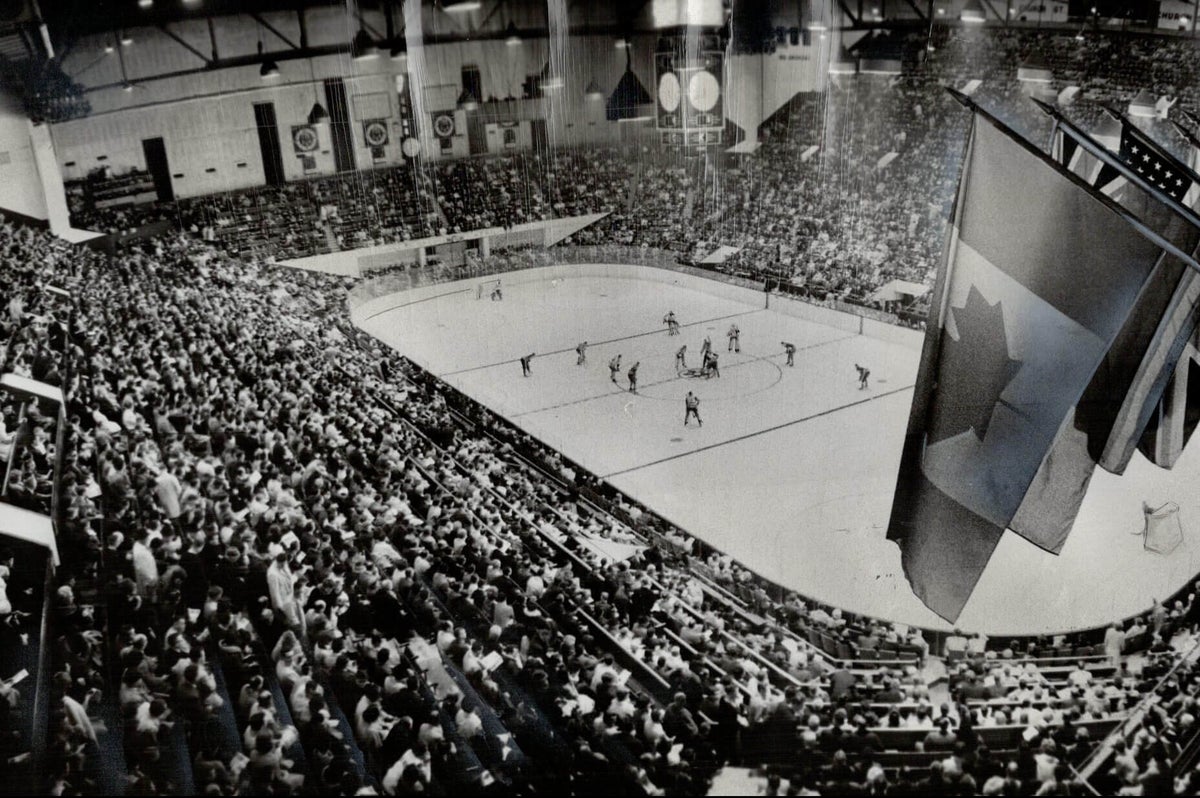
This article is part of our NHL Arena Rankings series, in which we rank all 32 current rinks and present stories about memorable rinks of the past and present.
Modern NHL arenas might have all the bells and whistles. They certainly come with larger concourses, more leg room and an abundance of technological advances. “Barns,” as buildings that housed hockey were once affectionately called, is not a term that applies today.
Still, fans of a certain, uh, vintage hold dear those arenas of yesteryear. And while nostalgia is powerful, the affection for buildings that lacked modern amenities is rooted in a fondness for unique features that helped people connect to their NHL teams through those old arenas.
Here’s a look at some of the NHL’s most-loved former arenas, and some of their defining quirks.
Boston Garden’s small ice
Boston Bruins (1928-95)
Designed with boxing matches in mind, Boston’s version of New York’s Madison Square Garden — its original name was “Boston Madison Square Garden” — was famous to NHL fans for its small ice dimensions. The ice surface measured at 191 by 83 feet, nine feet shorter and two feet narrower than the NHL’s regulation dimensions. Boston Garden was not the only arena with ice that didn’t meet standard measurements. However, the Bruins, especially in the 1970s, constructed rosters to feature players who would excel on the shorter, narrower ice. The Bruins’ size and physicality seemed more noticeable on the diminished rink.
Chicago Stadium’s fog, organ, steep steps
Chicago Blackhawks (1929-94)
Nicknamed the “Madhouse on Madison,” Chicago Stadium was modeled after Detroit’s Olympia. Both arenas were boxy, but Chicago Stadium was memorable for its poor ventilation, which could lead to fog forming during Blackhawks games, and a massive Barton organ. Chicago Stadium, like Boston Garden and Buffalo Memorial Auditorium, had an ice surface that was not regulation, with less space in the neutral zones. And then there were the steep stairs — at least 20 — that players had to climb to reach the ice after leaving the dressing rooms.
Cow Palace’s high roof
San Jose Sharks (1991-93)
The team’s current home is fondly referred to as the “Shark Tank,” but the Sharks started their NHL journey inside Cow Palace in Daly City, Calif. The Sharks were dreadful during their two-season stay at Cow Palace, so it existed primarily as an arena where scorers would show up to fatten their point totals. But any player who took the ice at Cow Palace recalls the building’s seemingly sky-high roof, which consisted of steel trusses and was 110 feet above the building’s floor. Even when viewed on television, the Cow Palace looked like hockey was being staged in an aircraft hangar.
Hartford Civic Center’s mall entrance
Hartford Whalers (1979-97)
This arena was home to professional hockey starting in 1975, with the New England Whalers of the World Hockey Association. A collapsed roof in January 1978 forced the Whalers, who had already relocated from Boston’s Matthews Arena, back to Massachusetts in the Springfield Civic Center. (Changing cities is kind of a thing for this nomadic franchise, known since 1997 as the Carolina Hurricanes.) But what stood out about Hartford Civic Center was its apt nickname, “The Mall.” Part of a large, multi-use complex, the Hartford Civic Center was situated in the center of retail/public spaces, along with food courts — part of a connected mall. Fans accessed the arena by way of the mall. Also, this was the home to “Brass Bonanza,” arguably the greatest goal song in NHL history.
The Forum’s Roman Coliseum resemblance
Los Angeles Kings (1967-99)
The late Jack Kent Cooke, a Canadian, brought the NHL to Los Angeles. Suburban Inglewood became home to what was a groundbreaking facility. Known by Southern Californians as “The Fabulous Forum,” this building was designed to resemble a Roman Coliseum — and from the outside, it did. Once inside, the absence of numerous support beams, combined with a cables-suspended roof with an approximately 400-foot diameter, made the Forum feel expansive compared to other arenas.
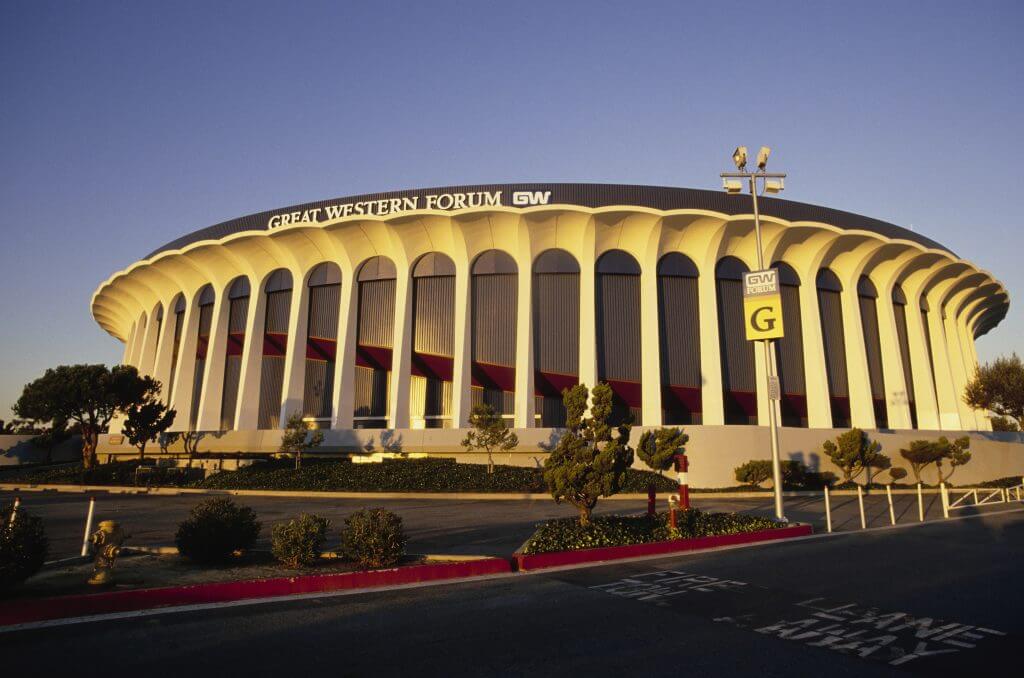
The Forum was quite a sight from the outside. (Rick Stewart / Allsport / Getty Images)
Joe Louis Arena’s bouncy boards
Detroit Red Wings (1979-2017)
The Red Wings can claim two famous former homes. “The Joe” followed Olympia Stadium, and it was constructed in just more than two years. (Perhaps such a short time frame is how a press box was omitted; legend had it that the architect simply forgot.) The boards were always bouncy, with pucks seemingly to be slung off them compared to other arenas. It wasn’t until the Red Wings finally gave captain Steve Yzerman a contending roster in the mid-1990s that Joe Louis Arena’s boards became legendary as a home-ice advantage. The Red Wings created chances because their players were familiar with how the puck would propel off the boards.
Maple Leaf Gardens’ penalty boxes, gondola
Toronto Maple Leafs (1931-99)
Considered, along with the Montreal Forum, as one of hockey’s cathedrals, Maple Leaf Gardens was the first arena to construct penalty boxes for each team. The boxes were installed in 1963 after a major fight between the Maple Leafs’ Bob Pulford and the Canadiens’ Terry Harper. Another famous feature was the gondola that hung until 1979, when it was torn down to make room for private boxes. This caused controversy, as the gondola was where legendary Canadian broadcaster Foster Hewitt regularly called games for “Hockey Night in Canada.”
Metropolitan Sports Center’s mismatched seats
Minnesota North Stars (1967-93)
Later shortened to “Met Center,” this arena in Bloomington, Minn., was home to the North Stars before their relocation to Dallas. Players loved the ice surface, which rivaled that in Edmonton’s Northlands Coliseum, for the unofficial title of NHL’s fastest ice. The North Stars were rarely good enough to take advantage. Though when they did make deep postseason runs — including Stanley Cup Final losses in 1981 and 1991 — fans watching on TV were treated to repeat viewings of the peculiar pattern among the arena’s seats. Colored white, black, yellow and green, the seats appeared to be randomly placed throughout the arena. That’s because, apparently, they were.
Montreal Forum’s open benches
Montreal Maroons, Montreal Canadiens (1924-96)
With an unrivaled history, the Montreal Forum was home to many of the NHL’s greatest teams, players and personnel. It was essentially the unofficial home rink of the Stanley Cup Final throughout the 1970s. And Canadiens superstar goalie Patrick Roy called attention to the building’s standout quirk. There was no glass behind the benches to separate spectators from players and coaches, providing the Forum with unmatched intimacy in terms of closeness to the action.
Had there been glass behind the benches, Roy would have had to climb it to reach Canadiens president Ronald Corey in 1995, when Roy was furious for hearing sarcastic cheers and being left in the game during a blowout loss to the Red Wings. The Canadiens trailed 9-1 when Roy was finally pulled from the game by his rookie coach, Mario Tremblay. Agitated while seated near Tremblay, Roy walked past the coach multiple times before finally leaning into the stands and telling Corey that he had just played his last game with the Canadiens. Four days later, Roy was traded to the Colorado Avalanche.
The Spectrum’s acoustics
Philadelphia Flyers (1967-96)
When it opened, the Spectrum was mockingly referred to as a “tuna can” because of its outward appearance. Then, early in its life, its roof partially collapsed, forcing the Flyers play games in Toronto, Quebec City and New York. It was hardly the best beginning for what would become one of the NHL’s most lively venues. The Flyers’ bullying and their fans’ bloodlust became synonymous with the building. But contributing to the intimidating nature of the Spectrum was its acoustics. Referred to as “America’s Showplace” because rock bands loved the way their music sounded inside, the Spectrum’s circular inner design made it one of the NHL’s most deafening arenas. Rarely was the building louder than when a fight broke out during a Flyers game.
Civic Arena’s steel dome
Pittsburgh Penguins (1967-2010)
Indeed, the Penguins once played in an arena nicknamed “the Igloo” because of the Civic Arena’s stainless steel dome. Perfect, right? The building was the first of its kind, a sports venue with a retractable roof. Why would a hockey arena have a roof that could open within minutes? Well, the Civic Arena was intended for the Pittsburgh Civic Light Opera when it debuted in 1961. The NHL’s expansion into Pittsburgh happened six years later, and the Penguins played in the Civic Arena until 2010. Because it wasn’t built with hockey or even sporting events in mind, the stands were steeply sloped. Fans in the back rows could touch the dome, and that continued whenever new sections were added to the arena.
St. Louis Arena’s roof
St. Louis Blues (1967-94)
Officially known for a time as the “Checkerdome,” the Blues’ first hockey home was a massive structure that rivaled New York’s Madison Square Garden in size. Like the Penguins in Pittsburgh and the Sharks in San Jose, the Blues played in an arena with an unforgettable roof. The one in St. Louis was supported by cantilever steel trusses and consisted of ribs that went together diagonally. It was known as the “Lamella” roof design, which, according to one report, “eliminated the need for large view-obstructing pillars.” As for the “Checkerdome” moniker — that was the name given to St. Louis Arena when Ralston Purina purchased it, and the Blues, in 1977.
The NHL Arena Rankings series is part of a partnership with StubHub. The Athletic maintains full editorial independence. Partners have no control over or input into the reporting or editing process and do not review stories before publication.