
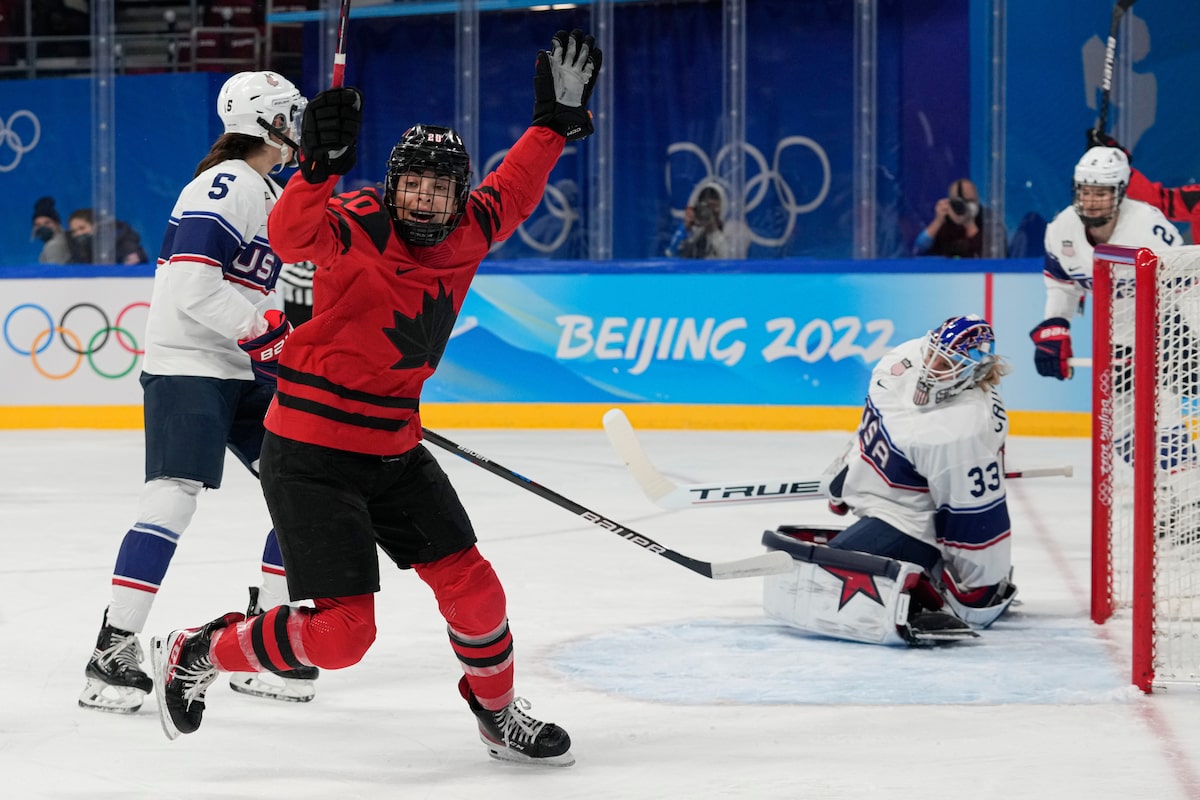
Canada’s Olympic broadcast does an excellent job of showing Canadians our best events, while not losing sight of the Olympics as a global event with intriguing stories from nations around the world, Cathal Kelly writes.Petr David Josek/The Associated Press
The only drawback to being at an Olympics is that it precludes you spending 14 hours a day watching the Olympics on TV.
Over the years, I’ve watched snatches of it in the places where the Olympics are being held, on their domestic broadcasters, and I’m happy to say that we do it as well or better in every case. Less fixated on glamour events. Less starstruck. Less homeristic.
Canadian TV people root for the home team, but they aren’t waving pom-poms as they do so. Our mania for fairness extends even to our romances.
As best I can tell, the Olympics is the only time people watch the CBC in a concentrated way any more. I guess they make shows, but I couldn’t name you one.
But before I leave for Italy, one of the last things on my household to-do list is digging back 18 months in my e-mail to locate the password for CBC Gem. It was wallpaper in our home during Paris 2024, and it’ll get an all-day, every-day, two-week workout for Milan 2026.
North over everything: Canada redefines itself for the middle-power era
Team Canada sizes up the Winter Olympics
The key to a great Olympic broadcast isn’t pathos or jubilation. That’s the mistake broadcasters – American broadcasters, in particular – make. They have to be constantly telling you how much this all matters.
It matters. I can see that because the woman who just won is in shuddering tears, and so is the one who finished fourth. These aren’t tennis-player tears – a faint lip wobble and a hard-to-believe weakening of the knees. This is the real thing.
At the London Olympics, the BBC made a meal of showing several of their on-air analysts going bonkers as Britain’s Mo Farah won a gold medal. It came off as the most scripted unscripted moment in sports television history.
Many pointed out at the time how the BBC lost its mind during those Games, giving up on their famous objectivity and committing fully to national agitprop. That was a harbinger of where things were headed.
Canada’s Piper Gilles and Paul Poirier take part in the figure skating exhibition gala during the Beijing 2022 Winter Olympic Games.MANAN VATSYAYANA/AFP/Getty Images
I’m trying to imagine Brian Williams jumping up and down as Donovan Bailey crosses the line in first. I can’t get there. That’s why Canada loved Brian Williams. He didn’t need to be the star.
This isn’t an NHL game in November. You don’t need to convince me to keep watching. I’m already sold.
A proper Olympics broadcast recognizes that our country isn’t the only one in the world. We matter most, obviously. If you don’t believe that, why care if they win?
But there are other people out there with interesting stories and I’d like to hear those as well. You watch 10 minutes of NBC during a Games and you’d think an Olympics was America vs. America for all the marbles.
Done right, the Olympics on TV provides what no other sporting broadcast can supply any longer – surprising variety.
A CTV staff member works in the Winter Olympics broadcast control room in Vancouver in February, 2010.Rafal Gerszak/The Globe and Mail
When I watch a football game, I know exactly what I’m getting. Football. I can probably guess what everyone’s going to say before, during and afterward, win or lose. The only unexpected thing about the whole experience is the result.
Those sports are the modern equivalent of soap operas – things may change, but glacially. You can drop out for a year and then pick them right back up and understand what’s happening.
They say that sports has value in the oversaturated media landscape because what happens on it cannot be known unless you see it live. I disagree. I think that it’s the soothing predictability of sports that keeps people coming back. In a frightening, shifting world, professional sports promises never to surprise you.
The Olympics is the exception, a confusion of incident.
Who’s this winning the ice dance? What is ice dance? Why is ice dance? Remind me again – in skeleton, are they pointed forwards or backwards? Are the Russians here and are they still bad? What is this guy doing and why is she dressed like that?
You don’t have to have an understanding of every sport at the Olympics to understand what winning in these events means for Canada.Cameron Spencer/Getty Images
We kid ourselves that we understand what’s going on in the sports we watch. We know the rules, which isn’t the same thing. The finer points escape anyone who hasn’t played these games at the highest levels. That’s why Tom Brady sounds so mixed up when he’s explaining what’s happening during an NFL game. He hasn’t yet figured out a way to dumb this down enough that civilians can grasp what he’s talking about.
All but a few of us are faking our understanding of sports, which I love because it is so much like life. It’s pretend, pretend, pretend, then maybe a brief glimmer of true understanding, and then it all fades to black.
At the Olympics, nobody bothers putting on their know-it-all cap. Nobody’s judging you for not understanding the intricacies of figure skating. Sometimes the person who falls down twice wins and that doesn’t make sense, but it’s all right.
What matters is that the people doing it are clearly living and dying every time they leave the ground. That’s compelling.
Ten Canadian athletes to watch at the Olympics
Nobody understands what biathlon is, but everyone understands what it would mean to win at it in the Olympics.
A good Olympic broadcast doesn’t need to tell us all of that. It only need show it to us. Avoid all the talk, talk, talk that dominates other, lesser events. Just let the images breathe.
Thanks to the magic of YouTube and VPNs, we can watch any one of dozens of Olympic broadcasts. When I do, I’ll watch Canada’s contribution. In part, because of the Canadians.
But mostly because we treat the Olympics as they ought to be treated – as a global happening, one that transcends winners and losers, even sport itself, to show us what it is like to be alive and in the mix in this precise moment in time.
Fans celebrate at Vancouver’s Library Square Public House in February, 2014, as the Canadian Olympic men’s hockey team scores against Sweden in the gold medal game at the Sochi Winter Olympics.DARRYL DYCK/The Canadian Press