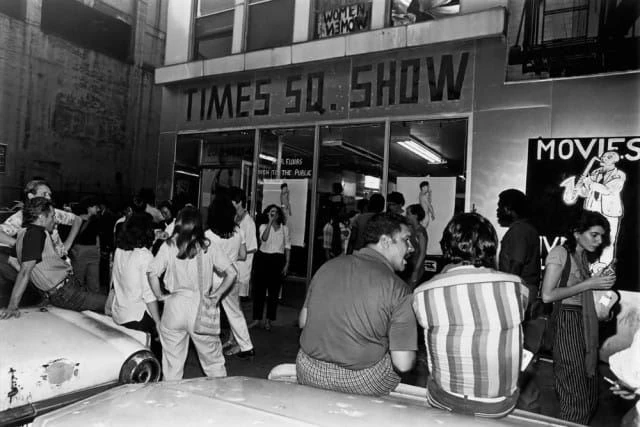
 Photo of the “Times Square Show” by Terise Slotkin, June 1980.
Artforum critic Richard Pincus-Witten visited the Times Square Show on June 25th, 1980. In his journal he described what he saw: “Four floors of extravagant bad taste, which is of course, already codified and imitated – in short, its own good taste. Black artists … graffitists galore, neo-Feminists inquiring after bondage porn. Pleated fans depicting penetration, moving sex tales coupled with explicit anecdotes of all kinds; in short, the resolute antithesis of any high art notion associated with Formalism…” This was mess and madness, a phantasmagoria of art and “art” that stuck its middle finger up at art world institutions and those who more easily found passage into their exhibition spaces. This was creative expression forged in underground clubs and social activist spaces; this was about the collective, not the individual. While the show is now, rather ironically, ensconced in the art historical narrative, and many of its artists were eventually welcomed into the highest echelons of the art world, this wasn’t the plan and it wasn’t the point. Let’s look back at this remarkable show with its “unrepentant raunch” (Pincus-Witten again) and see how it came to be, what it had to say, and what it all meant.
The Planning
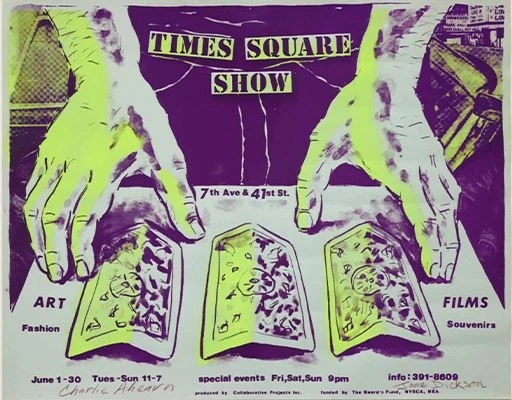
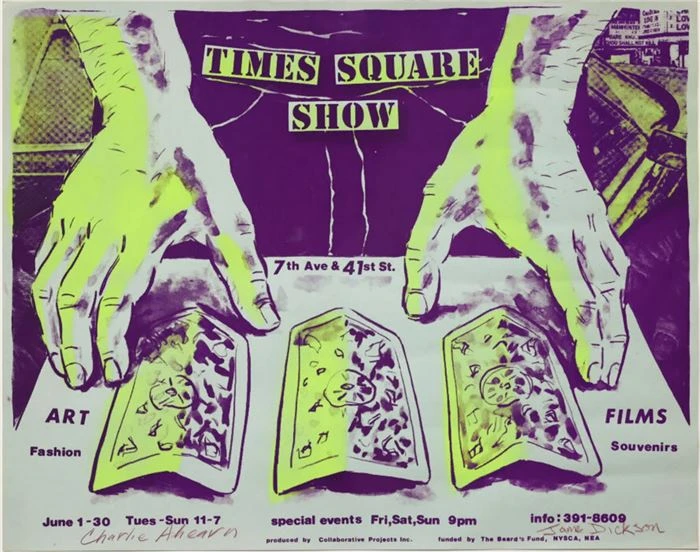 Charlie Ahearn and Jane Dickson, advertisement for the show, 1980.
Organized by the artist-run group Collaborative Projects, or Colab, the Times Square Show was meant to bring together artists from all mediums, all backgrounds, all creative and philosophical persuasions. Colab had already successfully organized a group show that year with the Real Estate Show, but the scope of this new endeavor was much wider.
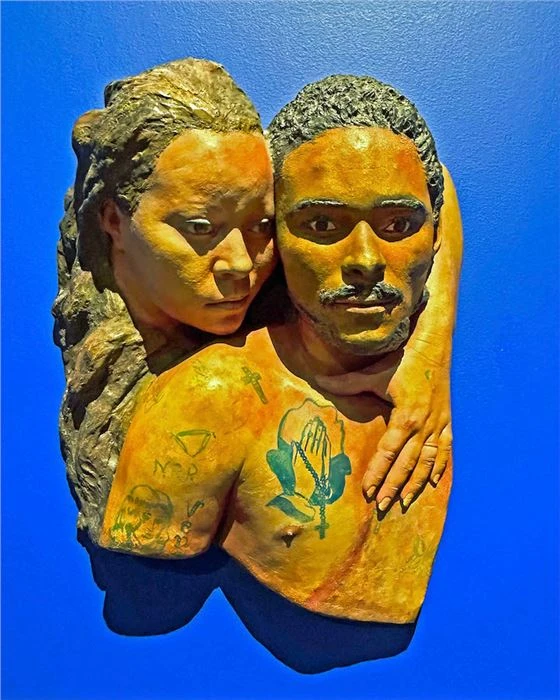
Over one hundred artists (the official number still isn’t known) agreed to show their work, many of them soon to be art world darlings – Jenny Holzer, Kenny Scharf, Nan Goldin, Jean-Michel Basquiat (showing as SAMO), and Kiki Smith, among others – but the individual was less important than the collective. Colab member John Ahearn stated that people often thought “that art belongs to a certain class or intelligence [and] this show proves there are no classes in art, no differentiation.” Coleen Fitzgerald agreed, remembering that “Basically it was open to anyone. It was sort of like taking all your cards and throwing them up in the air to see where they would fall.”
Colab chose an abandoned four-story building on 41st and 7th Avenue, which was right at the crossroads of the city – Times Square. The neighborhood in the late 1970s was on the precipice of gentrification, its porn theaters, video stores, prostitutes, and drug users already starting to be pushed out by the Koch administration’s redevelopment effort to “clean up” this part of the city and thus appeal to corporations and tourists. Tellingly, the building that housed the show had once been a massage parlor, a nod to the neighborhood’s tawdry past. Organizer and artist Tom Otterness said they were trying to “pull art out of the gallery and into the street,” and that since they were “trying to communicate with the public,” locating the show in Times Square was the best way to “talk about the underbelly of culture.” Critic Lucy Lippard commented that while the show “was ostensibly about Times Square – that is about sex and money and violence and human degradation,” it was also about “artists banding together as pseudo-terrorists and identifying with the denizens of this chosen locale.”
SEE ALL ARTWORKS FOR SALE BY JEAN-MICHEL BASQUIAT
The Show
It is impossible to analyze, or even list out, every work of art in the show, a show that billed itself not in conventional terms but as its press release claimed, a site of “human complexity, theatres of love and death, invention and phenomena, a gift shop of original objects, daring performance, comic relief, arcades of fiction, and halls of art from the future – all beyond the horizon of your imagination.” Instead, we will look at a handful of works in detail in order to give a sense of what the art on display was concerned with.
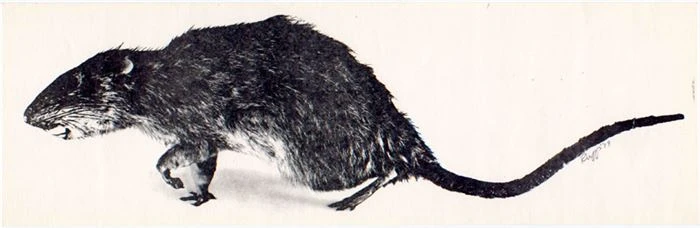 Christy Rupp, Rat poster 1979.
Christy Rupp’s Rat Patrol featured the rodent – then even more than now a scourge of the city, especially due to the 1979 garbage strike – screen-printed in a seemingly endless line on thin, horizontal bands of paper that in the show were affixed to stairwells and walls (prior to the show she had also posted some of these on walls and fences throughout the city). They were also accompanied occasionally by life-size concrete rat statues, connoting the “contamination” of the indoor space by the denizens of the outdoors and asking viewers to ruminate on their own role in the ecosystem of the city.