
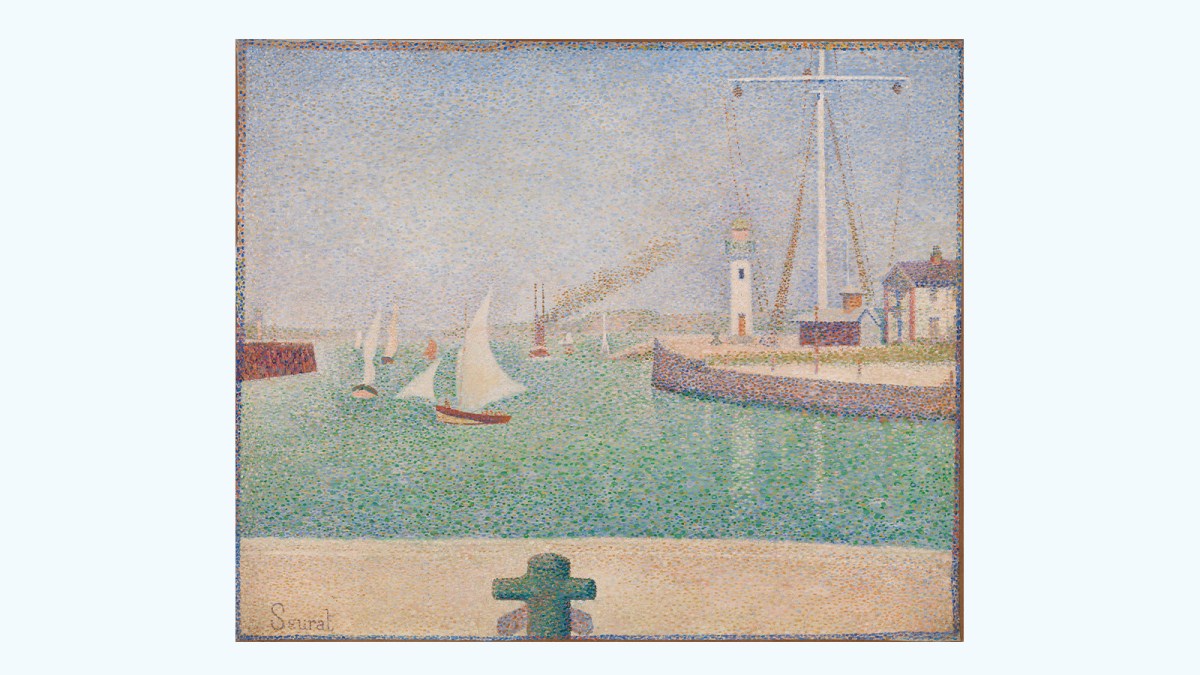
Divisionism split the critics from the beginning. What was the point of those dots, those spots, that plague of pictures with the pox? To eyes that had only just got used to the looseness of impressionism — and the critics had hated that, too, at the start — divisionism, pointillism, neo-impressionism, whatever you wanted to call this new technique of painting with thousands of dots of pure, unmixed colour, seemed a new artistic perversion. Georges Seurat was the ring-leader. Others — Paul Signac, Jan Toorop, Anna Boch — followed.
Their canvases, the critics complained, were made with “artillery and confetti”. The artists were “bubonistes” or spreaders of plague. A cartoonist sent up their pictures as mere punctuation, a collection of “full-stops, commas and semicolons”.
Writing of Seurat’s latest sally, one critic wrote: “We cannot abide his Sunday at La Grande Jatte, which is crude in tone and in which the figures are cut out like poorly made mannequins.” Another dismissed La Grande Jatte as “a flat imitation of Kate Greenaway”. To be likened to Greenaway, an illustrator of a pretty-pretty never-neverland of beribboned children, was bad enough, but to be flatter than flat Greenaway was the pits.

La Maria at Honfleur, 1886
NATIONAL GALLERY PRAGUE 2025
Another critic, the influential Joris-Karl Huysmans, thought the holidaymakers in La Grand Jatte “rigid and hard” and the whole composition “immobile and frozen’’. Even Seurat’s fellow painters stuck their oar in. The impressionist Camille Pissarro accused Seurat and Signac of “a frozenness” that he found “unpleasant”. Seurat, who had taken out a subscription to a press clippings service, kept all his reviews, good and bad.
• The best art, music and cultural events this week — the critics’ guide
While not being quite in the buboniste camp, I confess that I have generally found the neo-impressionists easy to admire (the discipline, the spirit of experiment, the light), but difficult to love (the stiffness, the fixity, the painstaking pernicketiness of it all). Loosen up, chaps. Chill out. Let it go.
An exhibition at the Courtauld promises to convert me. Seurat and the Sea is the first to be devoted to the artist in Britain in almost 30 years and the first anywhere to concentrate on his seascapes. Seurat painted more pictures of the sea and the Channel coast than any other subject and the exhibition will bring together the largest group of seascapes yet assembled: 17 paintings — Seurat painted 24 “marines”, so this is a mighty haul — and eight sketches.
The Courtauld has a knack for this sort of exhibition: small, focused, illuminating, set over two rooms and inviting close looking. (How my heart sinks when a press release trumpets “over 300 objects…”) In recent years, the gallery has given us Van Gogh’s self-portraits, Frank Auerbach’s charcoal heads, Monet’s views of the Thames and, most recently, Wayne Thiebaud’s chiller cabinets and lemon meringue pies. Winners all.
Seurat and the Sea draws on works from across the artist’s five summer painting campaigns on the Normandy coast. First in the small fishing village of Grandcamp (1885), then in Honfleur (1886), Port-en-Bessin (1888), Le Crotoy (1889) and Gravelines (1890).
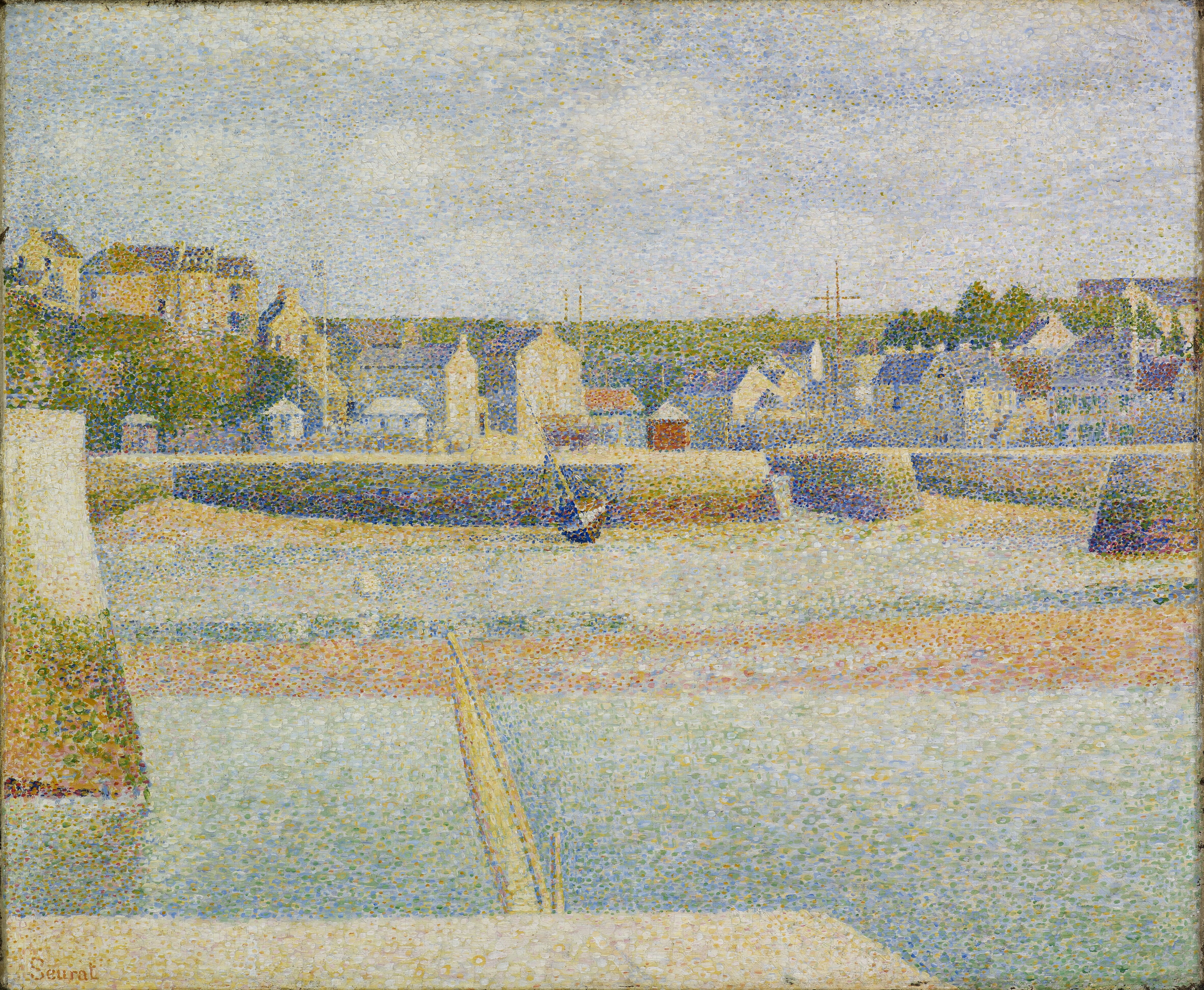
Port-en-Bessin: The Outer Harbor (Low Tide), 1888
SAINT LOUIS ART MUSEUM
No one could accuse the figures in these paintings of stiffness — there is none. The railway line between Paris and Normandy may have opened in 1850, but, with the exception of Honfleur, which was already a resort of sorts, the other ports were little visited. In La Grande Jatte, the Seine is rather secondary to the sunbathers and pleasure-seekers. In the seascapes, there isn’t a top hat or parasol in sight.
Squint at The Shore at Bas-Butin (Honfleur) and you’ll see a suggestion of a person on the sands and another further on that might be his dog. There are specks and their shadows on the beach in Le Crotoy (Downstream) that you can just about make out as an adult and child, a couple, solitary walkers here and there.
• Read more art reviews, guides and interviews
Three indistinct figures pass across the canvas of Port-en-Bessin — The Bridge and the Quays, but this is as busy as Seurat’s seascapes get. He gives more attention to the marine mooring bollard in The Maria (Honfleur) and the anchors in The Channel of Gravelines: An Evening.
These aren’t promenade paintings and there’s no interest in the city’s flâneurs en vacances. Seurat’s subjects are resolutely the sea, the sky, the almost magically transformative power of strong sun beating on water or sinking, spent, below the horizon, turning the harbour to embers.
Seurat’s career was short. He was born in Paris in 1859 to comfortably bourgeois parents. He studied at the École des Beaux Arts, served a year of military service and exhibited his first work — a portrait in Conté crayon — at the Salon in 1883 at the age of 23.
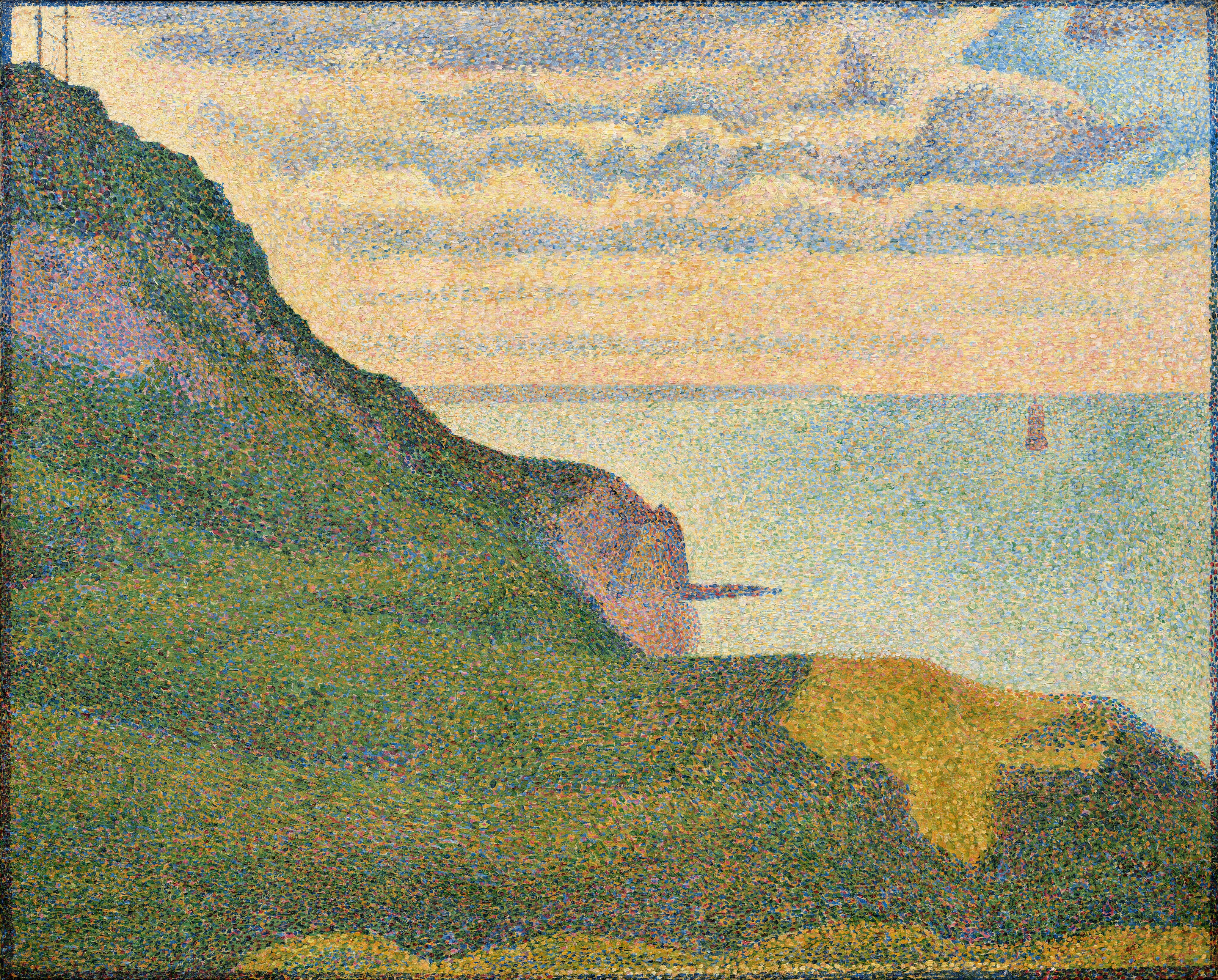
Seascape at Port-en-Bessin Normandy, 1888
NATIONAL GALLERY OF ART WASHINGTON D.C
When he died on March 29, 1891, aged 31, of pneumonia or meningitis or possibly diphtheria, he left behind fewer than 50 paintings. The most famous are the two monumental canvases A Sunday on La Grande Jatte, which is in the Chicago Institute of Art, and Bathers at Asnières, in the National Gallery in London.
If you’re a musical enthusiast, you’ll know La Grande Jatte as the inspiration for the Stephen Sondheim musical Sunday in the Park with George. A revival is coming to the Barbican next year with theWicked co-stars Jonathan Bailey as George (the Seurat figure) and Ariana Grande as the artist’s model and mistress called — what else? — Dot.
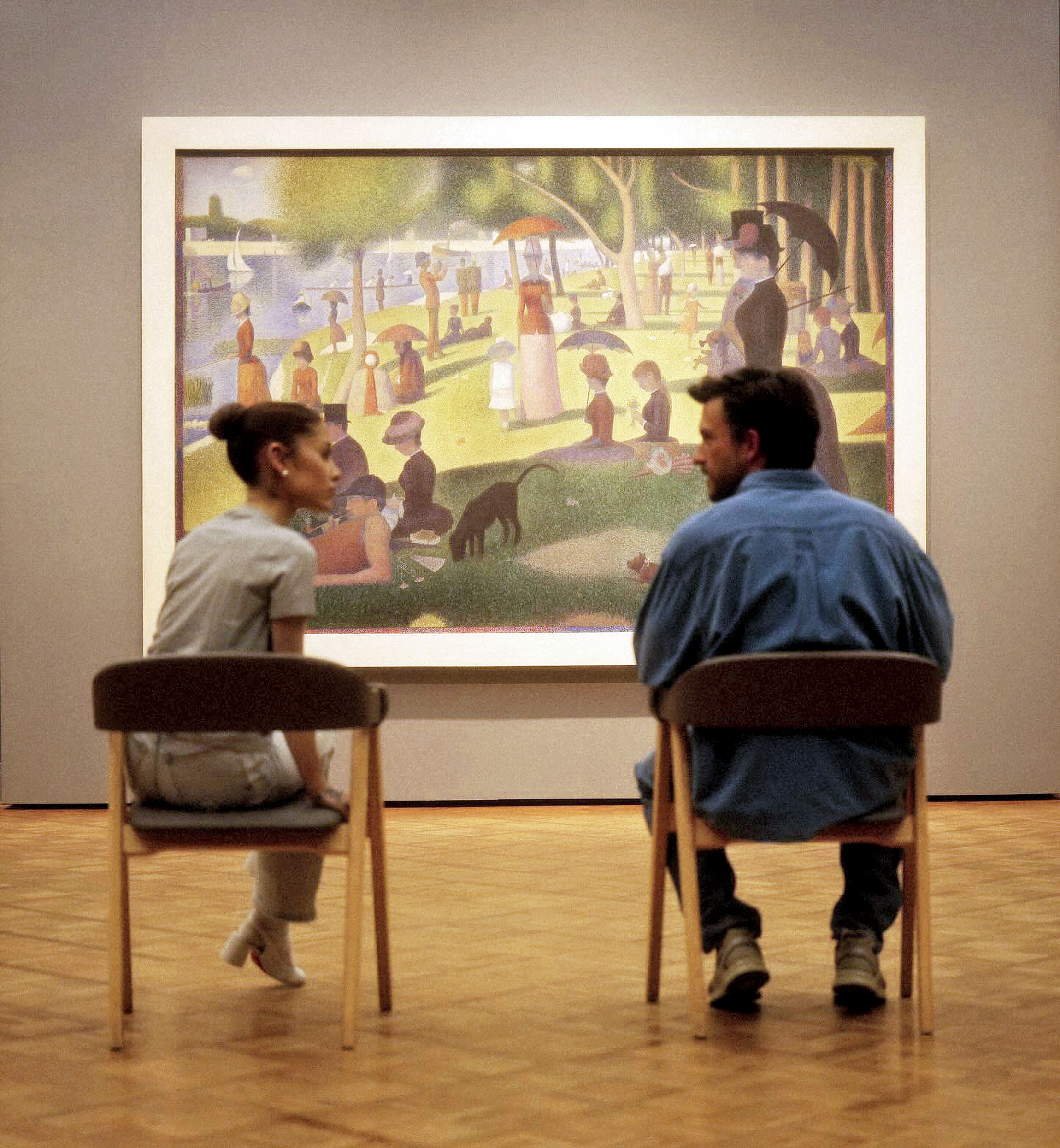
Ariana Grande and Jonathan Bailey in front of La Grande Jatte
You might also know Seurat’s city pictures, his scenes of modern life: the circus, the nightclub, sawdust, stage lights, after-dark high-jinks. If you caught the National Gallery’s recent neo-impressionists show Radical Harmony, you’ll have seen Seurat’s Chahut, with its line of can-can dancers.
These monumental toiles de luttes or “battle canvases” were manifestos in paint. The impressionists had mixed their colours on the palette; Seurat believed that “optical fusion” was the way to create truly luminous painting. Separate dots of unmixed, but often complementary colours, would be applied side by side, then “mixed” by the eye.
Such was Seurat’s commitment to the dot that he signed his name in dotted letters and let the spots spill out over borders and frames. He called his technique “chromoluminarism”. It didn’t catch on. But neo-impressionism, pointillism and divisionism did.
Signac would write that while the impressionist technique was born of “instinct and inspiration”, the neo-impressionists were “methodical and scientific’’. Sometimes, particularly in the hands of lesser followers, the method became a straitjacket, but in Seurat’s seascapes, pointillism takes wing and, like the gulls at Grandchamp, soars.
Seurat told the poet Émile Verhaeren that he spent the winters on his battle canvases. The summer was a time for “cleansing one’s eyes of the days spent in the studio and translating as accurately as possible the bright light, in all its nuances.”
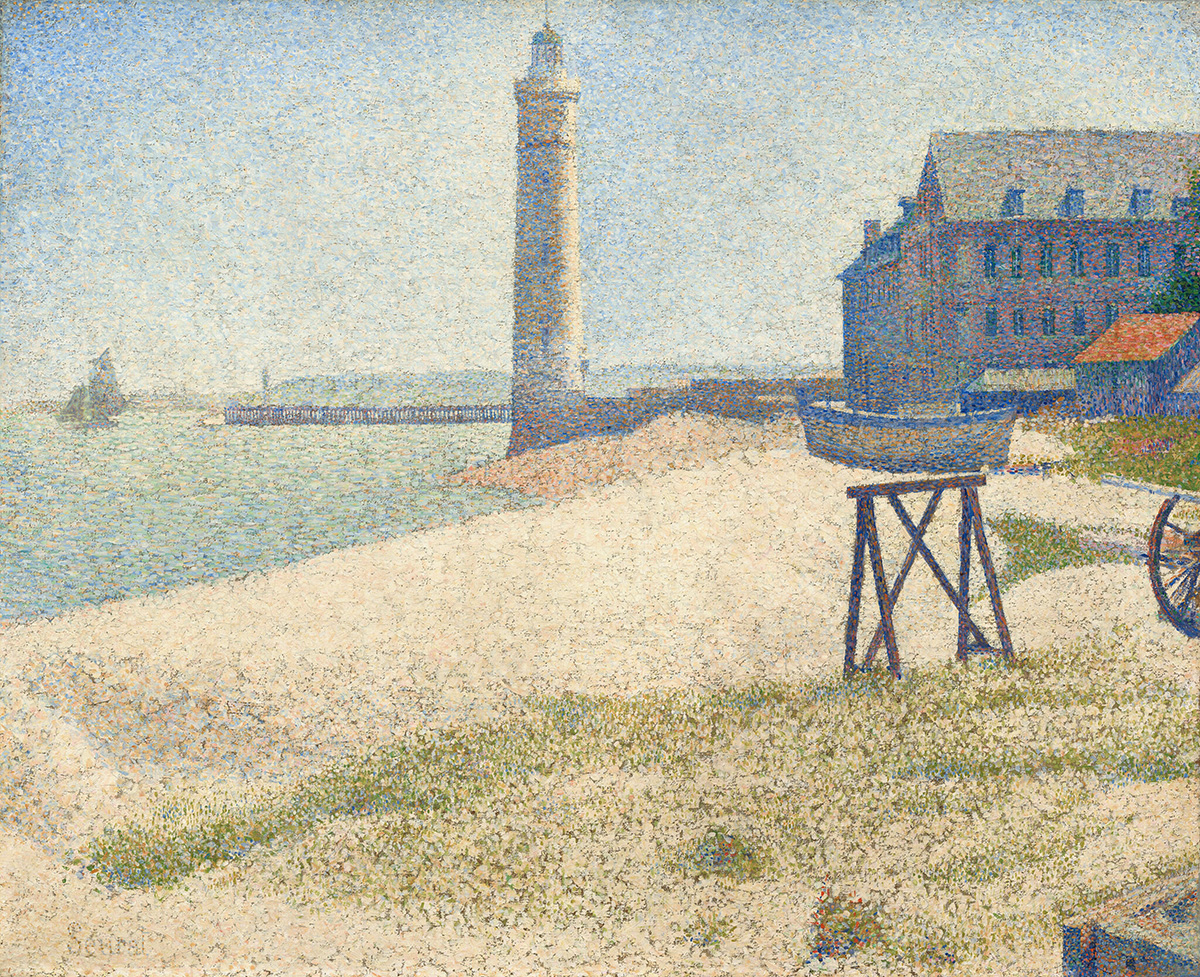
The Lighthouse at Honfleur, 1886
COLLECTION OF MR AND MRS PAUL MELLON NATIONAL GALLERY OF ART WASHINGTON D.C
He made oil sketches on the beach, on the cliffs and on the gorse, before tackling his canvases “in earnest’’. He travelled with a boîte a pouce, a small painting box with a little palette, paint tubes and turpentine, with an opening that allowed the box to be supported on a thumb (pouce). Grains of sand have been found in Seurat’s sketches, although the paintings proper were worked up in lodgings or in the studio.
From Honfleur in 1886, Seurat wrote to Signac: “The wind and therefore the clouds have bothered me these past few days… What else can I say? Well, that’s it for today, let us get drunk on light once again, it’s a consolation.”
The critic who had found La Grande Jatte so crude, was (guardedly) charmed by the seascapes. “Although the pointillist technique still seems too apparent to me, there is a vibration of light, a richness of colour in the shadows imbued with light, a soft and poetic harmony, something milky and flowery that voluptuously strokes the eye.” These are heady words.
The city battle paintings were hard won. As you look, you feel the labour. In the seascapes, there is a new accord between technique and effect: a slight loosening of the collar, a responsiveness to the stir of the wind. When Signac saw the seascapes from Crotoy in Seurat’s mother’s rooms three years after her son’s death, he was awestruck. “All the awkward aspects of the craft disappear — and only the benefit of light and harmony remains. I believe that the soft light of an apartment is very favourable to this type of painting, which does not need bright light since it creates its own.”
Seurat and the Sea arrives at the Courtauld at the end of a long, grey winter. There could be no greater contrast between the driving rain outside my window and the shimmering seas in the catalogue open on my desk. Book tickets. Cast off your preconceptions. Let the light in.
Seurat and the Sea is at the Courtauld Gallery, London, Feb 13 to May 17 (courtauld.ac.uk). Times+ members can enjoy two-for-one tickets to Seurat and the Sea. Visit thetimes.com/timesplus for more information