

For decades, scientists have suspected the presence of a magnetic field that holds the Milky Way together, but only now has the detailed structure of this invisible force come into focus. A new study using radio waves has unveiled how the galaxy’s magnetic field twists and turns, providing crucial insights into the forces that shape our galaxy’s future.
The discovery is the result of a comprehensive mapping project led by Dr. Jo-Anne Brown, a physicist and astronomy professor at the University of Calgary. By using advanced radio telescopes, her team has gathered new data that helps map the structure and changes in the Milky Way’s magnetic field. This groundbreaking research offers a new model for understanding how the galaxy’s invisible forces affect its evolution.
Unlocking the Milky Way’s Magnetic Structure
Scientists have long known that the Milky Way’s magnetic field plays an essential role in preventing the galaxy from collapsing. Without it, gravity would cause gas and dust to fall inward, potentially tearing apart the galaxy. However, what remained unclear was the exact shape and behavior of this magnetic field.
According to Dr. Jo-Anne Brown, the purpose of this research is to create accurate models that predict how the magnetic field will evolve over time. The team’s work is based on data gathered from the Global Magneto-Ionic Medium Survey (GMIMS), a project focused on how magnetic fields interact with the charged particles spread throughout the galaxy. This data allowed scientists to map the magnetic structure of the Milky Way in remarkable detail.
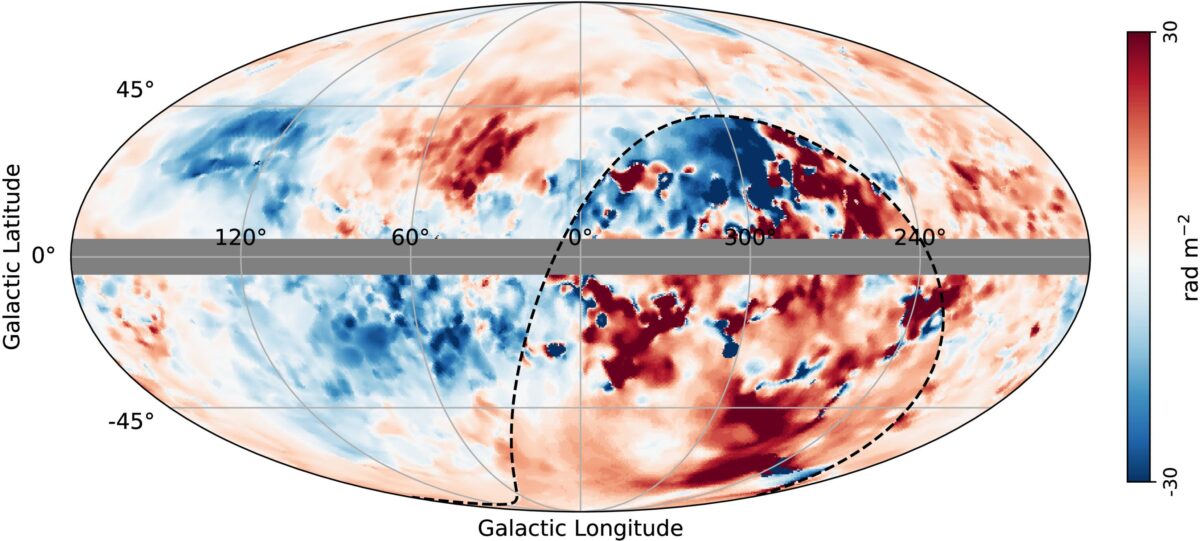 This map shows the intensity of the Milky Way’s magnetic field, with variations in red and blue indicating different strengths. Credit: The Astrophysical Journal
Radio Waves Illuminate Galactic Forces
To capture the data needed to map the magnetic field, the team used a radio telescope at the Dominion Radio Astrophysical Observatory in British Columbia. The telescope detects subtle changes in radio waves caused by magnetic fields, revealing crucial information about the structure of space itself. These findings, published in The Astrophysical Journal, come from a method called Faraday rotation, which occurs when radio waves pass through magnetic fields and clouds of electrons.
“Faraday rotation is similar to how light bends when it passes through a glass of water,” said Rebecca Booth, a PhD candidate and lead author of the second study, explaining how the team traced the field’s direction.
This technique allowed the team to track the shifts in the galaxy’s magnetic field and determine its precise orientation across different regions.
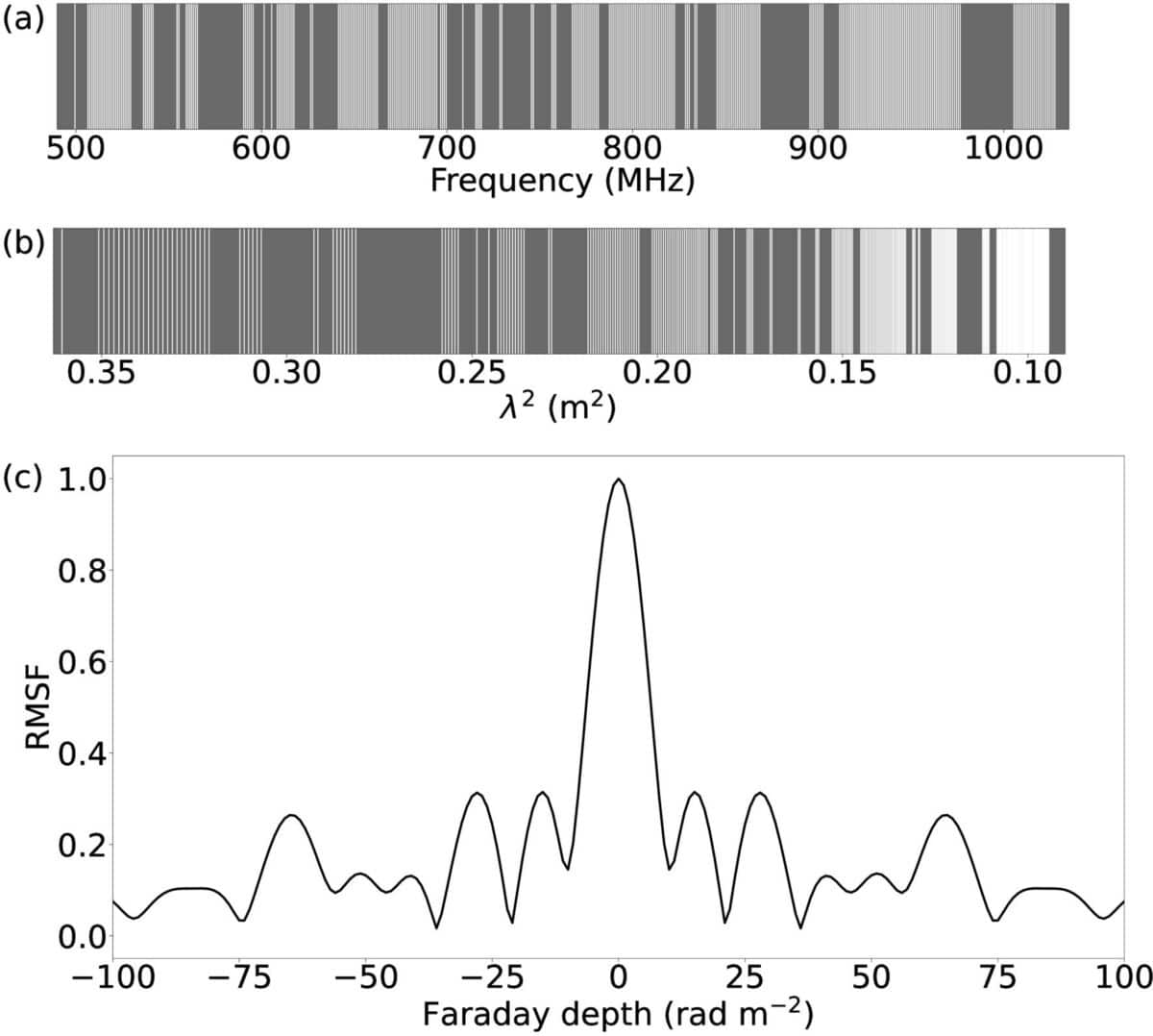 This image shows Faraday rotation data, with frequency and wavelength variations in (a) and (b), and RMSF vs. Faraday depth in (c). Credit: The Astrophysical Journal
The Surprising Magnetic Flip in the Sagittarius Arm
One of the most unexpected findings in the study came from the Sagittarius Arm of the Milky Way. In most of the galaxy, the magnetic field flows in a clockwise direction, but in the Sagittarius Arm, it flows counterclockwise. This flip was not only surprising, but its transition was far more complex than researchers initially expected.
Dr. Brown and her team discovered that the flip happens diagonally across the galaxy, a pattern previously unseen in earlier models. Booth’s new 3D model of this phenomenon shows how the magnetic field reverses within the Sagittarius Arm. This discovery has added a new layer of complexity to how scientists understand the Milky Way’s magnetic structure.