
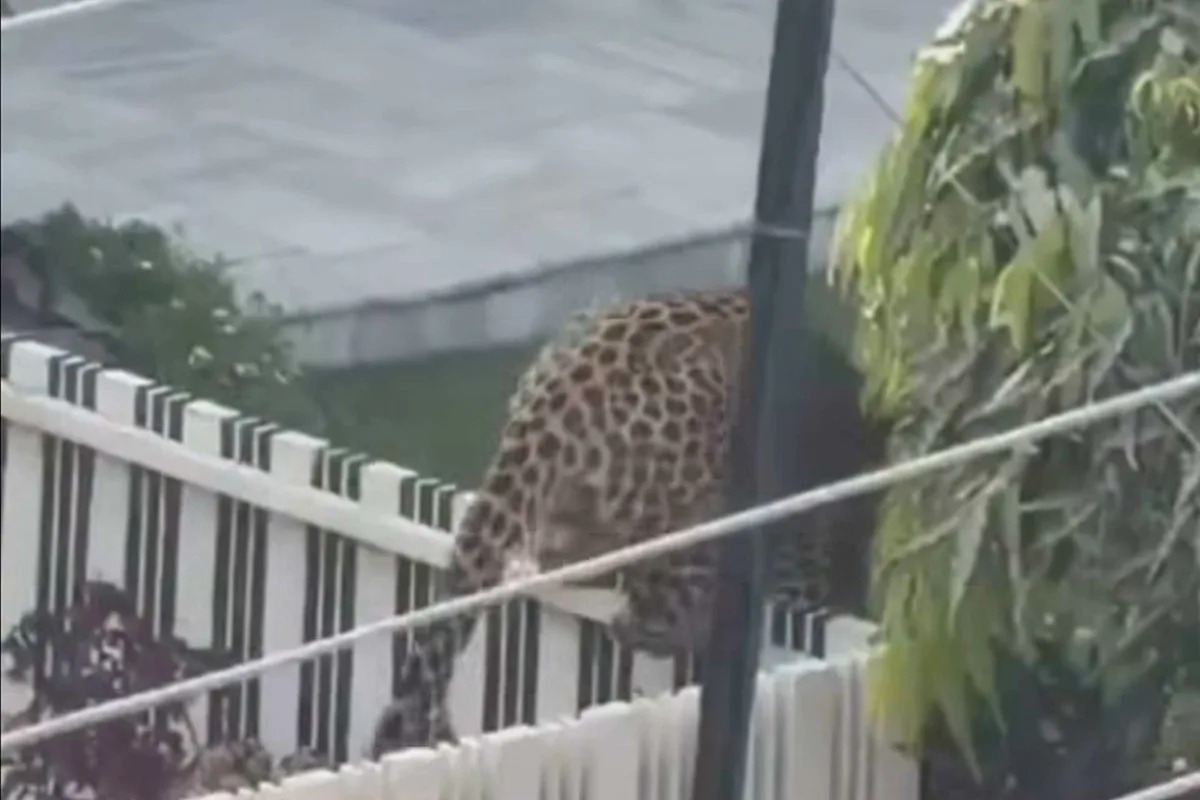
In late December, a leopard was spotted in Panchkula, an upscale city in northern India, prompting panic among residents.
What happened?
As The Indian Express reported, the wild animal was initially observed in Sector 6, a residential area that also includes the police headquarters and government buildings.
It wandered from house to house, stopping near the home of former chief of the army staff General V. P. Malik.
The Tribune reported that after receiving information on the leopard’s whereabouts, the Wildlife Department dispatched teams to contain the animal.
It was last seen in an under-construction building, but when officials attempted to capture it, the leopard escaped into the nearby forest outside Chandimandir.
Authorities alerted other sectors and closely monitored the adjacent areas of Mansa Devi and Majri. The forest and local police departments have increased overall surveillance and are using CCTV footage and drones to track the leopard.
“The use of the drone is expected to assist in monitoring the leopard’s movements and facilitate a safer rescue operation,” a police officer told the Indian Express.
Why is the leopard sighting concerning?
This was the second leopard sighting in the area in just one week, with the first occurring one day earlier in Dabla village, located in the nearby Morni Hills.
The Hindustan Times reported that a homeowner was awakened by their dog’s frantic barking at a leopard in the courtyard, but, thankfully, they were able to scare it off.
Wildlife inspector Surjeet Singh told the Times that leopards are attracted to human settlements because of easy access to food sources, and the rapid deforestation near Panchkula is likely driving them to seek food more often.
Human activities, such as agriculture, infrastructure, and housing development, as well as illegal tree felling in the area, are shrinking the forests that leopards depend on for survival, increasing the risk of human-wildlife conflict.
A booming leopard population may also be to blame for the increased sightings near homes, as Rajender Prasad, Panchkula’s divisional wildlife officer, said their numbers have increased by nearly one-third from former estimates, per the Times.
What’s being done to protect residents?
According to The Times of India, authorities hadn’t yet captured the animal as of January 2 and believed it was still roaming near residential areas.
Police forces patrolled and monitored areas adjacent to the forest to prevent further human-wildlife encounters and ensure public safety.
Residents were advised to remain vigilant, stay indoors at night, and report any further sightings to the police or forest departments.
The forest department and conservation groups, such as WWF India and Wildlife SOS, are working to foster coexistence between leopards and humans through habitat management, anti-poaching efforts, and public awareness campaigns among villagers.
Scientists have also used camera collars to learn more about how wild leopards live to improve safety measures.
With leopard sightings on the rise throughout India, residents can help protect the public and encourage conservation by donating to local wildlife organizations.
Get TCD’s free newsletters for easy tips to save more, waste less, and make smarter choices — and earn up to $5,000 toward clean upgrades in TCD’s exclusive Rewards Club.