
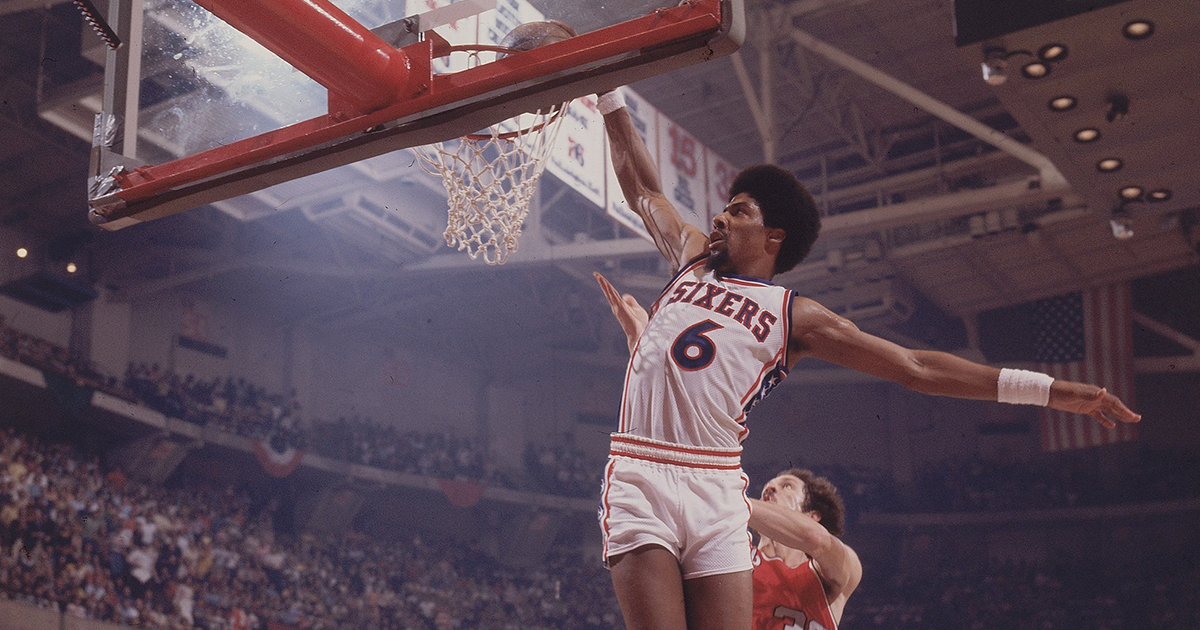
In an excerpt from the forthcoming Moses and The Doctor, author Luke Epplin explores everything that went wrong for the Sixers — and how the stakes were much higher than what happened on the court.
Get a compelling long read and must-have lifestyle tips in your inbox every Sunday morning — great with coffee!
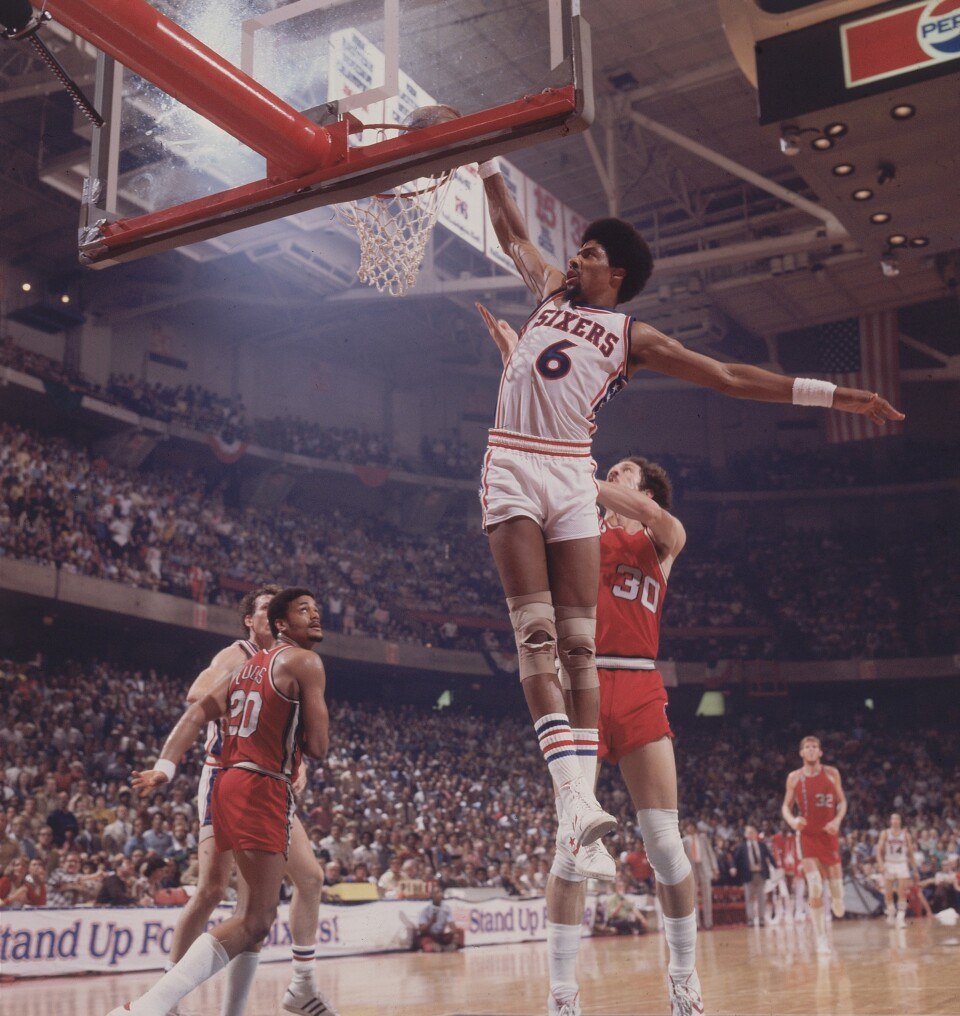
Philadelphia 76ers Julius Erving in action, making a dunk versus the Portland Trail Blazers in Game 2 of the NBA Finals (Philadelphia; May 26, 1977) / Photograph by James Drake/Sports Illustrated via Getty Images
The 1977 NBA season was the first season following the league’s merger with its upstart cousin, the American Basketball Association. With the merger came new players, most notably Julius Erving, who joined the Philadelphia 76ers. Buoyed by Erving and teammates George McGinnis and Doug Collins, the team posted the best record in the Eastern Conference and eventually made its way to the NBA Finals against the Bill Walton-led Portland Trail Blazers.
In this excerpt from the new book Moses and the Doctor, out next Tuesday, author Luke Epplin delves into the 1977 Finals and its racial and societal implications for the country at large.
Epplin will be in town next Tuesday, February 10th, at the Rittenhouse location of Barnes and Noble to talk about his new book with Philadelphia magazine executive editor Bradford Pearson. Tickets are available here.
Shortly before noon on May 21, the day before the 1977 NBA Finals began, the Philadelphia 76ers sauntered into practice loose and relaxed, looking no more troubled than if prepping to face a pedestrian opponent at midseason. Their outfits were as dissimilar as their personalities, a wash of styles and colors. Making it to basketball’s biggest stage hadn’t changed them. They warmed up as they always had: by lofting balls skyward from halfcourt. “We’ve been consistent all season. Consistently unpredictable,” Julius Erving explained. “We are not a blackboard team. I don’t know whether we could have gotten this far if we were. We’ve never believed in orderly practices or doing things by the book.”
Their opponents, the Portland Trail Blazers, had just wrapped up a workout that had unfolded with the precision of a symphony orchestra. In the eyes of Bill Livingston, a sportswriter for The Philadelphia Inquirer, Blazers practices were an “incredible study in intensity and enthusiasm.” Head coach Jack Ramsay, a whistle dangling around his neck, fronted the opening calisthenics himself — a conductor warming up his talent. When the whistle blew, Ramsay demanded absolute attention: no dribbling, no shooting, no ball spinning. Brooking little dissent, he placed his utmost faith in the painstakingly composed offensive and defensive schemes that he expected his squad to execute with minimal deviation. “The players,” Ramsay insisted, “are the medium through which the coach expresses his philosophy. The artist must be in control of his medium, and a coach must prepare his players for their performance.” Blazers guard Lionel Hollins said the team “ran the system so well that it became part of our DNA. We practiced and practiced and went over the same things. Jack [Ramsay] was so detail-oriented. He taught us that details matter.”
Basketball fundamentalists who were uncomfortable with the creeping influence of streetball viewed the Finals matchup as a morality play that pitted two distinct styles against each other: playground versus playbook, freelance versus structure, individual versus team. The Sixers were painted as outlaws, a stormy band of malcontents slapped together by an owner with bottomless coffers and capable of overpowering opponents with extraordinary one-on-one talent. Philadelphia Inquirer columnist Bill Lyon later characterized them as “a non-team for whom passes were something you reserved for your friends at the guest gate.” The Trail Blazers, in contrast, were hailed as purists, selfless practitioners of patterned play and off-the-ball movement. “Teamwork,” Hollins said, “is preached so much that when one of us turns an ankle, we all limp.” For some, the stakes were existential. “Basketball will be set back fifty years if the 76ers ever win,” one unnamed fan declared.
Bleeding through it all was another binary: Black versus white. Race had been baked into mainstream coverage of the 76ers all season long. Rather than lauding the faster, freer, more expressive brand of basketball that had propelled the Sixers into the championship round, the press pathologized it in terms that white Americans often ascribed to the Black inner city: disorderly, brash, unruly, authority-averse. Articles about the club oozed with racially tinged condescension. The cure for the squabbling Sixers, a writer for The Sporting News declared, was “teamwork, character, and a little humility” — in other words, less playground, more deference. The 76ers were an object of both fascination and derision, at once an unmissable spectacle and an emblem of a troubled league that had gotten too Black too fast for its fans’ taste. Reporters fixated on markers of the players’ wealth — their Mercedes and colorful clothes and six-figure contracts — as a means of calling out their lack of hustle, their perceived unwillingness to sully their hands with the dirty work that wins titles. “All season, we’ve been the millionaires in our tuxedoes out there and the other team was carrying its lunch pails,” said Doug Collins, the team’s lone white starter. George McGinnis put it more bluntly: “I think most of white America thought of us as a bunch of bigmouth, cocky, high-priced n****rs.”
At the heart of it was Julius Erving — or Dr. J, depending on how the narrative was framed. The gap between Erving and Dr. J had never been wider. More than anyone, Erving had deviated from the Sixers’ me-first ideology, curbing his creative instincts — he averaged eight fewer points than in his final season in the ABA — to such an extent that at one point he’d mused, “When are you going to see the old Dr. J? Maybe never.” Somewhat echoing the media’s criticisms, he spoke frankly of his club’s helter-skelter approach. “Lots of times we run up and down and I don’t know what’s accomplished,” Erving said during the playoffs. “That’s how we play in games. As far as execution goes, we don’t work on it. That’s why our execution suffers. We’re a fast break team. We create as we go along. You can’t practice that.”
At the same time, there was an alternative narrative that centered on Dr. J in the abstract, the spiky-haired, slickly outfitted leader of the league’s foremost Black club. In this telling, Dr. J had abandoned his home out of greed and latched onto a superteam that closely resembled the outlaw league he’d hailed from. As a result, the stigma of the ABA along with its accompanying racial baggage clung to Erving like an unshakable odor, no matter how much he modeled the team-oriented approach that critics claimed the Sixers lacked.
Erving’s superstar counterpart on the Trail Blazers, Bill Walton, headed into the Finals saddled with baggage of his own. His, however, was spun in wholly different ways. Walton was two people at once: a fundamentally flawless center whose pair of immaculate seasons at UCLA in the early 1970s had thrust him into the national spotlight and a long-haired, tie-dye-clad, left-leaning vegetarian who used to answer his phone “Impeach Nixon,” had been hauled off to jail at an antiwar protest, and had once faced questioning from the FBI about associating with someone connected to the kidnapping of heiress Patty Hearst. “If a black player ever tried any of that stuff, he would’ve been banished from the league,” wrote Darryl Dawkins, cutting to the core of a double standard that cast aspersions on Black players for speaking their minds while affording white players wide latitude.
By 1976–77, his third season in the NBA, Walton had learned to clam up about his off-court endeavors, which garnered him positive profiles of personal growth as he led the league in rebounds and blocked shots. He was a player of such exceptional instincts and vision that he could boost his team without ever putting the ball in the hoop. When Walton was healthy, the Trail Blazers were the best team in the NBA; when he was hurt, they were the second worst.
To his credit, Walton swatted away efforts to portray him as the sport’s “Great White Hope.” But that didn’t stop the media from trying. Too much was on the line to quibble with Walton’s past. In the first postmerger Finals, after the mass injection of ABA talent had scrambled the rhythm and complexion of NBA games, the best shot at reassuring aggravated fans and executives that white team basketball could still triumph over Black expressive individualism flowed through Walton’s club.
•
Before the start of the opening game on May 22, 1977, Sixers fans welcomed the Trail Blazers to Philadelphia by pelting the players with paper cups — a gesture consistent with a city whose fabled brotherly love had never extended to sporting events. The tipoff heralded what was to come. Sixers center Caldwell Jones batted the ball to George McGinnis, who whipped it downcourt to Julius Erving for a one-handed jam. It was the exact sort of crowd-igniting play that the Blazers had been hoping to prevent. Nearly every time Erving caught the ball, three defenders swarmed him. That didn’t stop Erving from exploding for thirty-three points.
In the end, the Blazers netted more rebounds and assists, but the Sixers fired up more shots, which put them over the top, 107–101. Basking in the victory, Erving lobbed some veiled shots at his critics. “I don’t have anything to prove to anyone,” he asserted, adding, “I was trying to be steady, trying to be a factor, not only with my scoring, trying to have a total consciousness of how I could do the best for my team.”
No game more fully captured the beauty and the bedlam of the Sixers than Game Two. For twenty-four minutes, they flew up and down the court with the speed and brute force of a locomotive. By the time the halftime buzzer sounded, the Blazers found themselves down by eighteen. Even though the lead held in the second half, the drama that had destabilized the Sixers all season once again reared its head. Midway through the fourth quarter, Darryl Dawkins tossed Blazers forward Bob Gross to the floor while the two tussled for a rebound. Popping back up, Gross stomped toward him as if to retaliate, and Dawkins threw a wild left hook that missed Gross but nicked his own teammate Doug Collins above the right eye. Maurice Lucas, the Blazers’ self-appointed enforcer, charged across the court and clocked Dawkins on the back of his neck. Taken by surprise, Dawkins whirled around and put up his dukes like a bare-knuckled boxer. Around them, spectators vaulted railings and poured onto the hardwood. Referees pulled the two fighters apart while security guards chased after Philadelphia fans eager to incite a rumble. In the eye of the storm, Erving plopped down at center court, resting his elbows across his knees, waiting for the familiar gust of anarchy to breeze by.
Ejected from the contest, Dawkins stormed into the locker room, incensed not at Gross, Lucas, or the referees but at his teammates for insufficiently jumping to his defense. Awash in rage, Dawkins toppled two floor-to-ceiling lockers, tore apart a metal fan, bent several folding chairs, and ripped a toilet off its concrete base, spraying water all over. Loose shoes were floating across the floor by the time the game ended. As George McGinnis put it, the locker room looked “like a hurricane had hit a junkyard.”
Clad in a fedora and a cream-colored suit, a carnation peeking from the front pocket, Dawkins ranted to reporters about his perceived betrayal. When Pat Williams attempted to calm him down, Dawkins shoved the Sixers general manager. Decades later, Dawkins was still sore. “What was Doc doing when the tussle started?” he asked. “Sitting his ass down on the court and being an eyewitness.” It was an image that resonated almost as much as the scuffle itself. “When Doc sat at halfcourt, it sent a message: ‘I am part of this team, but I’m not going to get involved in something like this.’ I think that it would’ve been a better look if he’d come over and put a hand on Darryl and tried to break it up,” Sixers backup center Harvey Catchings said, adding, “Once that incident happened, it changed the whole dynamic. The fact that your leading guy stepped away and sat down . . . We’re supposed to be a team, and whether you step in or not, you’re part of the visual. That hurt us.”
Whatever good spirits should have trailed the team to Portland dissolved into dysfunction and backbiting. Following the Sixers’ humiliating 129–107 loss in Game Three, Steve Mix and Joe Bryant jawed at each other about playing time in the locker room, then filled the next day’s newspapers with quotes about their feud. Everything fell flat in the fourth game. The Sixers’ slam-dunk extravaganza played to silence during warmups; their vaunted breakneck offense sputtered. They fell behind 19–4 in the first quarter and never recovered. Abandoning his seat with minutes to play and his team down thirty, Sixers owner Fitz Dixon muttered, “A disaster, isn’t it?”
Desperate for a reset, head coach Gene Shue convened a team meeting at a hotel in Cherry Hill, New Jersey. Over beers and cheese, they reviewed film of their back-to-back losses. “I looked around,” Erving later said, “saw a lot of things going in one ear and out the other. Saw guys’ (minds) wandering. Saw guys going to sleep.” Those were the least of the Sixers’ problems. Steve Mix was nursing a severely sprained ankle, Lloyd Free a cracked rib that had collapsed one of his lungs. Hampered by a painful groin pull, George McGinnis was receiving regular injections of cortisone and xylocaine, which numbed his left leg. He fell into such a dire shooting slump that his teammates had taken to yelling “Brick!” whenever he chucked a jumper during shootarounds. Shue was forced to close his practices to the press to avoid embarrassing comparisons to his opponents’ sessions.
For the first time since he’d dragged the New York Nets to the ABA championship the previous season, Erving took matters into his own hands. He sensed that if the Sixers were to regain the momentum, he would need to take “Dr. J out of the closet.” Erving’s command to his teammates was uncharacteristically forceful: “Unless somebody else is going well, here’s where the ball should come.” Over the next two contests, he hoisted a full 30 percent of the Sixers’ shots, piling up thirty-seven points in the fifth game, forty in the sixth. So fervently did Erving attempt to will Philadelphia to the title that one writer claimed he “resembled a guy pulling a locomotive with his teeth.”
In one memorable sequence, Erving fielded an inbounds pass, dribbled through four Blazers defenders, then threw down a vicious one-handed slam over Bill Walton. Before heading back, Erving flicked the ball off Walton’s back — a small playground gesture of one-upmanship. It was Dr. J’s long-awaited national unveiling, the moment when the oral mythology turned visual, putting to bed any remaining uncertainties about whether Erving’s alter ego had been a smoke-and-mirrors apparition, born of a defunct bush league in which “defense” had been a dirty word.
But it wasn’t enough. Exhausted, Erving sucked air on defense, unable to keep pace with Blazers forward Bob Gross. The Blazers swung the ball around the perimeter until Gross, running Erving through multiple screens, shook free for open jumpers. An eleven-point scorer in the regular season, Gross poured in forty-nine total points in the final two contests, both wins for the Blazers. “Who the hell is Bobby Gross?” broadcaster Neil Funk asked Sixers assistant coach Jack McMahon after the Blazers clinched the championship in six games.
“He’s the guy that just kicked our ass,” McMahon retorted.
In reality, it was a group effort. Consistent with Jack Ramsay’s philosophy of sacrificing individual accolades for the collective good, the Trail Blazers reached near parity on offense — all five starters averaged double digits for the series, with none scoring more than twenty points per game. Erving, at thirty per contest, bested the next closest Sixer by eleven points. “What went wrong with the Sixers,” Bill Walton proclaimed amid the celebration, “was we’re the better team.” A fan-made banner draped across the upper reaches of Portland’s Memorial Coliseum had summed it up neatly: “The Blazers fly United. The Sixers use four planes.” Basketball executives breathed a sigh of relief. Symbolically, at least, the NBA had staved off one final challenge from the ABA.
In the hours after George McGinnis — whose shooting touch had deserted him so fully that he likened himself on the court to “a blind man searching for the men’s room” — had missed a tying shot at the end of Game Six, sealing the Sixers’ 109–107 loss, Erving sprawled out across the locker-room floor, an ice bag perched on each knee. Over and over, reporters took turns asking variations of the same question: what happened? Doug Collins marveled at Erving’s patience and self-control in those circumstances, at his willingness to respond to each query without snapping, “You dumbass, I just answered that question.” Even amid the sting of defeat, Erving managed to puncture the argument that playground basketball had unraveled under pressure, that this was the last the league would see of the attitude and the approach that the ABA had ushered into the NBA. “If we won, you would all be saying that our style is the wave of the future in the NBA. The old Boston Celtics team concept would be a thing of the past,” Erving said. “Now, because we lost, tradition has been upheld and we’re just a bunch of outcasts. One shot in the final minute could have changed that.”
Finally, after every notebook and recorder was full, Erving brushed off the ice bags, slung his gym bag over his shoulder, and shuffled toward the exit. Just then, a reporter for a local Oregon newspaper dashed in with apologies for being late. “It’s OK,” Erving murmured as he dropped his bag to the floor, prolonging the worst night of his professional career out of duty and etiquette.
•
Fury gripped Philadelphia in the days after the 76ers fell to the Trail Blazers. Everywhere, residents groused about how a club swollen with talent had bickered among themselves while a championship had sifted through their fingers like sand.
For decades, Philadelphia’s professional sports teams had made a habit of frittering away playoff berths and championships, often in excruciating fashion. The Phillies of Major League Baseball would go nearly a century before winning a World Series. In 1964, they held a six-and-a-half-game lead in the National League with twelve games remaining before ten straight losses cost them the pennant. Similarly, the Eagles of the National Football League were in the midst of a title drought that would stretch for more than five decades. Even though the Flyers of the National Hockey League were coming off back-to-back Stanley Cups, they, too, were entering a fallow championship period that persists as of this writing. So when the Sixers dashed out to a 2–0 advantage against Portland, Philadelphians braced themselves not for victory but collapse. In Philadelphia, journalist Jere Longman said, “victory is only defeat that hasn’t happened yet.”
Jerry Selber, a self-professed “basketball freak,” sensed the anger at Norris Square Park in North Philadelphia, where college players and even some ex-pros clashed in sharp-elbowed pickup games. “The prevailing feeling was, this was in our grasp and we got robbed. How the hell did that happen?” Selber remembered.
By day, Selber labored on the creative end of Sonder, Levitt & Sagorsky, the agency that handled the Philadelphia 76ers’ advertising. In the summer of 1977, Selber and his colleague Victor Sonder racked their brains to figure out how to reflect in an advertising campaign the city’s emotional response to blowing the NBA Finals. They settled on the slogan “We Owe You One.” In four words, it conveyed two distinct messages: an apology for the previous season and a promise for the upcoming one. It validated Philadelphians’ gripes while also suggesting that this club somehow was immune to the city’s hard-luck history. The subtext, Selber explained, was that “you fans have a right to a title, and dammit, we’re gonna give it to you.”
Erving harbored misgivings not only about guaranteeing a championship in a fickle profession but also about having to continue fielding questions about losing the last one. When asked if Philadelphians deserved a title, he scoffed, “Are you kidding? Where did we screw up last year? I thought we had the potential to win a championship. We didn’t win a championship, what happened happened. We had a hell of a year. We just didn’t win the championship.” Nonetheless, ever the company man, Erving reluctantly agreed to appear in the television commercial for the campaign.
Toward the end of summer, right before training camp, a film crew set up in the locker room at the Physical Fitness Center at Hofstra University, close to Erving’s house on Long Island. As they began rolling, Erving stared straight into the camera, extended his elongated index finger, and, enunciating each word unhurriedly, uttered the line that would hang like a millstone around his neck into the following decade: “We . . . owe . . . you . . . one.”