
Chinese scientists have pushed solid-state vacuum ultraviolet laser technology to a new milestone by achieving a record-short wavelength using a new specialized optical crystal.
The breakthrough, which is hailed as a major advance in vacuum ultraviolet (VUV) laser technology was carried out by a research team at the Chinese Academy of Sciences (CAS). The team was led by Pan Shilie, PhD, a director at the academy’s Xinjiang Technical Institute of Physics and Chemistry.
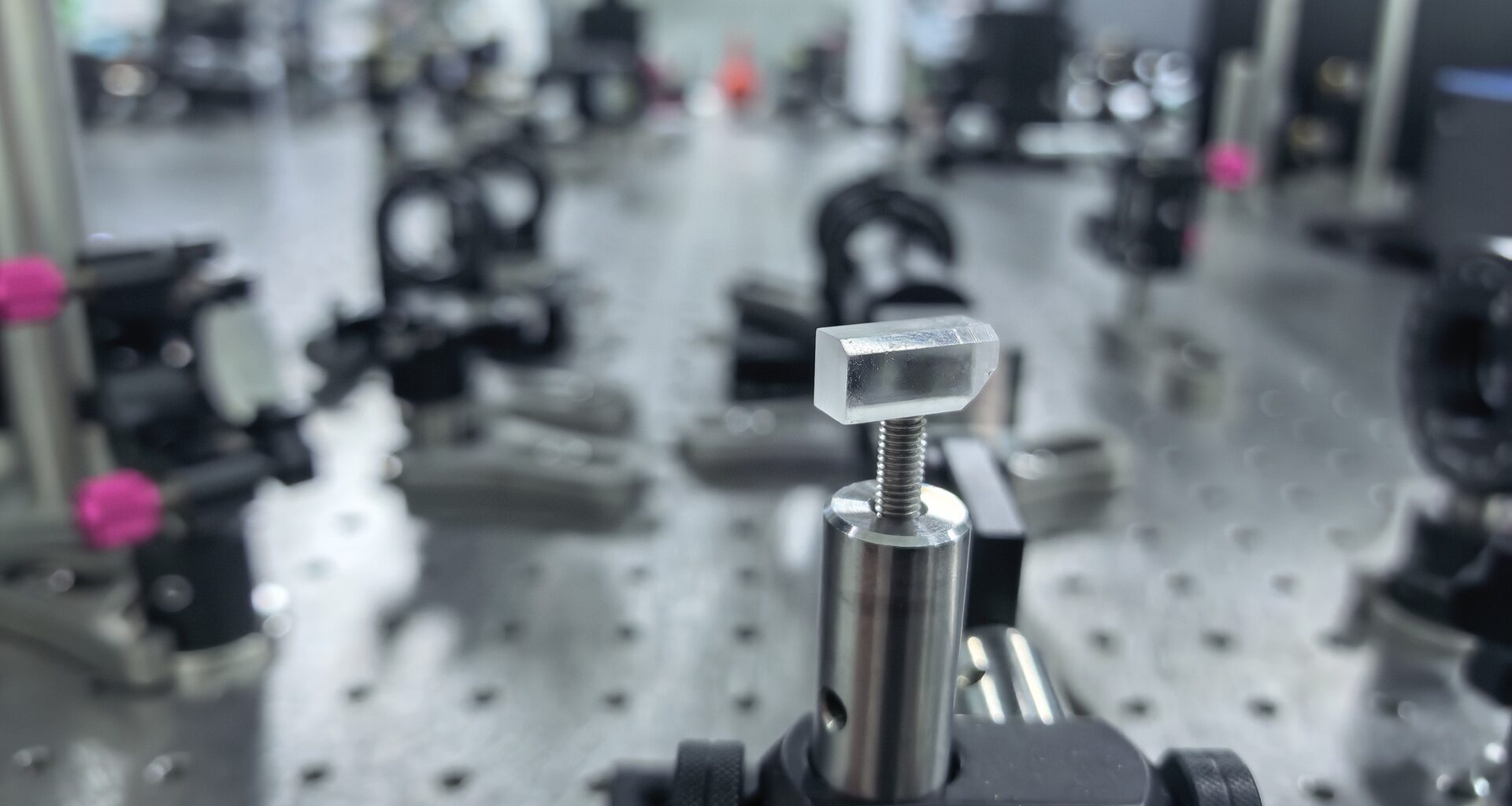
For the project, Shilie relied on a non-linear optical crystal, known as ammonium fluorooxoborate (NH4BF4) or ABF. Using this material the team created a vacuum ultraviolet laser beam at a wavelength of 158.9 nanometers (nm), through direct frequency doubling.
“The development of ABF paves the way for compact, efficient all-solid-state VUV lasers,” the team stated. It could additionally enable applications across quantum computing, space platforms, chipmaking as well as precision manufacturing.
New VUV laser record
Vacuum ultraviolet light typically covers all of the wavelengths between 120 and 240 nanometers. It is highly sought after for applications ranging from advanced spectroscopy and semiconductor manufacturing to quantum research.
Still, producing such light efficiently has long posed a challenge. While nonlinear optical frequency conversion is one of the most effective methods, progress has been constrained by the scarcity of suitable crystals.
Shilie stated that potassium beryllium fluoroborate (KBBF) was the only practical crystal capable of generating laser output below 200 nanometers through direct frequency doubling. However, despite being highly effective, it posed limitations in crystal growth and device fabrication.
In contrast, the ABF crystal, designed and grown by Chinese scientists over more than a decade, overcomes many of these obstacles.
It combines properties that are rarely achieved in a single material, including high transparency in the vacuum ultraviolet range, a strong nonlinear optical response and sufficient birefringence for phase matching at extremely short wavelengths.
“The ABF crystal is a novel material, entirely developed and patented by our institute, from initial design to crystal growth, to final laser output,” Shilie pointed out. “ABF not only achieves the shortest wavelength but also delivers the highest energy output and conversion efficiency to date.”
Solid-state progress
The researchers first synthesized the ABF crystal in 2016. They spent a decade to grow it to centimeter-scale sizes with high optical quality. The efforts have made it suitable for real laser devices rather than just lab demonstrations.
By introducing fluorine to the borate crystal framework and carefully controlling the structure, the team outlined a broader design strategy for discovering future vacuum ultraviolet nonlinear optical materials.
“Future optimization of crystal growth and processing techniques is expected to further enhance the laser’s performance,” Shilie said. Apart from the 158.9-nm wavelength, the ABF achieved a nanosecond pulse energy of 4.8 millijoules (mJ).
It also reached a conversion efficiency approaching six percent. The team noted that the figures represent new records for vacuum ultraviolet lasers generated via second harmonic generation. The short wavelength means the ultraviolet light carries more energy, thus enabling new applications.
“We will use this directly generated laser to create new demand,” Shilie revealed, adding that China is transforming into a manufacturing powerhouse that needs to lead and create opportunities. “For instance, in future space communications, there are many ‘uncharted territories.’”
In quantum research, vacuum ultraviolet lasers enable precise control of atomic and ionic energy levels. This supports the development of next-gen quantum computers. The study has been published in the journal Nature.