
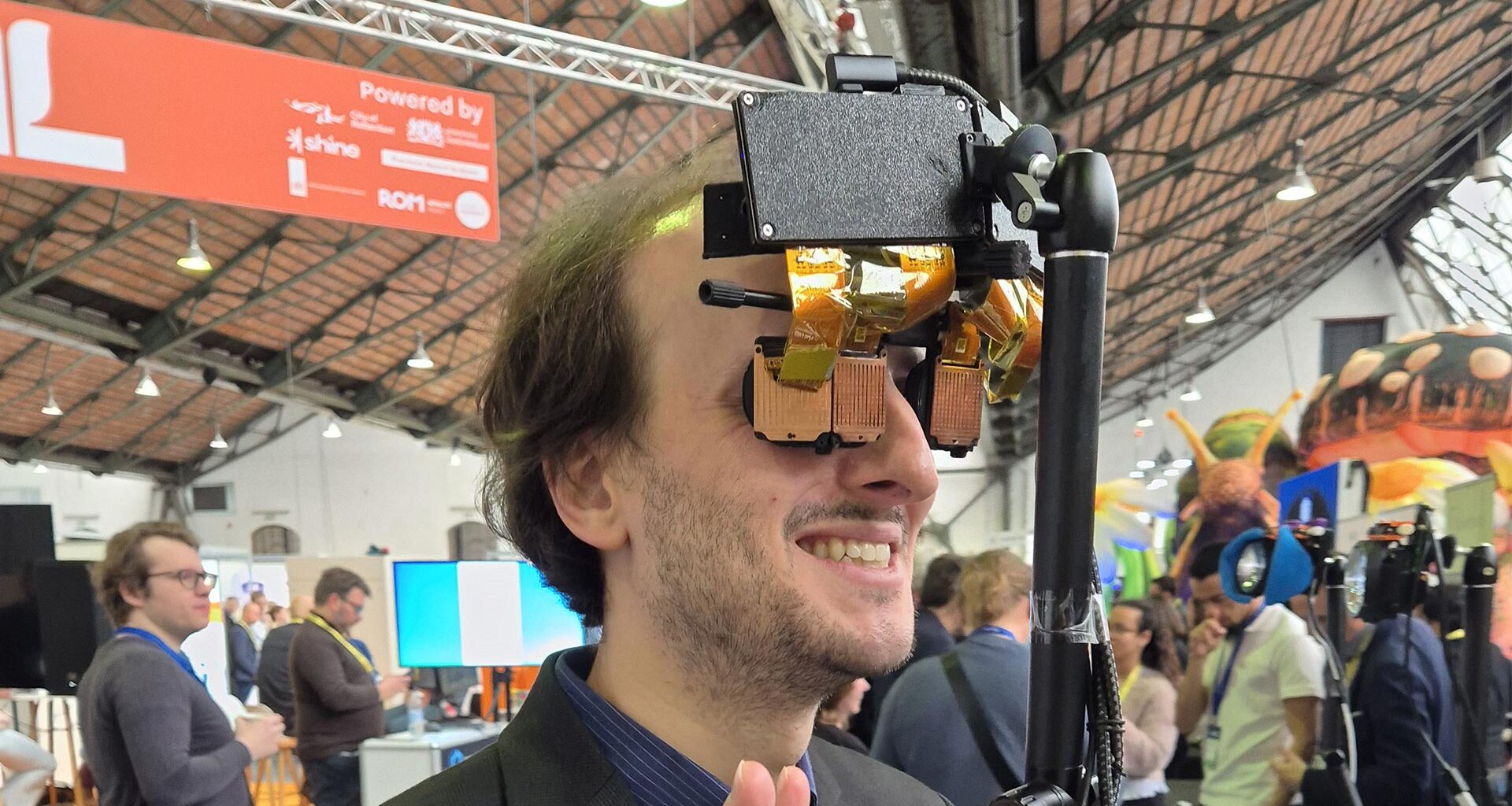
One of the things that has not evolved much in these 10 years of consumer VR is the Field Of View. Some companies are working hard to solve this problem, and one of my favorites is for sure Hypervision, a startup with a deep expertise on the topic that has been able to produce optical systems for VR headsets with a very wide FOV. If the just-announced Lynx R2 has the widest FOV among all standalone MR headsets, it is because it uses lenses designed by Hypervision. At United XR Europe, I was able to try the latest optical systems by Hypervision, including a crazy one with more than 200° of horizontal FOV! Let me tell you my impressions about them…
I also recorded a live video at the event about these cool devices!
Previous prototypes
Before trying the latest prototype with the super-wide FOV, Hypervision CEO Arthur Rabner also let me try the previous models. I have the pleasure of meeting Arthur at least twice a year at VR events, and I have tried almost everything that Hypervision has created. These prototypes were not new to me, but as a VR nerd, I tried them again with much pleasure.
The first optical system showcased at United XR was from a year and a half ago and was based on Fast-LCD displays manufactured by BOE.
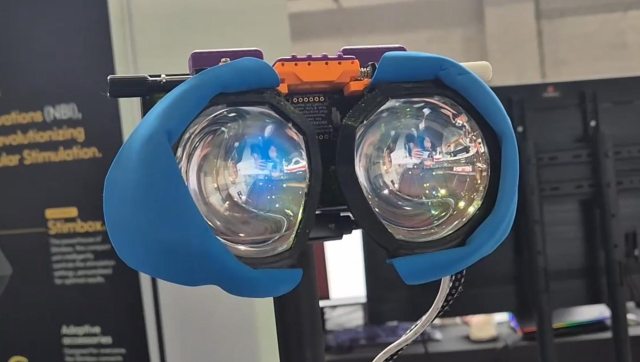 The first prototype I tried. As you can see, the lenses are very large
The resolution was 2.1K per eye, like in the upcoming Steam Frame. But the field of view was already very large: 160° x 120°. I put my eyes inside, and I could appreciate a very immersive virtual reality: my eyes were filled with the virtual images, and I could see the virtual world also in my peripheral vision. The colors were very bright, the resolution was good: it was incredibly immersive.
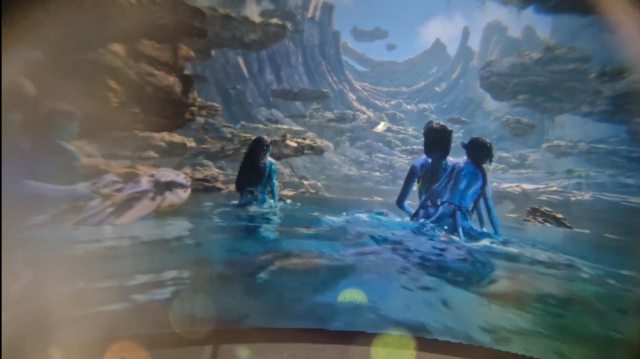 Through-the-lenses of this prototype. As you can see, the definition and colors are good
The second one I tried was actually a new version of the same system, employing new displays by TCL instead of the usual BOE ones. The resolution of these displays is actually higher (2.73K per eye), and they also feature local dimming, allowing them to display darker blacks. They offer more contrast, but at the price of being less bright than their BOE equivalent. The FOV of the resulting system was still 160×120, with 28 PPD in the central area and 80° of stereo overlap. Putting my eyes in, I could again see a very immersive virtual reality, but I could notice the difference in brightness. The display looked less bright and the colors a bit washed out. The experience was still good, and maybe if I tried just this system, I would find it cool, but trying it straight after the other, I could clearly spot the difference in terms of brightness.
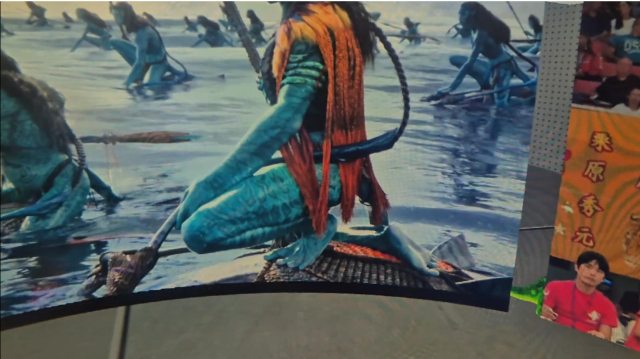 The through the lens image still shows a very good definition, but from the inside, I could spot the difference in brightness
By the way, if you are wondering if these are the systems used inside the Lynx R2, the answer is no. Arthur told me during an interview that since Lynx is an open-periphery MR headset, it doesn’t need a super wide FOV for its mixed reality, because the peripheral vision of MR is already given by the real world. So Lynx is using a system with a narrower FOV.
New Micro-OLED prototype
I kept the best for the last thing to try. Hypervision showcased for the first time at United XR its latest prototype, which has some peculiar characteristics. First of all, it is not based on fast-LCD displays, but on micro-OLED ones, which can guarantee a small size and very bright colors. Then, it doesn’t feature just one display per eye, but two. By putting two canted displays one close to the other, it can show a wider image to each eye. Since explaining it by words would be very complicated, let me show you a schematic of how it works, taken directly from the Hypervision website:
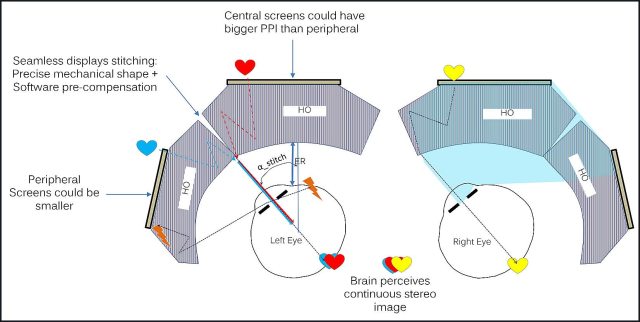 This is how the latest prototype by Hypervision works (Image by Hypervision)
Each eye features two displays and a sort of big lens which looks as if two lenses have been welded together. This is what each optical unit looks like:
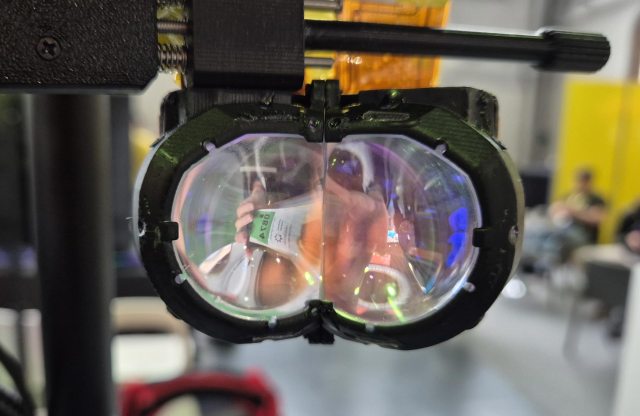 Every eye has two displays, and this big lens that looks like two lenses welded together
Yes, it looks a bit weird. But it also enables an unprecedented FOV. Hypervision is using 1.3-1.35-inch displays in this product, and it claims that with its technology, it could provide up to 140° of FOV if it used just one display per eye… and that would already be pretty wide for a headset employing micro-OLEDs (which, being small, usually can’t provide a large FOV). But using this patented dual-display tech, which they call VRDom (which is a short version of Virtual Reality Dome Projection Room), they can provide a FOV of 220°, or even 240°.
This is huge, if you consider that the horizontal FOV of the human vision, if you keep the eyes looking forward and still, is 210°. So this headset can accommodate the whole human FOV. Notice that I said “if you keep your eyes looking forward and still” because actually, the whole human FOV is 270°. Our eyes can move, and the eyes being able to move to the far left or far right adds 30° of FOV per side. Anyway, 220-240° FOV is just impressive for a VR headset.
All this horizontal FOV comes at the expense of the vertical FOV, which is just 94°, which is not bad, but it is still a bit less than that of Quest 3. Even if we often talk about the horizontal one, the vertical FOV is very important for the sense of immersion, so it should not be underestimated.
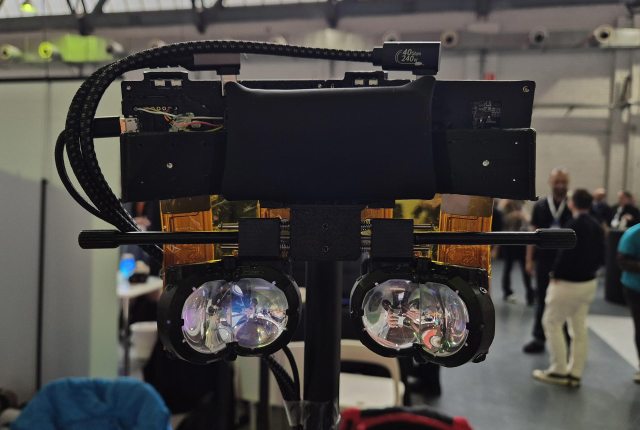 The optical system offering 220° FOV
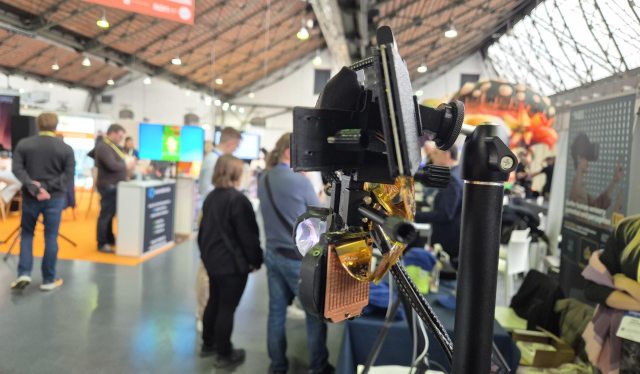 Lateral view
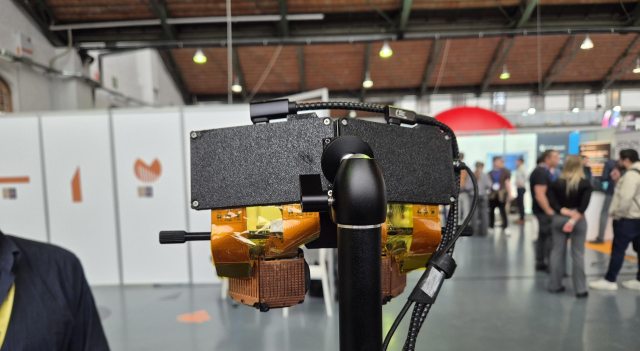 Back view
I couldn’t wait to put my eyes into this device. When I tried it, it was incredible to appreciate such an immersive VR, which filled all my visual periphery. I could perceive the limitation in the vertical FOV, but I was also amazed by how large the horizontal field of view was. It was something I never tried before: as long as I kept my eyes looking forward, my vision was complete, and when I started moving my eyes, I could just perceive some small areas of the real world. And the rest of the characteristics were great, too: a great resolution, no screen door effect, and bright colors.
Through-the-lenses of the Hypervision system (… and yes, I’m not very good at making this kind of videos!)
But the thing that I found the craziest was that the seam between the two “lenses” of every eye was hardly visible. I already tried some prototypes from Hypervision with this dual-lens design over these years, but I was always able to see a big seam when moving my eyes around: the area where it seems that there are two lenses glued together created visible artifacts. With this new version, the experience was almost seamless: no seam was visible, it just happened that sometimes I could see a very slightly dark vertical line when my eyes went from one display to the other. Arthur told me that they are working to make the lenses even more mechanically precise and use better software adjustment to remove the 100% of the artifacts created by the seam between the lenses.
 The seam somtimes appeared as a slightly darker area, while other times it was basically invisible
I found this new product simply amazing. I asked Arthur if this design can be used in consumer headsets, but he told me that it is actually very expensive, so it is more suited for headsets for enterprise, prosumers, or the military. It uses 4 micro-OLED displays, and the BOM for just the displays is $1.5K! So, I don’t think we’ll see this in the Quest 4…
The future plans
For 2026, Hypervision aims to make its products ready for mass production. Now they are hand-made in a custom way, so they are very expensive. But they want to create reference designs that can be manufactured at scale, and so be integrated into headsets, as happened with the Lynx. Since Hypervision aims at producing reference designs for developers, it is also asking for the help of the community: VR developers and tech people can head to its website https://www.hypervision.ai/ and answer the questions of a survey that is there, so Hypervision can create reference designs that appeal more to the needs of the XR ecosystem. Please, do that if you have time!
Final impressions
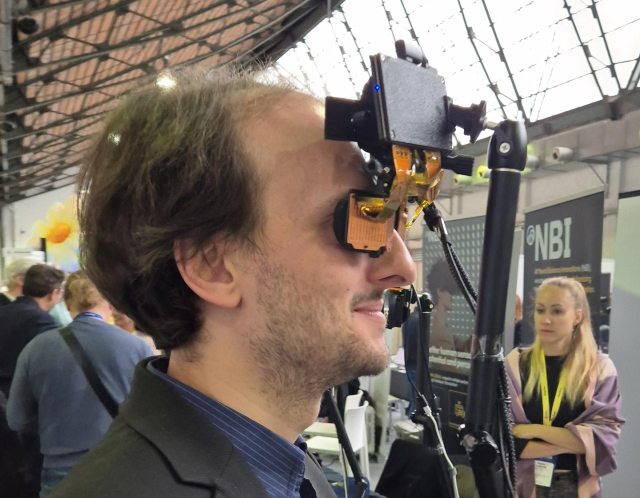 Enjoying the wide FOV of Hypervision systems
I left the booth of Hypervision very excited about what I tried. I know these technologies won’t be integrated soon into consumer standalone VR devices, but it was cool to try them and experience what the future of VR holds. A wider FOV can make XR more immersive and increase our sense of presence. And being able to try a system with 220° of horizontal FOV was incredible. Hypervision has for sure a great expertise in its field, and it is good that its systems have started to be integrated in an interesting headset like the Lynx R2. But the road to wide-FOV mainstream headsets is still long…
Disclaimer: this blog contains advertisement and affiliate links to sustain itself. If you click on an affiliate link, I’ll be very happy because I’ll earn a small commission on your purchase. You can find my boring full disclosure here.
Share this with other innovators
Related