
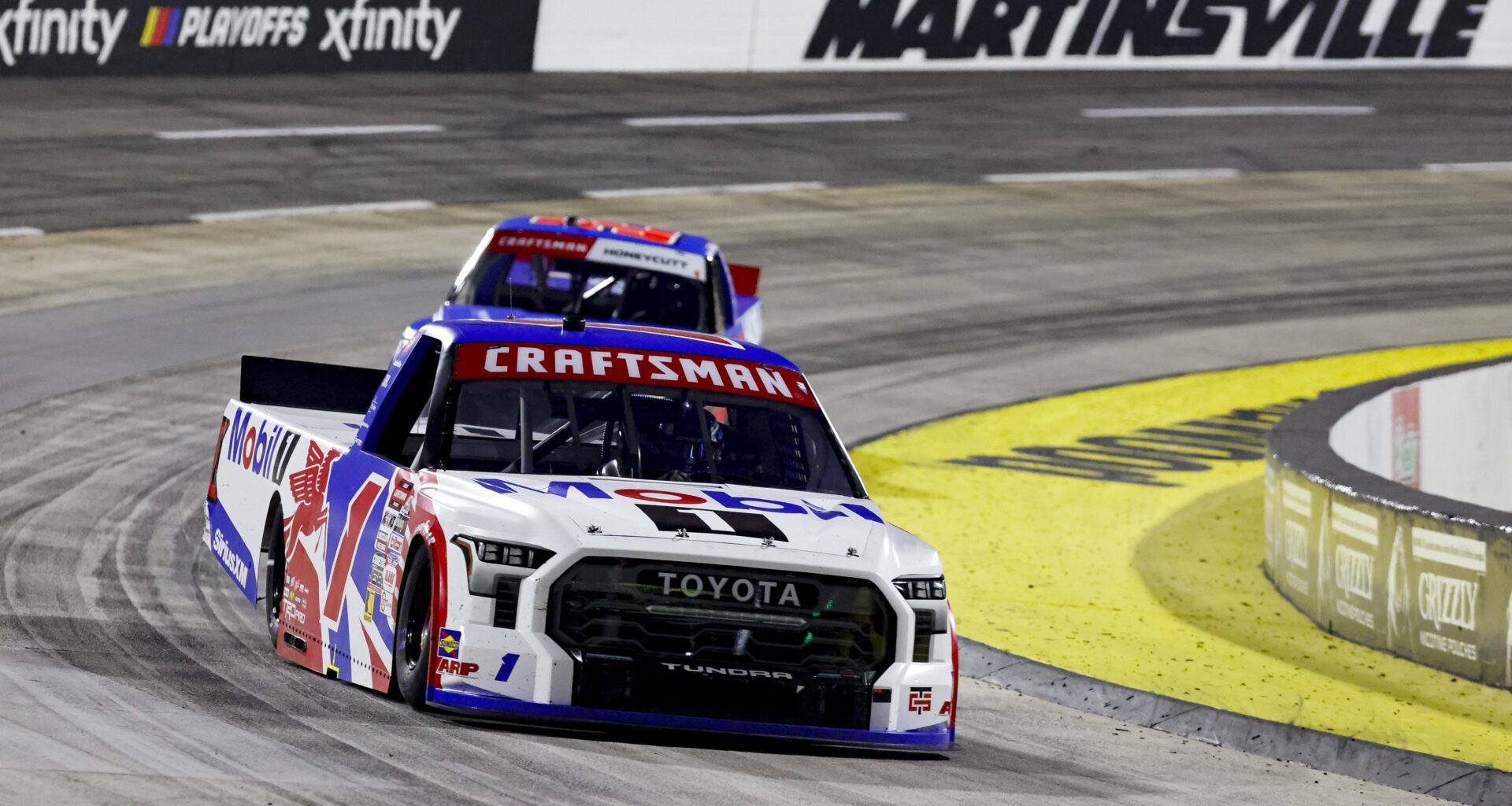
CONCORD, N.C. — NASCAR had numerous notes to share with media members on Thursday as part of an annual preseason briefing, including an explanation for why younger drivers can compete in the Craftsman Truck Series and O’Reilly Auto Parts Series races.
Last year, the sanctioning body announced it had lowered the minimum age for drivers in the two lower national series. Drivers can now compete in O’Reilly Auto Parts Series road course races and events at ovals shorter than 1.25 miles in length after turning 17. They must still be 18 to compete on ovals larger than 1.25 miles. The minimum age for Truck Series drivers at these shorter oval tracks and road courses will remain 16.
The reason for this is that some teams requested the change from a developmental standpoint. They can start working with these younger drivers and help them move up the racing ladder. However, this is not a blanket policy for the series. NASCAR will still examine the respective resume of each driver and decide whether to approve them for competition.
“Prior to this year, we didn’t have latitude, if you will, to be able to approve (drivers),” Elton Sawyer, SVP of competition, explained. “In the rule book, it stated an age.
“…Now at least we can look at candidates and say some 17 year olds are probably ready to do it and ready to compete at that level in the national series, and there’s probably some that still need some some more training.”
Here are some other nuggets from the Thursday afternoon briefing
Flyovers: Sawyer took part in one of the trips out to Naval Base Coronado ahead of the San Diego street race. He spoke to the base’s commanding officer, Capt. Loren “Wookie” Jacobi, and learned that he is a huge NASCAR fan. Capt. Jacobi promised the “best flyover we’ve ever had.” Capt. Jacobi controls the FAA flying space, so he can dictate how low pilots fly during this pre-race tradition.
Daytona 500 Open entries: NASCAR has streamlined qualifying for Open entries in the Daytona 500. The fastest two during qualifying will lock into the race. The rest have to look forward to the Duel races, where two more will qualify through their finishing position. In past seasons, Open cars could potentially get in on speed after the Duel races if the fastest cars from qualifying had a better finish. That is no longer the case.
Open Exemption Provisional: Two key details surfaced about the OEP, which guarantees a prestigious driver a spot in a race with more than 40 entries. This is the rule that ensured four-time Indy 500 champion Helio Castroneves would compete in last season’s Daytona 500, and it will apply to seven-time Cup Series champion Jimmie Johnson.
If a driver requests the OEP, as Johnson did this year, it does not prevent them from doing so again later in the season. Johnson could ask for the OEP for both the Daytona 500 and San Diego street race if he felt he needed this. It would be up to NASCAR whether to approve or deny the second request.
If a driver requests the OEP but fewer than 40 entries show up for a race, they will just slide back into the standard rules for Open cars. They will once again be eligible for prize money and other benefits of winning.
Helmets & crash data: NASCAR will continue its relationship with Wake Forest this season while working with drivers across all three national series to gather crash data. Special mouthpieces will be available for every Cup Series race, which the drivers can wear. These mouthpieces provides details about the G-forces sustained at the time of the incident.
The majority of Truck Series and O’Reilly Auto Parts Series races will have these mouthpieces available as well. It will be up to the drivers to decide whether they want to wear them.
NASCAR has also started working with a company called Biocore to look at changes to the driver helmets. Biocore works with the NFL on its helmets to reduce concussions, and NASCAR hopes that this partnership will lead to changes to the helmet.
The goal is to improve the low to medium impact areas in crashes. NASCAR says that the helmets work very well with the severe end of the scale, but it wants to further improve the less violent collisions.
ECU: The Cup Series teams will have a new electronic control unit (ECU) this season, one that they tested at North Wilkesboro Speedway. These new ECUs will not debut until the trip to Bristol Motor Speedway in April.
According to Sawyer, some teams pushed back against the idea of updating the ECU in the cars. However, he and series managing director Brad Moran explained that the parts and pieces and chips limited the number of available ECU systems. They compared the situation to using a cell phone from 2012 in 2026.
The Chase tiebreaker: NASCAR hopes the return of The Chase will lead to a situation like in 2011 when Tony Stewart and Carl Edwards tied after 10 races. If this happens, the series will use multiple tiebreakers to determine the champion. It will be the best finish in the round, including wins, runner-up finishes, third-place finishes, etc.