
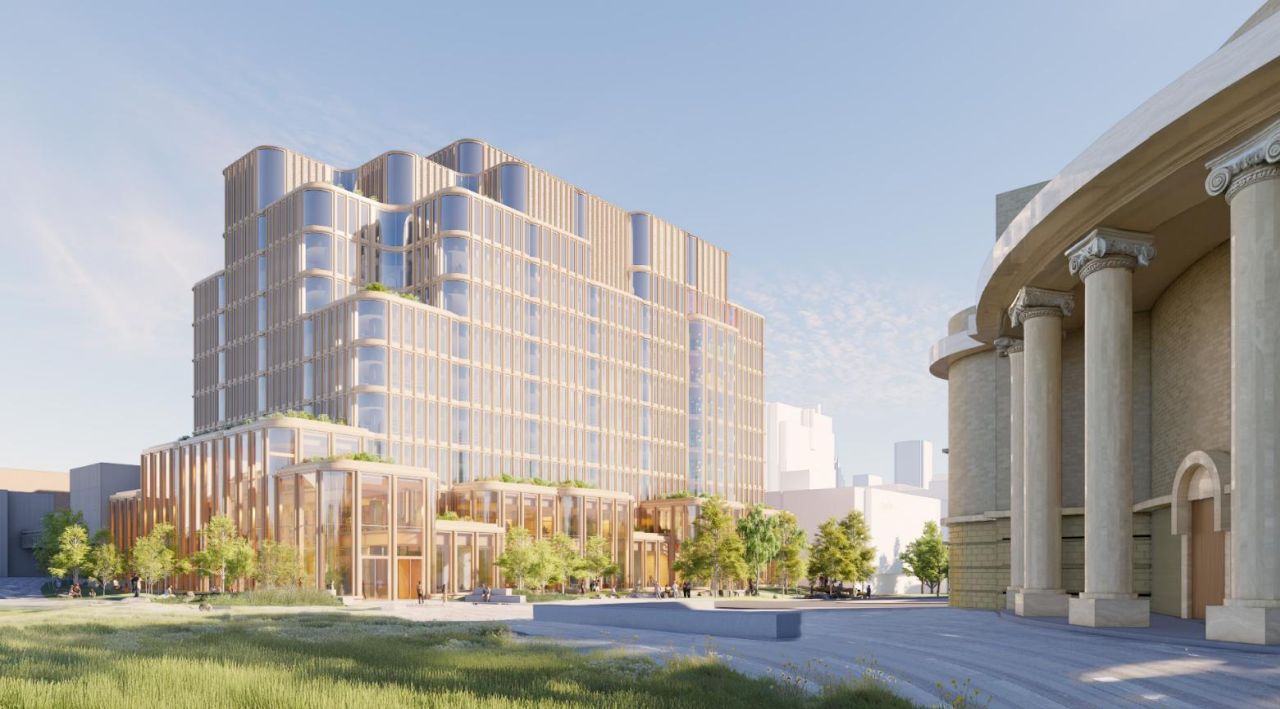
State of the art, expanded facilities are proposed to replace the existing West Wing of the Medical Sciences Building at the University of Toronto’s St George campus. Designed by world-renowned MVRDV in collaboration with Diamond Schmitt Architects, the James and Louise Temerty Building is planned as an 11-storey institutional, educational, and laboratory facility on the south side of King’s College Circle.
Looking southeast to the Temerty Building, designed by MVRDV and Diamond Schmitt Architects for the University of Toronto
The building is a major institutional reinvestment that would remove obsolete and inflexible laboratory space dating back to the late 1960s and replace it with modern research, teaching, and campus-serving facilities. Located at the southeast corner of King’s College Circle and King’s College Road, and directly across from Convocation Hall, the Temerty Building would support education and research in medicine and life sciences while accommodating university functions related to student life and major institutional events.
The surrounding campus is defined by institutional and academic buildings surrounding the open green space at the heart of Front Campus. The university has been making surgical redevelopments of its campus buildings over the years to increase capacity and catch up with evolving technologies. Nearby development activity just outside the campus along College Street and Spadina Avenue includes several residential towers mostly aimed at student accommodation.
An axonometric view looking southeast to the site and surrounding area, image via the University of Toronto
Originally completed in 1969, the Medical Sciences Building was purpose-built to house what is now the Temerty Faculty of Medicine, and today accommodates roughly half of the faculty’s on-campus space. Over time, however, the West Wing’s laboratory infrastructure has deteriorated, with original layouts and building systems proving increasingly incompatible with contemporary research models.
According to a recent U of T Project Planning Committee report, multiple feasibility and condition assessments determined that renewing the existing structure would be cost-prohibitive and highly disruptive to ongoing academic and research activity. Instead, the university advanced a replacement strategy supported by interim off-campus laboratory conversions, setting the stage for a purpose-built facility to modernize biomedical research space while enabling the longer-term revitalization of the remaining Medical Sciences Building.
Looking southwest to the Temerty Building, designed by MVRDV and Diamond Schmitt Architects for the University of Toronto
Plans call for a single 11-storey institutional structure, with two underground levels. The building would be physically connected to the remaining portions of the Medical Sciences Building, effectively doubling the functional area previously housed within the West Wing.
A distant view looking south to the Temerty Building, designed by MVRDV and Diamond Schmitt Architects for the University of Toronto
The proposal has a Gross Floor Area of 36,978m², all dedicated to institutional uses. Research space would account for a majority of the program, with multiple floors of flexible wet laboratories shared between the Temerty Faculty of Medicine and the Faculty of Arts & Science’s Department of Cell & Systems Biology. Additional space would be allocated to active-learning studios, classrooms, student study areas, administrative offices, and large ground-floor assembly areas to support Convocation, Alumni Reunion, and other major campus events. Mechanical and servicing functions, including space for a campus nodal utility plant, would be accommodated below grade and within dedicated building zones.
Site plan, designed by MVRDV and Diamond Schmitt Architects for the University of Toronto
The building is planned without vehicular or bicycle parking, reflecting its location beside the recently completed underground parking facility for both motor vehicles and bicycles below the field within Kings College Circle. The site is also within one of Toronto’s most transit-accessible areas, a short walking distance of Queen’s Park station on University Line 1, with additional TTC bus and streetcar routes operating along College Street and University Avenue. Internal pedestrian routes and campus walkways would continue to serve as the primary means of access.
An aerial view of the site and surrounding area, image via University of Toronto
The building would rise within an increasingly active development context surrounding the Front Campus. To the west, the University of Toronto’s Lash Miller Building Expansion is under construction at four storeys, while to the southwest, the Koffler Health & Wellness Centre Expansion is proposed at three storeys. Just south of campus, 191 College Street is proposed at 31 storeys, 700 University Avenue at 57 storeys, and 149 College Street at 60 storeys. East of the site, the school’s Schwartz Reisman Innovation Centre Phase 2 is planned at 20 storeys. A new, larger Ronald McDonald House is another nearby proposal on McCaul Street, at 18 storeys.
UrbanToronto will continue to follow progress on this development, but in the meantime, you can learn more about it from our Database file, linked below. If you’d like, you can join in on the conversation in the associated Project Forum thread or leave a comment in the space provided on this page.
* * *
UrbanToronto’s research and data service, UTPro, provides comprehensive data on construction projects in the Greater Golden Horseshoe—from proposal through to completion. Other services include Instant Reports, downloadable snapshots based on location, and a daily subscription newsletter, New Development Insider, that tracks projects from initial application.
Related Companies:
Diamond Schmitt Architects, Tarra Engineering & Structural Consultants Inc