
Lewis Hamilton and Charles Leclerc face 2026 F1 challenges after Ferrari struggles in 2025
Ferrari driver Lewis Hamilton will be eager for the 2026 Formula 1 season to mark a fresh start after a deeply frustrating debut year with the Scuderia. Following a challenging 2025 campaign, Hamilton is determined to see a dramatic improvement in his results, particularly as he looks to close the gap to teammate Charles Leclerc, who finished the season 86 points ahead of him.
Hamilton’s 2025 season was marred not only by the difficulty of adapting to a new team but also by technical issues and strategic missteps that heavily affected his performance. Ferrari, under team principal Fred Vasseur, acknowledged that development of the SF-25 ceased in April after the team recognized that competing for either the Drivers’ or Constructors’ Championship had become unrealistic. This strategic shift came after Shanghai, where Lewis Hamilton initially claimed victory in the Sprint Race, only to be disqualified from the Grand Prix later that weekend.
The disqualification in Shanghai was due to excessive plank wear, forcing Ferrari to make significant setup adjustments for the remainder of the season, including raising the ride height of both Hamilton’s and Charles Leclerc’s cars at every race to avoid further penalties. These measures directly affected car performance and were a contributing factor to Hamilton failing to reach the podium throughout the 2025 season. Charles Leclerc also suffered from similar restrictions, notably missing out on a potential victory in Hungary due to the same regulations.
F1 teams concerned about plank wear under 2026 rules
Looking ahead to 2026, Formula 1 teams are increasingly concerned about how changes to the technical regulations might amplify plank wear issues, particularly in mixed-weather races. Journalist Jon Noble, speaking on The Race’s Patreon platform, highlighted that teams are still trying to fully understand how the new rules regarding downforce and aerodynamic settings will impact their cars.
Noble explained that while adjustments to front and rear wings have minimal effect on overall performance during normal conditions, testing has revealed potential complications under specific scenarios. For example, in situations where front wing adjustments are disabled due to safety concerns or wet conditions, the resulting increase in drag can cause greater stress on the car’s plank. This can accelerate wear, deplete battery power more quickly, and potentially lead to disqualifications, creating a scenario that could be particularly critical in mixed-weather races.
Teams have reportedly conducted experiments to study these effects, observing sparks flying and planks wearing during simulations to better predict performance under such conditions. These findings underline a significant technical challenge for both Lewis Hamilton and Charles Leclerc, as Ferrari seeks to optimize performance while staying within the regulatory limits.
Ferrari’s SF-26 shows early promise ahead of 2026 season
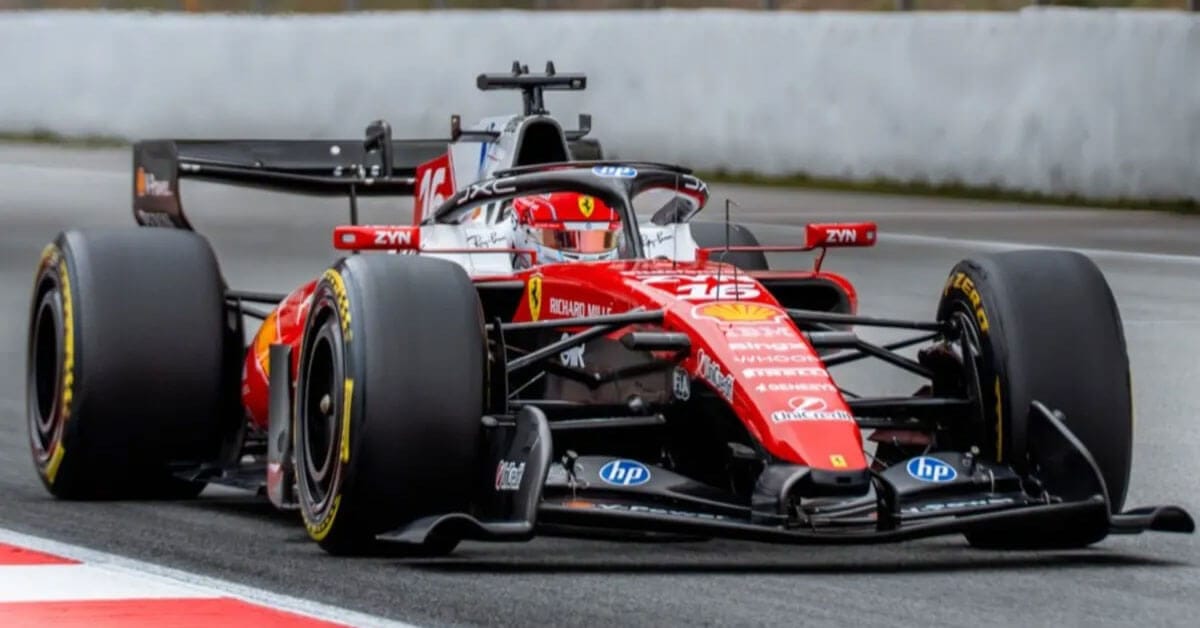
The Ferrari SF-26 has already made its track debut in Barcelona, with promising early results for both Lewis Hamilton and Charles Leclerc. The Briton recorded the fastest time during testing, a positive sign that provides both drivers with a much-needed confidence boost after widespread criticism of Ferrari’s performance last year. While single-lap pace does not guarantee season-long success, it suggests the team is moving in the right direction with the new car.

Ferrari is preparing an extensive upgrade package for the SF-26, focusing heavily on reliability as the team heads into the 2026 Australian Grand Prix. The new power unit is being tested collaboratively by Ferrari, Haas, and Cadillac, offering valuable data to refine performance and ensure durability over a full race weekend. Ferrari and Haas, in particular, have logged extensive mileage during testing, second only to Mercedes, demonstrating the level of preparation taking place.
One of Ferrari’s biggest challenges this year remains balancing ride height and car setup to suit Lewis Hamilton’s driving style. Hamilton thrives when the car runs as close to the ground as possible, maximizing aerodynamic efficiency and overall speed. However, the potential for excessive plank wear under the new rules could again force Hamilton into conservative setups, potentially placing him at a disadvantage compared to Charles Leclerc and rival teams.
Looking ahead to the 2026 F1 season
With the SF-26 showing early promise and Ferrari investing heavily in upgrades and testing, Lewis Hamilton and Charles Leclerc enter the 2026 Formula 1 season with renewed optimism. However, teams remain vigilant about the plank wear issue, particularly in unpredictable weather conditions, which could replicate some of the challenges Hamilton faced in 2025. Ensuring that both drivers can extract maximum performance while staying within regulatory limits will be crucial for Ferrari if they hope to challenge for victories and championship points consistently.
As the season approaches, Ferrari’s ability to deliver a competitive and reliable car will determine whether Lewis Hamilton can finally avoid the frustrations that overshadowed his first year with the Scuderia and close the gap to Charles Leclerc, setting the stage for a much more competitive and exciting 2026 campaign in Formula 1.
Feb 8, 2026Alex Marino
Let other Scuderia Fans know about us


