
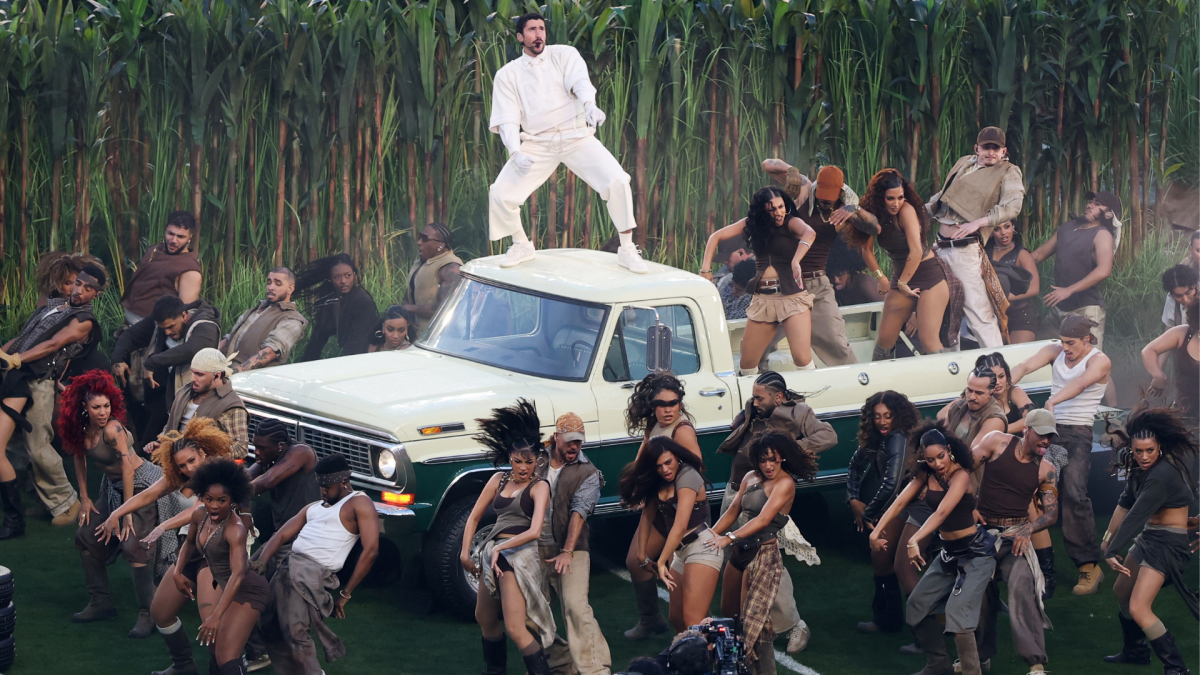
Forget a simple halftime event. Bad Bunny’s setlist was a cultural game changer. After months of planning and marketing, the artist born Benito Antonio Martínez Ocasio delivered an interactive celebration of Latino culture at one of the most contentious times for the community in the United States.
Bad Bunny’s Super Bowl halftime performance featured guest appearances by Lady Gaga and Ricky Martin, along with several cameos of Latin artists who were part of his celebratory stage setup. After opening with his 2022 hit “titi me pregunto” and odes to Puerto Rico and the Latin community, he closed out with DtMF (Debi tirar mas fotos, which translates to I should’ve taken more pictures), leading a large crowd of guests like a host leading a paranda during Christmas before holding up a football that read “Together, we are America.”
Throughout the show, he showcased many elements that resonated with Latino culture, such as a live band, a taco stand, a nail tech doing someone’s nails, ordering a piragua (shaved ice), friends and family playing dominoes, and more in a wedding reception scene. All of this while singing, dancing, and wearing a white football jersey that read his last name, “Ocasio,” on the back with the number 64, potentially a nod to his mother’s birth year, 1964.
Bad Bunny brings star power — and surprise guests — to the Super Bowl LX halftime show
Shanna McCarriston
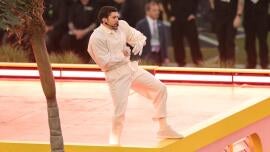
He already made history as the headliner for Super Bowl 60 just one week after winning the Grammy for Album of the Year. A Grammy winner and former Super Bowl performer herself, Lady Gaga was there to celebrate Bad Bunny’s recent win and called him a “brilliant musician,” along with Ricky Martin in a second superstar collaboration.
Martin, another Puerto Rican global pop star, praised Bad Bunny after his Grammy wins in an open letter in El Nuevo Dia, a Puerto Rican newspaper, perhaps opening the door to a collaboration with the current island star at the Super Bowl.
“I know what it means to succeed without letting go of where you come from. I know how heavy it is, what it costs, and what is sacrificed when you decide not to change because others ask you to. That’s why what you have achieved is not just a historic musical accomplishment, it’s a cultural and human victory,” Martin wrote.
“You won without changing the color of your voice. You won without erasing your roots. You won by staying true to Puerto Rico.”
As for the game, the Seattle Seahawks defeated the New England Patriots, 29-13 after carrying a 9-0 lead into the locker room for the extended halftime. The Patriots were viewed as underdogs, with young quarterback Drake Maye leading a team many argued reached the big game thanks to an easy schedule and playoff path. Still, New England, came alive late in the second half, scoring all their points in the fourth quarter. The Seahawks defense was certainly tough, but the Patriots were more complete than some gave them credit for.
The Seahawks, meanwhile, were widely considered one of — if not the — best teams in football this season. Quarterback Sam Darnold has enjoyed a career resurgence, and Seattle’s defense was dominant once again during their biggest game of the year.
While the game may have captivated Seahawks and Patriots fans, Bad Bunny captured the attention of casual and die-hard sports viewers around the globe. His progression from present to past to everlasting culture told a story bigger than any canvas and any single song, and included a message. The only thing more powerful than hate is love.
Lady Gaga and Ricky Martin were Bad Bunny’s surprise guests
Bad Bunny was announced as the headliner earlier in the season, but the Puerto Rican singer didn’t announce any special guests ahead of time, leaving fans to spend months guessing. Months ago, anyone who predicted the guests to share the stage would be Lady Gaga and Ricky Martin might’ve also been playing the long shot vibe that was Patriots-Seahawks.
Lady Gaga was the first guest to make an appearance, performing her hit, “Die With a Smile,” that she put a Spanish twist on. Lady Gaga has now performed at the Super Bowl three times, once as the national anthem singer, once as a halftime show headliner and now as a halftime show guest. Martin then took the stage to perform “LO QUE LE PASÓ A HAWAii” (What Happened to Hawaii).
Gaga and Martin weren’t the only famous faces on the field. Pedro Pascal, Cardi B, Karol G and Jessica Alba were all seen dancing outside Bad Bunny’s casita.
No Spanish needed
As promised, understanding Spanish was not needed to enjoy the halftime show. Former NFL star J.J. Watt said it best, it was all about the vibes. But it was also about much more than that.
California Gov. Gavin Newsom declared it “Bad Bunny Day” to celebrate the Puerto Rican star, an honor that is not handed to just anyone. While the show was happening, the three-time WNBA champion Las Vegas Aces posted about dancing to “DeBÍ TiRAR MáS FOToS.” Across the country, American comedian and TV host Jimmy Fallon watched while wearing a pava, a traditional Puerto Rican hat. It might seem like a small thing, but the popularity of the hat means Benito has succeeded in sharing his culture with others — and also that others are embracing it.
New York Knicks star Jalen Brunson thanked Benito after his performance. Many others did too, including Elmo — yes, that Elmo — who called Benito a “Good Bunny.” This is a cultural movement, but not just a Latino one. This one was for everyone.
Cultural statement of Latino celebration
Bad Bunny’s Super Bowl halftime show was a different kind of force than the event has typically seen. It was a deep look at the raw influence of Latin identity. The first solo artist to headline the Super Bowl halftime show performing almost exclusively in Spanish, the 13-minute performance wasn’t just a concert, but a vibrant, defiant, and moving cultural statement full of symbolism and messaging.
The entire performance transported viewers through multiple facets of Latin culture, beginning with a field set up similar to his “No Me Quiero Ir de Aquí” concert residency in Puerto Rico. Bad Bunny navigated through a stylized town square reminiscent of the island, displaying several aspects of community life.
He walked with and past field workers in traditional straw pavas (hats) while engaging with vendors who sold piraguas (shaved ice), jewelry, nail services and tacos. All while peeking in on a game of dominos, with boxers training in the corner, and an actual wedding reception. It was representative and acknowledged only some of the contributions, offering a glimpse into the everyday lives of Latin communities.
In an era where the language itself can be politicized, Bad Bunny’s halftime show was not only a triumph but a milestone validation. In America, Latin culture, its music, foods, and language, is part of the cultural fabric.