
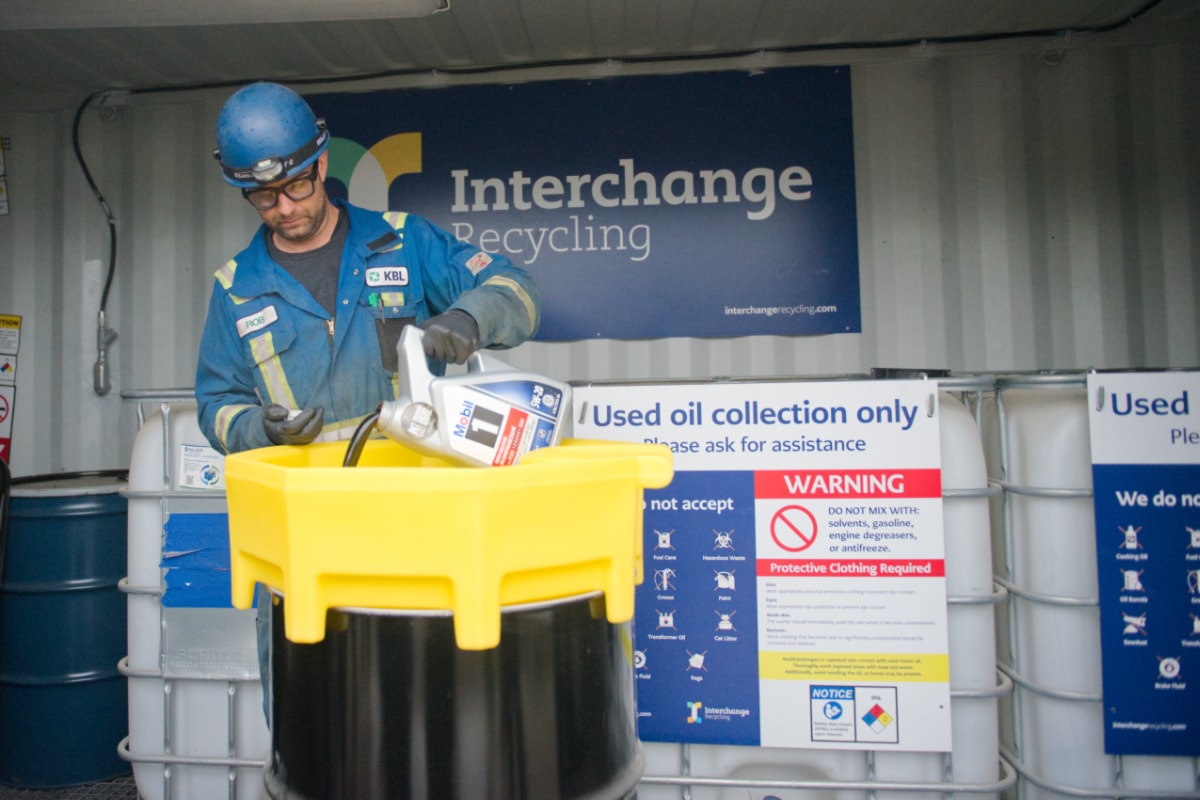
Interchange Recycling launched its new collection site for recycling hazardous materials at the Whitehorse waste management facility on Aug. 1. Launches are also scheduled for sites in Teslin, Faro, and Watson Lake
A sea can at the Whitehorse municipal waste management facility is the latest instalment of the Yukon government’s extended producer responsibility program.
The sea can, operated by KBL Environmental on behalf of Interchange Recycling, is where Whitehorse residents can bring their motor oil, automotive containers, oil filters, diesel exhaust fluid, and antifreeze for recycling. The large white bins sitting inside had signs advising what materials can be collected within.
The site will accept these items on Mondays, Thursdays and the first Saturday of every month from 9 a.m. to 4 p.m., according to a release from the City of Whitehorse. The city’s waste management facility will no longer accept these items but will continue to accept other forms of household hazardous waste for the time being.
Jenn Robson is the director of operations for Interchange Recycling. Standing outside that sea can on the rainy morning of Aug. 1, she told reporters that site operators will take materials like used oil or antifreeze from residents dropping them off. The site operators will ensure that the material is put into the right container, she said.
Once those containers are full, she said, the material is bulked and prepared for shipment to one of the several certified processors in Alberta that KBL and Interchange Recycling are working with.
With these processors, Robson said used motor oil is refined, glycol has additives re-added and is sold as antifreeze, metal in filters and containers are repurposed as rebar, nails, and wire. Plastic containers are pelletized and sold for reuse, she said.
Cleaner materials have a better chance of being refined and resold, Robson said, hence the importance of not mixing materials.
However, she said contaminated materials could also be processed so that clean oil could be re-refined, and “slightly less clean oil” can serve a purpose as waste-to-energy, such as fuel for cement kilns and similar applications.
Under the new extended producer responsibility program, producers of materials which need to be recycled are responsible to operate a stewardship program to collect and recover the material they produce.
These producers can fulfill that responsibility through producer responsibility organization, who will operate that collection and recovery program on their behalf. Interchange Recycling is one such producer responsibility organization.
Producer responsibility organizations have started launching their collection and recovery programs in the territory this year, beginning with Call2Recycle’s battery recycling program. That program began on July 1.
The overall EPR program is meant to shift the responsibility for recycling from taxpayers to the people who produce the materials that need to be recycled, per a press release from YG when the EPR regulation was approved in January 2024.
However, the Yukon Chamber of Commerce and the Canadian Federation of Independent Business (CFIB) have criticized the program. In May, the two groups sent letters to then-premier Ranj Pillai and Environment Minister Nils Clarke, saying the program was overly complex and harmful to businesses.
In the letters, shared to the News in June, the chamber and CFIB asked for the implementation of the program to be delayed.
Environment minister Nils Clarke was present at the launch of the site at the Whitehorse waste management facility. He said that there’s been a great deal of work done in terms of outreach by the department of the environment and department of community services.
“Every new program will have its bumps and its challenges,” Clarke said. He referred to pushback that was received when the department of community services put deposits on tires and electronics in 2018.
“But now I think Yukoners understand that it’s, that has been a strong development.”
“Yukoners generate somewhere around 570 to 580, I think, kilograms of waste per person. So we do want to reduce that,” he said.
It is important that there is no dumping of hazardous products anywhere in the territory, Clarke said.
The departments of environment and community services will continue their outreach to businesses regarding the program, Clarke said.
“We are absolutely excited, and this is the right thing to do for all Canadians, but certainly for all Yukoners.”
Robson said that the program will be launching in Teslin on Aug. 5, Watson Lake on Sept. 13, and Faro on Sept. 20.
“It’s a brand new program, so I’m sure there’s several challenges that we have yet to face,” Robson said.
“Right now, it’s just ensuring that we get the word out that the program is accessible and easy to use and understand for residents,” Robson said, “and then just ensuring that we’re able to cost effectively service the vast territory of Yukon and not miss anyone as we’re going through.”
While launch events have been confirmed for Teslin, Watson Lake and Faro, Robson said Interchange Recycling is working with all municipalities and several unincorporated solid waste management facilities to ensure all rural communities are serviced.
Contact Talar Stockton at talar.stockton@yukon-news.com