


Listen to this article
Estimated 4 minutes
The audio version of this article is generated by AI-based technology. Mispronunciations can occur. We are working with our partners to continually review and improve the results.
The N.W.T.’s industry minister says it’s vital for the territory to diversify its economy, amid uncertainty about the future of diamond mining.
On Monday, Mountain Province Diamonds — which owns 49 per cent of the Gahcho Kué diamond mine in a joint venture with De Beers — announced a pause on the development of the Tuzo Phase 3 project. It said the decision follows a “careful assessment of the project’s economics considering the prevailing market environment.”
Industry Minister Caitlin Cleveland said the territorial government was notified after the close of markets on Monday.
“They gave us as much notice as they could, but given they’re a publicly traded company, they had to make sure that they were within their own boundaries as well,” Cleveland told CBC News.
She said it would be up to the company to provide more details about their future mining operations beyond the pause on the Tuzo expansion project, which was the development of a diamond-bearing kimberlite pipe.
“But certainly our thoughts are with the workers right now, as the diamond industry is definitely in a transition,” she said. “It’s a very difficult time for northerners.”
The Gahcho Kué mine, located about 300 kilometres northeast of Yellowknife, opened in 2016. At the time of opening, De Beers predicted that during its 12-year life, the mine would provide a $6.7 billion boost to the Canadian economy.
A De Beers production report published last week shows a 108-per-cent production bump in Canada in the fourth quarter of 2025, compared to the same period the previous year, totaling 949,000 carats.
Gahcho Kué is De Beers’s only remaining active operation in Canada after the closure of the Victor mine in Ontario and the Snap Lake mine in the N.W.T. in early 2025.
The report notes Gahcho Kué accessed new ore from the latest cut at the mine after an initial waste stripping phase.
“Rough diamond trading conditions continued to be challenging in the quarter amid persistent industry, geopolitical and tariff uncertainty,” the report reads.
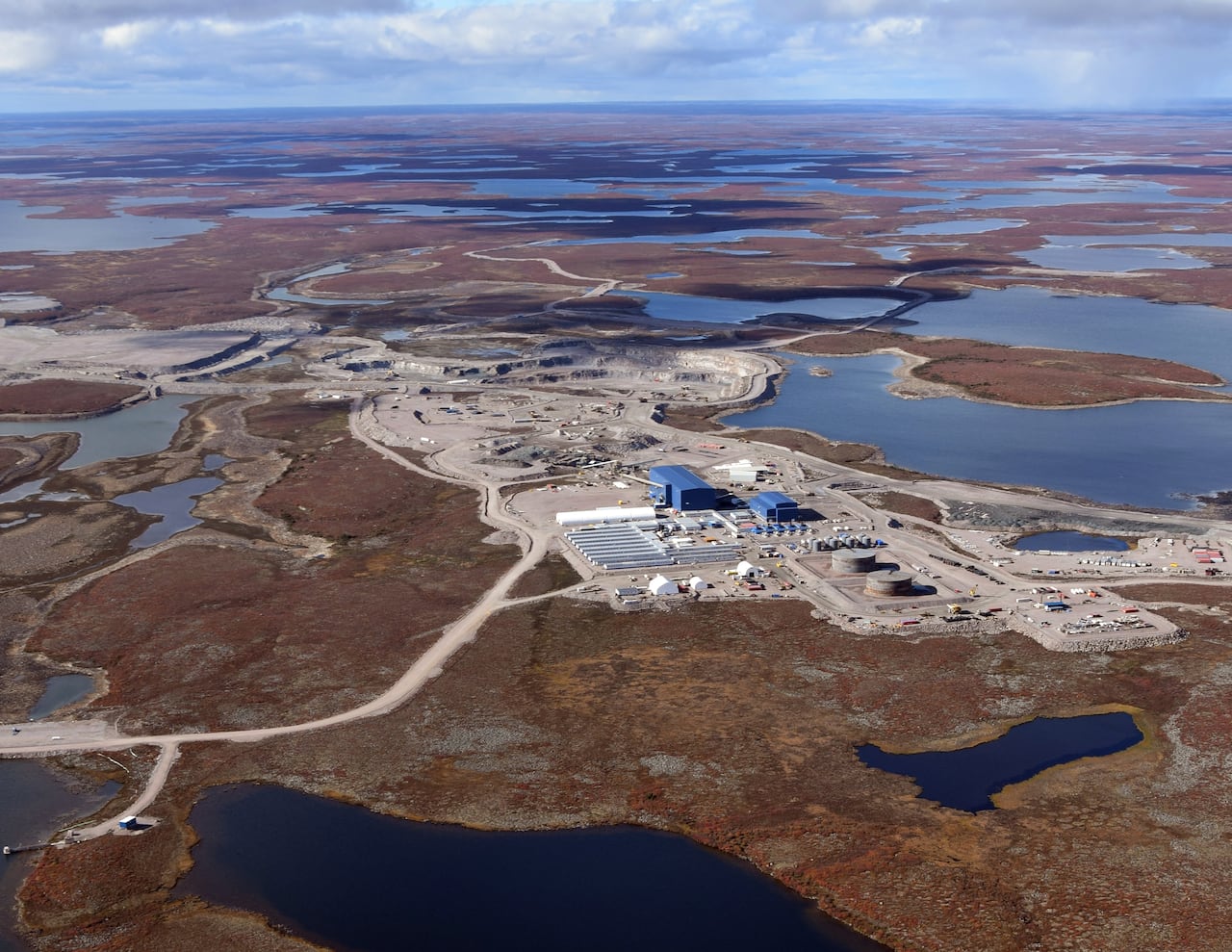 An aerial view of the Gahcho Kué dimaond mine. The mine’s owners announced this week a pause on an expansion program at the site, which threatens jobs and the Northwest Territories’ budget. (The De Beers Group)
The pause in the expansion could also be tied to De Beers’s parent company, Anglo American, trying to sell it, said independent diamond industry analyst Paul Zimnisky.
“I think they’re kind of looking at what industries and then what assets within the industries they want to prioritize,” he said. “And it just seems like Canadian diamonds are not a priority at the moment.”
He said it would take a rebound in prices to make investors enthusiastic about diamonds again. Zimnisky said prices have been trending down for the last six months, though he believes 2026 could bring some stability.
“But again, there’s just so many moving parts, it’s difficult to say for sure,” he said.
No expansion would impact workforce
Karen Costello, executive director of the N.W.T. and Nunavut Chamber of Mines, said the news isn’t very surprising.
“The diamond industry overall is facing some challenges with commodity prices and certainly the N.W.T. diamond industry has not been immune from those headwinds,” Costello said.
She said there are “no details yet” on what this latest news could mean for the territory’s mining workforce.
“We hope that perhaps any change in their status is short term and they’re able to secure opportunities or return to [Gahcho Kué] if Tuzo Phase 3 goes ahead.”
If the project doesn’t go forward, its effects will be felt by Indigenous and northern businesses contracted by the mine, Costello said.
“It would be a tough pill to swallow. And let’s be real, it’s not just about a large mining company, it’s about the people, it’s about the businesses.”
Figures from De Beers’ website tout $2.2 billion in procurement with businesses in the Northwest Territories since 2015, and that over 35 per cent of its Canadian workforce is from local communities. According to Mountain Province’s website, about 500 people work at Gahcho Kué.
Cleveland says the bulk of the territory’s GDP is from mining, and the pause on the Gahcho Kué expansion will eat into the territory’s revenues from payroll taxes.
“It’s really important that northerners have access to meaningful employment in the Northwest Territories and that they have the opportunity to continue to call the Northwest Territories home,” she said.
“It’s incredibly important we diversify our GDP in the territory.”