
The Great Acceleration
By Edward Burtynsky
Steidl, 2025
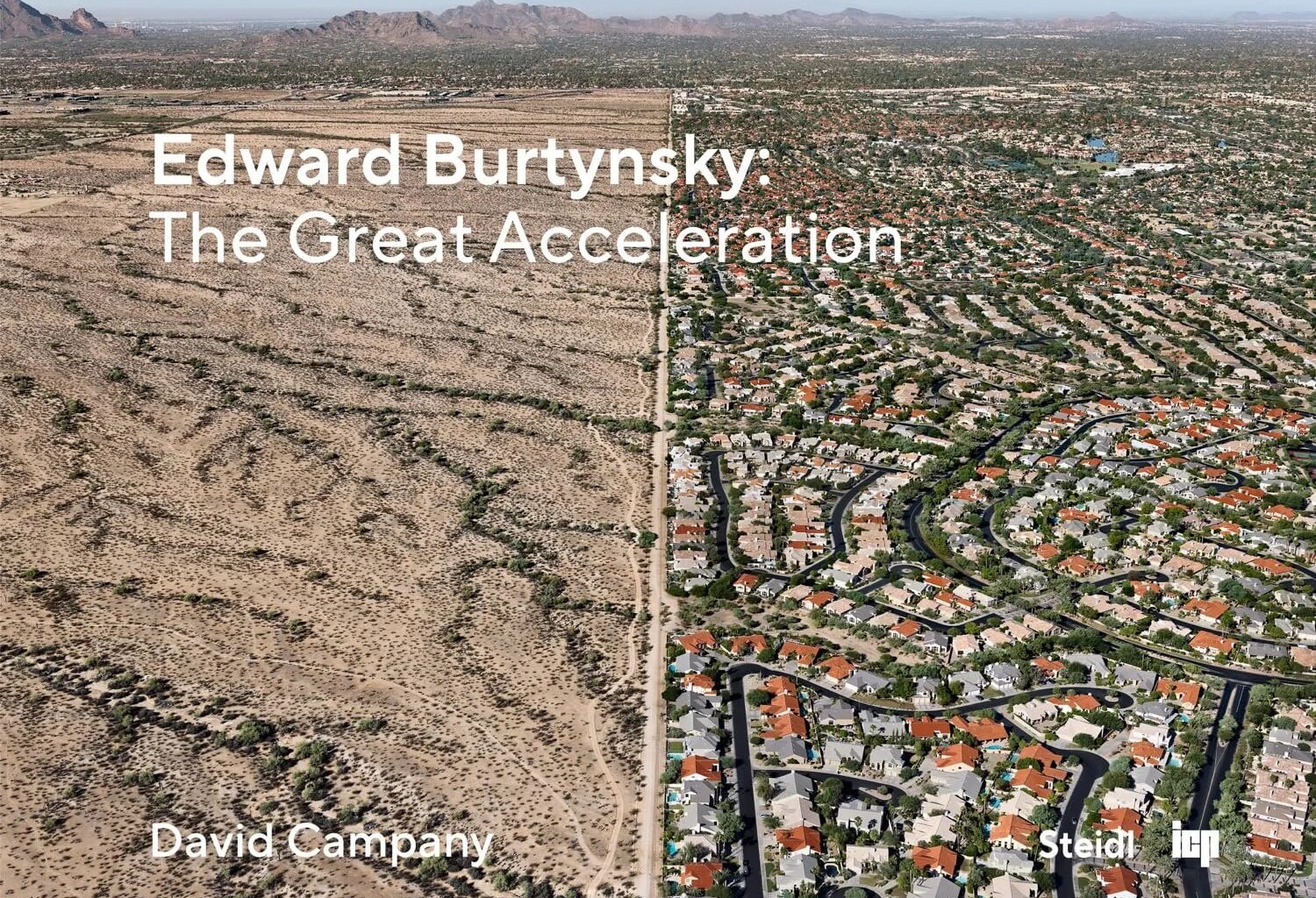
I’ve been reviewing photobooks in these pages for a while now. The Great Acceleration is the most important I’ve come across. In fact, it’s the most important work of any kind I’ve written about since 2023 when I discussed the significance of Gravity’s Rainbow at 50. Pynchon’s book is what I call a “systems novel,” a work that locates characters within cybernetic, environmental, economic, political, and cultural systems. The Great Acceleration is systems photography. As Burtynsky’s cover image suggests, his primary concern is environmental, how humans in the last few decades have accelerated their impact on planet Earth. Although not always recognized as an environmental novel, Gravity’s Rainbow is also most fundamentally an ecological work, one that posits Earth as a “living critter” that humans were created to destroy.
“Be not afraid,” as Prospero says in The Tempest. Gravity’s Rainbow is large and difficult of access. Burtynsky’s trademark photographs are huge and immediately, even shockingly accessible. The book The Great Acceleration does not do—cannot do—justice to the size of the photographs currently exhibited under the same title at New York City’s International Center of Photography where some of the images are ten feet across and five feet high. For Burtynsky, printing photographs at an unconventional spatial scale is one way to communicate temporal acceleration: so much damage in so short a time. To record the scene takes less than a second.
You know—you know you do—how humans have ruined what Pynchon has called the “green uprising” in the Anthropocene. Seeing Burtynsky’s photographs, you will never forget what you know even if you don’t want to remember. That is the importance of The Great Acceleration I claimed above. Unfortunately, the reviewer is not allowed to reproduce some of the best, most unforgettable images. One of my favorites, free at https://www.artworksforchange.org/portfolio/edward-burtynsky/ , is the following, derrick locusts as far as the eye and camera can see: