
US motorsport organization National Association for Stock Car Auto Racing (NASCAR) is applying its expertise in additive manufacturing and digital engineering to optimize performance in Winter Olympic luge. By producing life-size 3D printed athlete models, performing CFD simulations, and testing in wind tunnels, NASCAR is helping USA Luge refine sled aerodynamics and athlete positioning to overcome constraints that traditional fabrication cannot address.
The collaboration began through engineering firm TotalSim, a long-time NASCAR partner on computational fluid dynamics projects. During a visit to NASCAR’s North Carolina R&D facility, Olympic representatives recognized similarities between race-car aerodynamics and sliding sports. After USOPC innovation lead Mike Levine proposed evaluating sled and athlete positioning, NASCAR Vice President of Vehicle Performance Dr. Eric Jacuzzi identified clear opportunities to apply motorsport-derived engineering techniques to Olympic competition.
From 3D Scanning to Digital Twins
The first phase involved capturing detailed digital data of athletes and sleds. Engineers built a custom scanning rig that allowed Digital Reality Scanning specialists to produce high-resolution 3D scans without markers or disrupting posture. Conducted during a Luge World Cup in Park City, Utah, the scans created accurate digital replicas for CFD analysis.
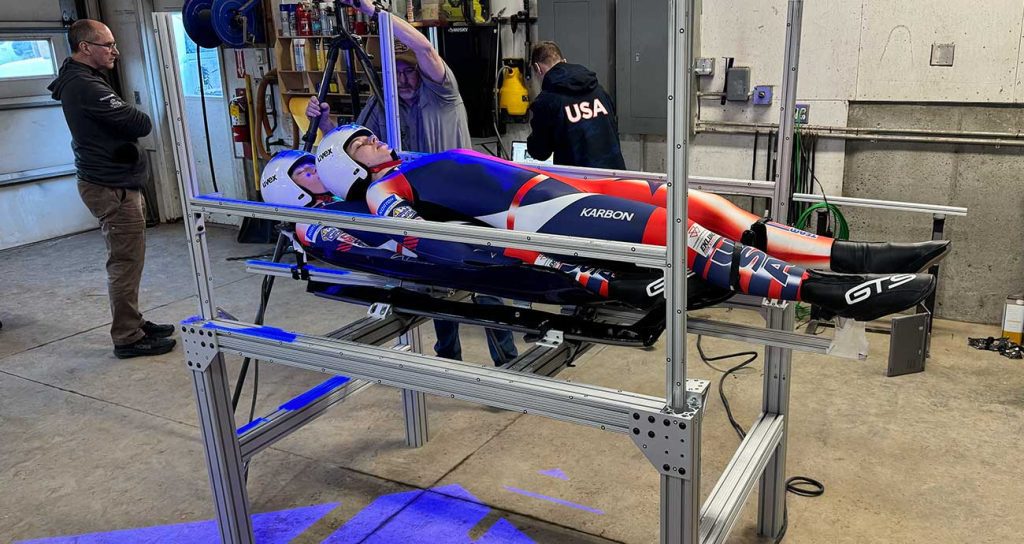 3D Scanning Olympic Athletes. Photo via Eric Jacuzzi | NASCAR.
These scans are being converted into virtual models that allow engineers to evaluate how small changes in sled geometry or athlete posture influence airflow and drag. NASCAR works with TotalSim to establish simulation frameworks and accelerate iterative design cycles, applying motorsport development principles in a winter sports context.
Large-Scale 3D Printing for Wind Tunnel Testing
Once simulations identify promising adjustments, NASCAR produces life-size, modular 3D printed prototypes for physical testing. Initial builds include a women’s singles sled and a men’s doubles configuration.
NASCAR R&D’s newly opened 3D printing lab will produce these models, using their Stratasys F900 and Fortus 450mc systems to fabricate modular 3D prints of both the athletes and their sleds. These modular models allow engineers to swap components quickly during testing in the WindShear rolling-road wind tunnel, enabling rapid evaluation of aerodynamic tweaks. Dr. Jacuzzi noted, “The men’s doubles sled is kind of the wild west so we feel like we can do some damage there,” highlighting the flexibility to innovate within competition rules.
The immediate focus is on reducing drag through sled geometry and athlete positioning. Some current sled designs rely on legacy practices rather than data-driven analysis, creating opportunities for performance gains. NASCAR’s aerodynamics team is expanding, and the partnership also includes technical and commercial collaboration with USA Luge. While long-term ambitions target competitive advantage at the 2034 Winter Olympics in Utah, the development roadmap emphasizes continuous annual iteration, starting with upcoming World Cup events and early wind tunnel trials.
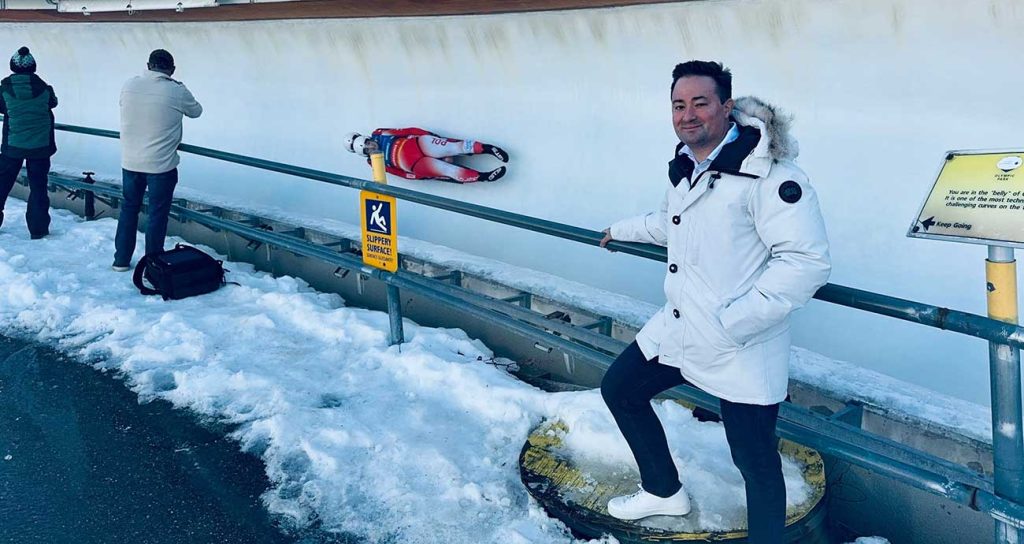 Dr. Eric Jacuzzi, VP of Vehicle Performance, NASCAR. Photo via Eric Jacuzzi.
Limits and Challenges
Despite these capabilities, the program faces technical and regulatory constraints. Luge sleds and athlete positions are governed by strict international rules, limiting design modifications. Full-scale 3D printed models are used primarily for aerodynamic testing rather than race-ready equipment, and translating wind tunnel data to real-world performance is complicated by the dynamic movements of athletes. Producing large, modular prototypes also requires significant time, materials, and post-processing, forcing engineers to balance rapid iteration with practical production schedules. Adapting NASCAR’s motorsport methods to winter sliding sports further requires accounting for different environmental conditions and sport-specific biomechanics.
3D Printing Is Being Used in Winter Sports
Additive manufacturing is increasingly used in sports and the Olympics because it enables fast, precise, and athlete-specific prototyping that traditional methods cannot match. In luge, teams have used 3D printing to produce custom molds, sled components, and ergonomic tooling, allowing iterative testing of aerodynamic performance ahead of competitions, as demonstrated by the USA Luge team before the 2018 Winter Olympics.
Related to winter sports, CAPiTA’s 3D printed snowboard sidewalls improved durability and performance while enabling rapid design changes. These examples show that 3D printing allows engineers to make precise, data-driven adjustments to sled geometry, athlete posture, and materials within existing constraints.
The 3D Printing Industry Awards are back. Make your nominations now.
Do you operate a 3D printing start-up? Reach readers, potential investors, and customers with the 3D Printing Industry Start-up of Year competition.
To stay up to date with the latest 3D printing news, don’t forget to subscribe to the 3D Printing Industry newsletter or follow us on Linkedin.
Featured image shows 3D Scanning Olympic Athletes. Photo via Eric Jacuzzi | NASCAR.