
Defenders have said the stress-based training is a necessary crucible to forge troopers who may find themselves in tense situations, such as, as the academy curriculum puts it, a “knock-down, drag-out fight at the side of a highway at 2 AM.”
After Delgado-Garcia’s death, the academy suspended the boxing program, which was one part of a defensive training that also includes takedowns, restraints, and escaping holds. Some major police forces in other states also use boxing to train recruits, according to publicly available course listings.
According to state law, manslaughter is when “wanton or reckless conduct” leads to another person’s death. Longtime defense attorney Janice Bassil said the definition of manslaughter includes conduct a reasonable person should know will result in grievous bodily harm.
The specifics of what happened in the leadup to Delgado-Garcia’s death remain unclear. But the special prosecutor, David E. Meier, described decisions by the accused instructors, Lieutenant Jennifer Penton and troopers Edwin Rodriguez, David Montanez, and Casey LaMonte, that run contrary to boxing best practices, which the national rulebook and local instructors say require serious precautions when a concussion is possible.
One local trainer the Globe spoke with said a boxer should not return to the ring after a concussion until cleared by a doctor. A second trainer said that if possible, he would keep anyone who’s concussed out for a year.
“You can’t mess around with the human brain,” Boston-based boxing trainer Brian Silverstein said. “You just can’t.”
The current rulebook for USA Boxing, the national governing body for amateur boxing, says that if a boxer has been knocked out or received a severe head blow that required a match to be stopped, the fighter should be evaluated by a physician and, at minimum, not fight for 30 days. If the person was knocked out, the break should be longer, and repeat knockouts can result in years away from the ring. (USA Boxing did not respond to an interview request.)
On Sept. 11, 2024, Delgado-Garcia suffered the “concussion-like symptoms” in “unauthorized, unapproved, and unsupervised boxing-related sparring exercises” during academy training, according to Meier, the special prosecutor.
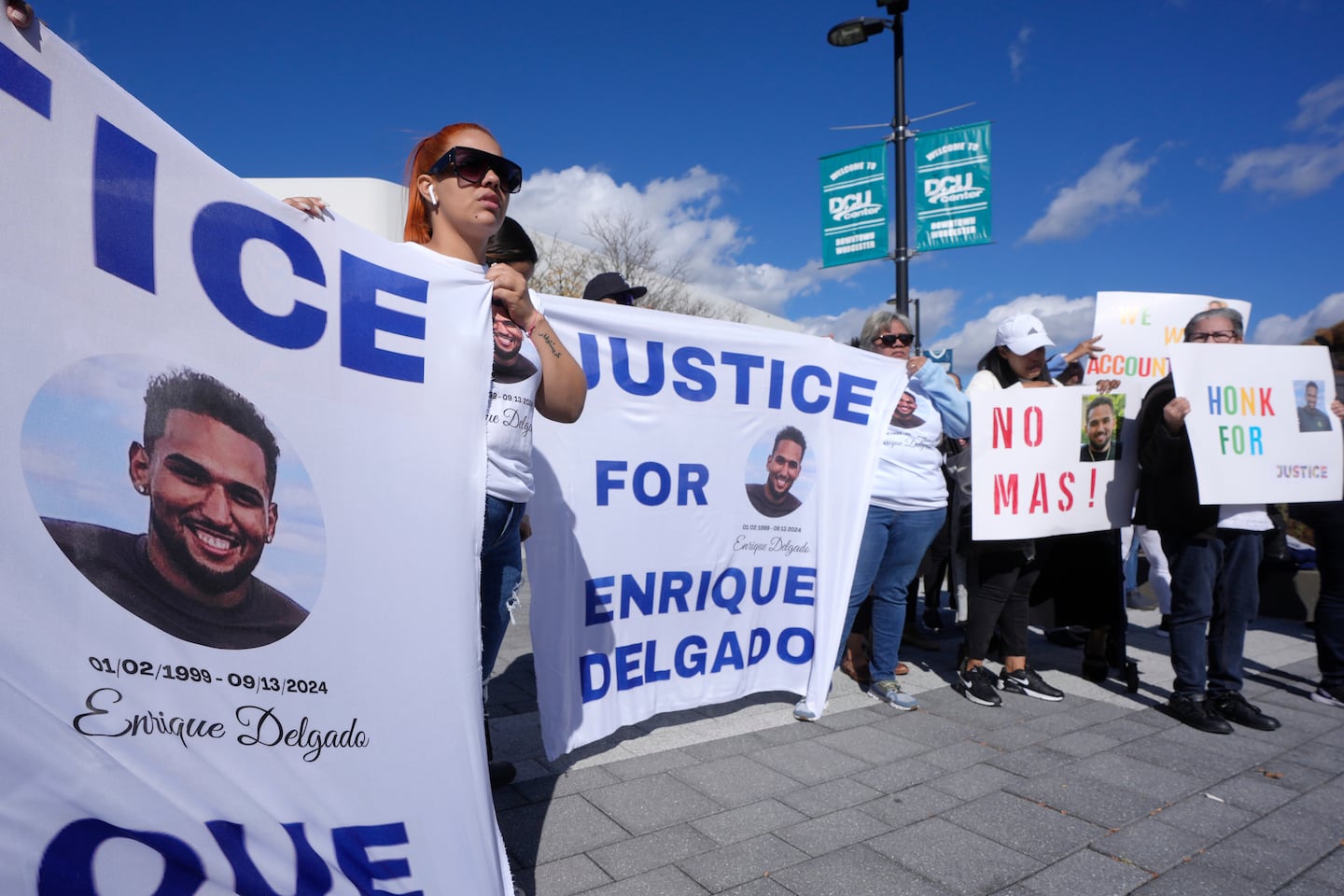
The following morning, Delgado-Garcia suffered further multiple blunt-force head injuries, leading to massive brain bleeding, Meier said. Delgado-Garcia died just a few weeks before graduating from the academy. He was sworn in as a trooper on his deathbed.
Following his death, Attorney General Andrea Campbell ordered the investigation by Meier. In his review, Meier noted the paramilitary structure of the academy, saying command staff “had the authority and the ability to address many of the circumstances surrounding Enrique Delgado Garcia’s death,” but concluded the evidence was “insufficient to support criminal charges” against those leaders.
The State Police defensive tactics lesson plan claims safety as its primary goal, though it does not address how quickly someone who’s concussed should box again, according to materials provided to the Globe last year.
Even the shorthand for the training is suggestive: it’s known as SCAR, for Subject Control Aggression Response, and “is rough by necessity,” according to the curriculum. “However, serious injuries are inexcusable.”
The lesson plan provided to the Globe was last updated in March 2024. LaMonte is one of the four authors, and the lesson plan lists him, Montanez, and Rodriguez, who’s a former professional boxer, among the instructors.
The curriculum document says instructors should step in any time a fighter appears stunned: “When in doubt, call time out!”
Still, the lesson plan hews to the paramilitary, stress-based ethos that’s the foundation of the notoriously rigorous academy.
That’s the reason, the authors write, how the bouts are organized: trainees are divided into groups of 10, and two fight at a time while the rest watch. They should be looking for safety violations, according to the lesson plan, which also adds: “This has the added effect of placing social pressure on the two competing trainees in order to encourage maximum effort.”
Retired State Police major Dennis Galvin, who ran the academy for several years and was a longtime member of the force’s boxing team, said boxing teaches trainees how to both throw a punch and take one. But, he said, the training should be done in a controlled setting and someone with concussion symptoms should never be allowed back in the ring.
“I don’t know what happened here but this doesn’t sound like the same school,” said Galvin, who’s now the head of the Massachusetts Association for Professional Law Enforcement.
The State Police academy in New Braintree is known as unusually difficult. Last year, a Globe investigation found it akin to a military-style boot camp system that often pushes recruits physically and emotionally to their limits, resulting in at least 100 injured recruits over the four most recent classes, including at least two dozen who ended up in the hospital or urgent care. Some, as what allegedly happened to Delgado-Garcia, were injured multiple times.
The Globe investigation found injury and dropout rates much higher than national averages.
The stress-based approach has its supporters, but others question whether the boot-camp-style approach creates the type of modern police officer who is ready to interact with the public with tactics of deescalation and communication.
One of those questioning that approach is Colonel Geoffrey D. Noble, who became the new commander of the State Police a few weeks after Delgado-Garcia’s death. He suspended the boxing program and commissioned the International Association of Chiefs of Police to review the academy, including its paramilitary structure and physical requirements. The State Police this week said that review is nearing its conclusion.
Friends have said Delgado-Garcia spoke about the difficulties of the academy, but was insistent on pushing through.
On Tuesday, a day after the indictments were unsealed, the state Peace Officer Training & Standards Commission, which licenses police officers, suspended the certifications of the four instructors, meaning they can’t work as police officers in Massachusetts for now. The same day, the State Police announced all four were on paid administrative leave pending disciplinary hearings.
The agency wrote that none had been subject to agency discipline before. Rodriguez and Montanez were still working at the academy when they were placed on leave. Penton and LaMonte were both transferred last summer, according to documents obtained by the Globe; Penton was transferred twice, ultimately landing at the Revere barracks, according to the State Police.
All four face charges of involuntary manslaughter, which is a felony, as well as a misdemeanor count of injuring someone during a training exercise, according to the indictments. Penton, a supervisor, also faces a charge of lying to the grand jury about when she learned of Delgado-Garcia’s original symptoms, according to court documents
In Massachusetts, convictions for manslaughter can carry a wide range of penalties. State law allows for a sentence of up to 20 years, but does not have a minimum sentence.
Sean Cotter can be reached at sean.cotter@globe.com. Follow him @cotterreporter.