
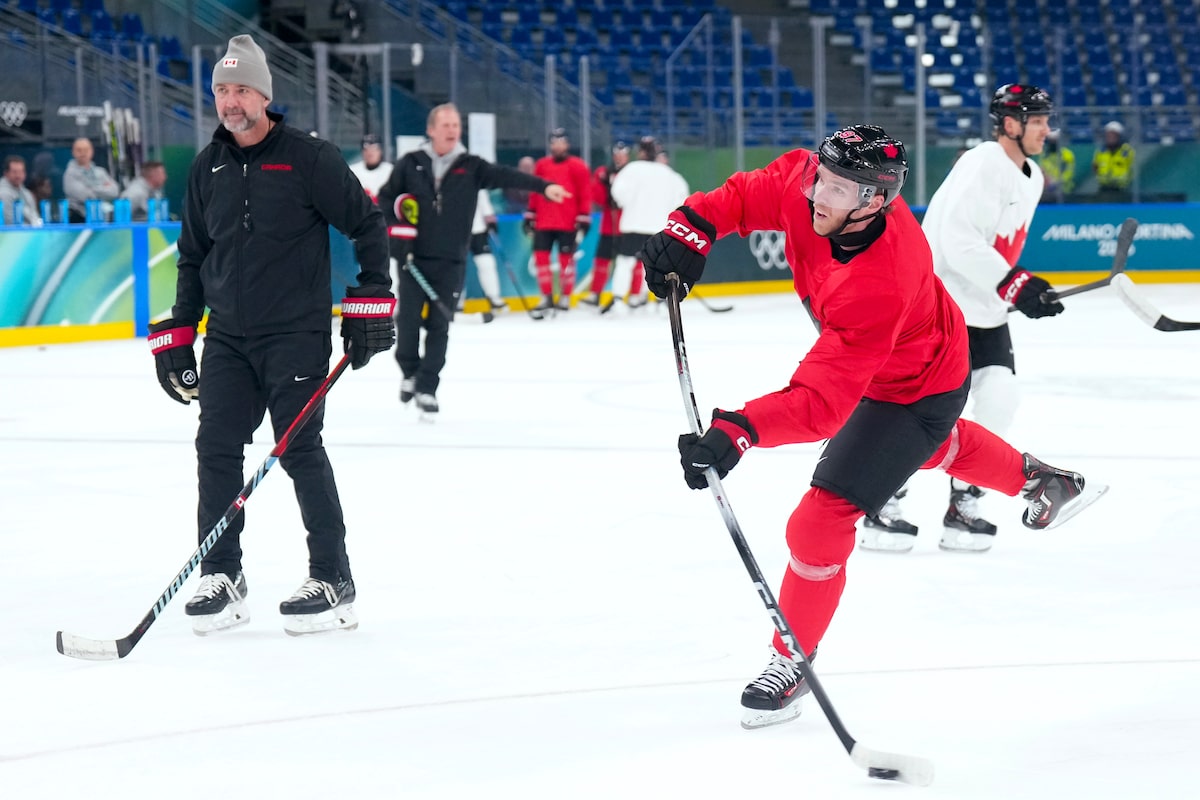
Connor McDavid and the Canadian hockey team have the option of not staying in the athletes village at the Olympics, if they choose not to. It’s a perk that comes with the big money around the NHL and its return to the Winter Games.Nathan Denette/The Canadian Press
Ahead of their appearance here, a small kerfuffle broke out when people realized that Canada’s NHL-based Olympians might not be staying in the athletes village.
On Wednesday, Team Canada GM Doug Armstrong walked into that one when he said of the players that “the time they’re having at the village is fantastic.”
“At” is a funny word choice in that context, as opposed to “in.”
“I think this has grown a little larger than it is,” Armstrong said when asked about it – a formulation that is only used when things are just about the perfect size.
“The players have always had a hotel room in all the Olympics prior to this, in Vancouver, in Sochi. They’ve stayed with their families. They have a room in the village. They have a room provided by the NHL and NHLPA outside there.”
So if you’re inclined to be offended by the idea that Connor McDavid is lounging in a heart-shaped hot tub at the Ritz, while Canada’s skiers are huddled together for warmth in a single double-wide up in the mountains, this story is actually worse. It turns out that Team Canada is a 25-man Italian real-estate crisis – they don’t even live here and they each have two homes.
However, there’s no point inclining that way. The Olympics have always been divided by class, as well as ability.
The underclass stays in the village. These are the athletes who compete in sports that have no professional opportunities, or limited ones.
A few of them – Chinese freestyle skier Eileen Gu leaps to mind – have ascended the class ladder on the basis of non-sporting endorsements. Her Instagram is filled with charming videos taken inside the village. She brings along her own rice cooker!
Silver medalist Eileen Gu of China has built a great deal of success through endorsements.Hannah Peters/Getty Images
Does Gu also have a hotel room? If so, you won’t see that on Instagram. Gu may be a multi-multimillionaire, but she has the sense to play a woman of the people on TV.
Not so, Dutch speed skater Jutta Leerdam. She’s a sort of sub-Gu – a pin-up blonde whose social media output would not be described as charming. She’s also engaged to American boxer-influencer Jake Paul. She flew to Milan on a private jet, and made sure everyone knew about it.
Leerdam won gold the other day, and the Dutch teammate who placed second didn’t bother to come out onto the ice to congratulate her. Neither did the Japanese skater who finished third, and was standing right beside her at the end. This may be what happens when you rub your good fortune in the faces of colleagues who don’t share in it.
Other members of the underclass include those from smaller, non-Western countries, regardless of discipline, and those who aren’t expecting to win medals, regardless of what they’re doing.
The overclass is made up of anyone who plays a major pro team sport, as well as golfers and tennis players. Well, the good ones. The ones whose names you know. There are tennis players at the Olympics who had to get there by slow boat.
How a speech about ‘small moments’ may impact Canada’s hockey fate at the Olympics
Those at the top are joined by a few competitors who take part in traditionally amateur disciplines, but are so good at them that they have become globally famous. Michael Phelps and Usain Bolt are in that category.
Do golfers stay in the village? I don’t know, do they sleep in their cars at Augusta? Of course golfers don’t stay in the village. They visit for the purpose of taking pictures, but they sleep in a California king.
A few big timers have given themselves over to the full Olympic experience. Rafael Nadal famously stayed in the village at Beijing 2008. He even tried doing his own laundry.
British cyclist Jamie Staff – an honorary overclass member as a gold medalist – told the Guardian he’d witnessed Nadal’s attempt at playing chav.
Rafael Nadal won people over in 2008 by staying in the athletes village at the Beijing Summer Games. The tennis superstar even tried doing his own laundry.Elise Amendola/The Associated Press
“He was shoving all his colours and whites in together,” Staff said. “I really wanted to say, ‘Dude, you’re going to have a nightmare with that. You can’t just put the whole bag in – there’s red in with the whites.’ But what can you do?”
Exactly – what can you do when you see your betters stumbling around in the real world? You just tug a forelock as they pass and wait to be asked.
There is a fantasy that the Olympics represents a great coming together of the flower of the world’s youth in material harmony. Maybe that was true a hundred years ago, but it hasn’t been for ages. As soon as you started charging media to broadcast this thing, any hope of a flat class structure vanished.
This is now coming into conflict with phony concerns about equality (phony because no one intends to do anything about it).
This is presumably why Armstrong was so precise about who is paying for the NHLers’ hotels – the NHL and NHLPA. You still know someone is going to wonder why the PWHL isn’t providing a similar service for its players (it’s because they can’t afford it).
By Los Angeles 2028, American WNBA players will be the newest ascendants to the overclass, regardless of where they finish. You think their assortment of six-and-a-half footers are going to be sleeping in single beds that inflate out of a vac pack? No chance.
Will Canada’s women basketballers get the same treatment? Also, no chance. They are still the Swiss men’s hockey team – on the cusp of elite status, but not quite there yet.
Thinking of things this way is an alternate way to view the Olympics. Not just as an opportunity to see who’s best at what, but to see who and what matters. Skiers were the gods of the Winter Games 50 years ago. Not any more. Now it’s hockey players.
In the Olympics to come, who will rise and who will fall? On a long enough timescale, who sleeps where, and who pays for it, tells you more about who’s winning the competition under the competition – the one for global status – than any medal table.