
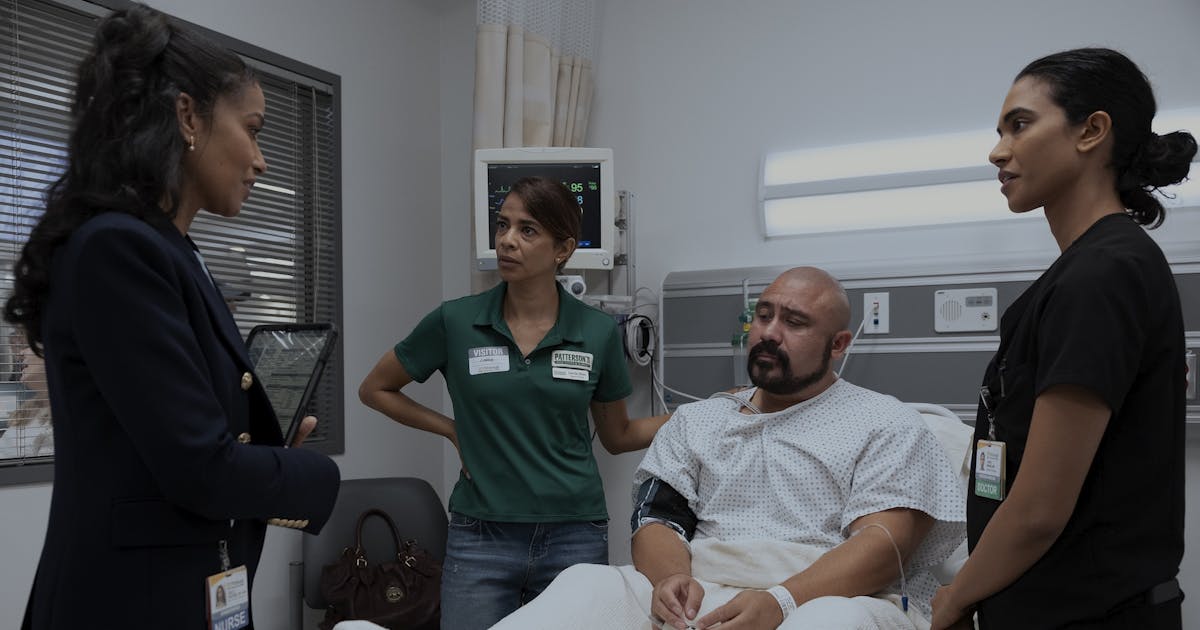
OK, The Pitt is also a fun and fast-paced medical drama with engaging characters and a level of accuracy that has earned it plaudits from physicians. (If you’re anything like me, you just allow the medical jargon to wash over you like a gentle tide, without ever attempting to actually grasp the wave.) The show could also be viewed as an extended public service announcement; one in which every installment is a Very Special Episode. And since each episode of the show is one real-time hour of a 15-hour work shift at the fictional Pittsburgh Trauma Medical Center, it suggests that health care professionals spend as much of their day navigating the vicissitudes of the health care system itself as they do healing patients. The Pitt wants you to know that we live in a society, and one that often fails its most vulnerable.
I’ve covered poverty policy for several years, including Medicaid; like many professionals with a level of knowledge in a certain field, I tend to overestimate the average person’s understanding of the social safety net; what may be obvious to me could be brand new information to you. (Although hopefully not, if you’ve read my articles about Medicaid and the ACA before.) If you have the money to afford the HBO streaming service without a second thought, you may not realize a family of five, like Orlando’s fictional household, would need to earn less than $38,680 a year to receive Medicaid.
Throughout its inaugural season and the first third of its second, The Pitt has, with varying degrees of subtlety, expounded upon the difficulties that patients face in obtaining adequate care. The first season covered such issues as—deep breath—abortion access, vaccine skepticism, opioid addiction, the coronavirus pandemic, unconscious bias in the medical industry, young men’s mental health, sex trafficking, the safety of health care workers, and gun violence, specifically through the lens of a fictional mass shooting. (And these are only the topics I can remember off the top of my head.) Every episode is peppered with new lessons about how the medical system works and how patients are treated. One installment depicts a Black woman experiencing severe complications after giving birth, highlighting that Black women face disproportionately high rates of maternal mortality and morbidity. In another, a doctor gently chides another for her unconscious bias against an overweight patient.