
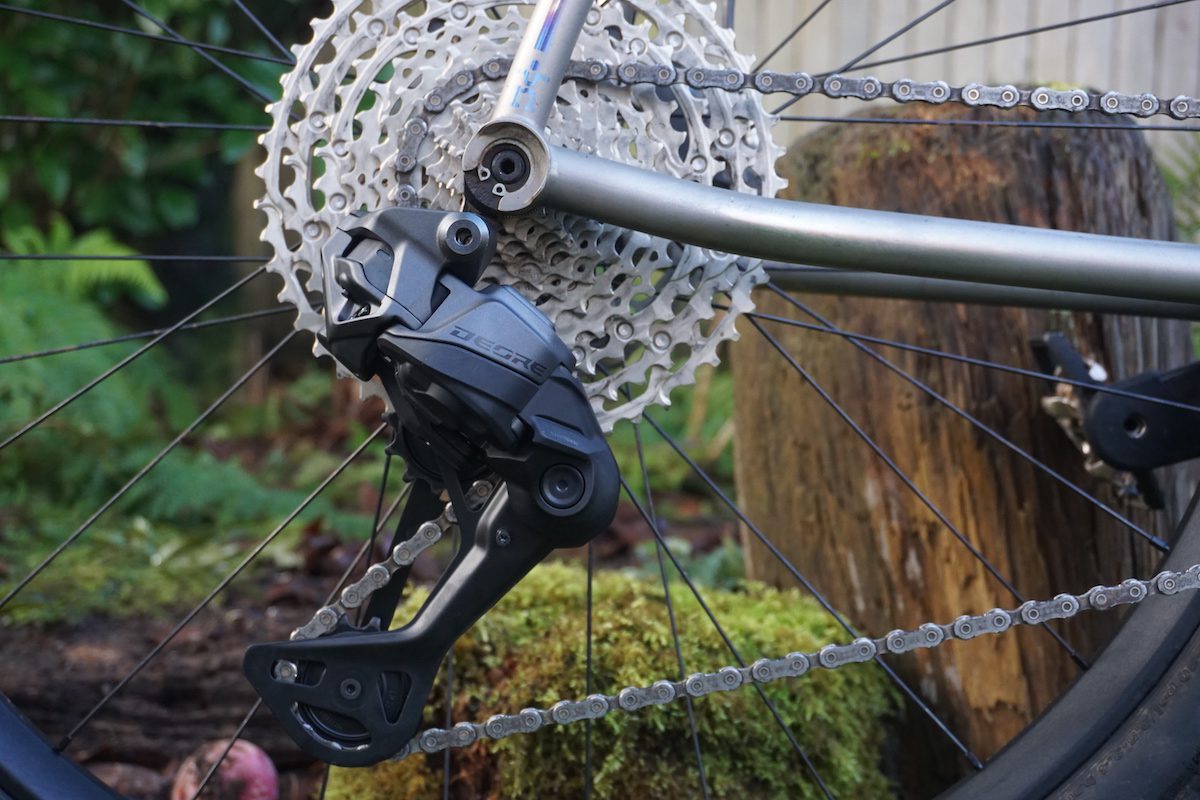
When Shimano launched its long awaited / overdue wireless Di2 system, it went all in. Four groups, from XTR to XT and Deore and even a GRX gravel option. But it also launched all of these as upgrade kits, not just full drivetrains. This is an option we were really interested in from the start and, with Deore only coming as an upgrade kit, it seemed like the perfect opportunity.
Why? Well, it lets you turn any existing Shimano 12-speed drivetrain, and there are a lot of those out there, into a wireless electronic group with minimal new parts.
Here’s our experience installing Shimano Deore Di2 6200 and our initial impressions of the third-tier wireless drivetrain.
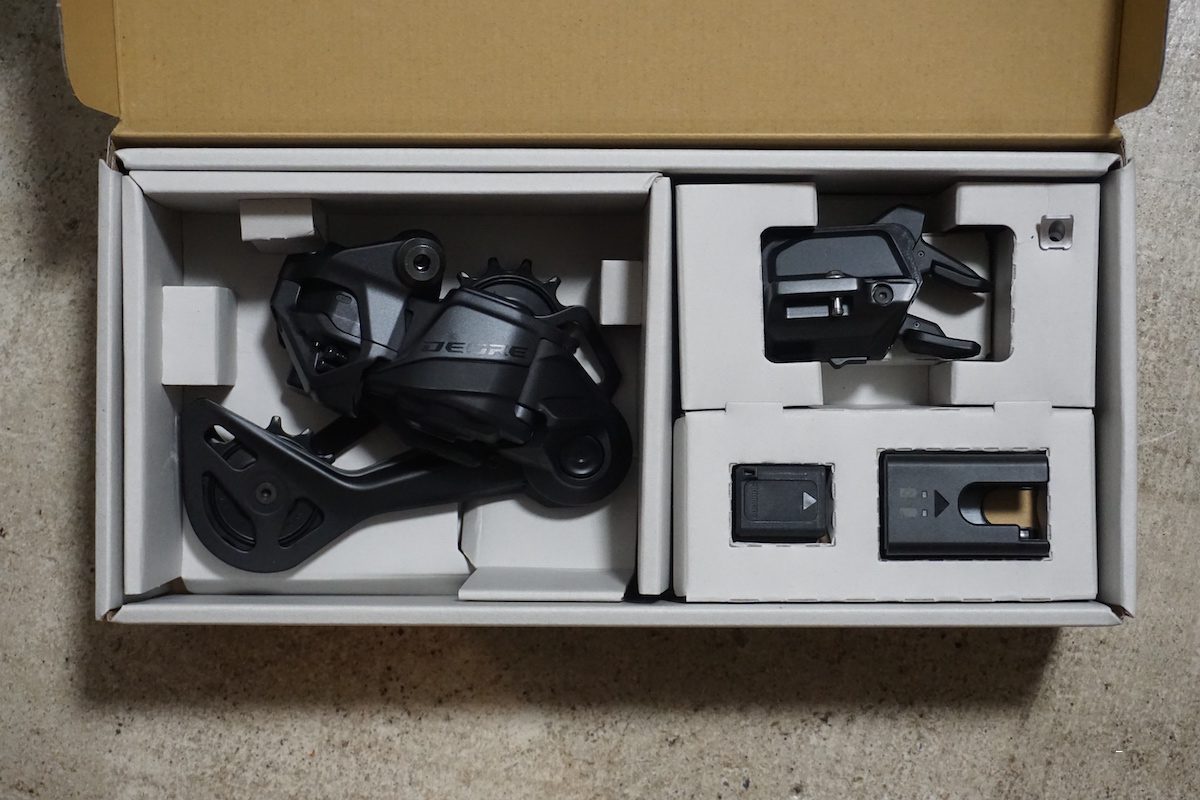
What is in a Deore Di2 upgrade kit?
The idea behind the upgrade kits is simple: allow anyone with a Shimano drivetrain to upgrade to wireless shifting without turfing their entire existing drivetrain. That’s possible because Di2 is backward compatible with any existing Shimano 12-speed HyperGlide+ (HG+) drivetrain.
The upgrade kit, then, includes everything you need to pull off that upgrade, down to a quick-link, and nothing more. That is a rear derailleur, shifter, battery, charger and cable. That, and a 12-speed quick-link to reconnect your old chain, since quick-links are supposed to be single-use.
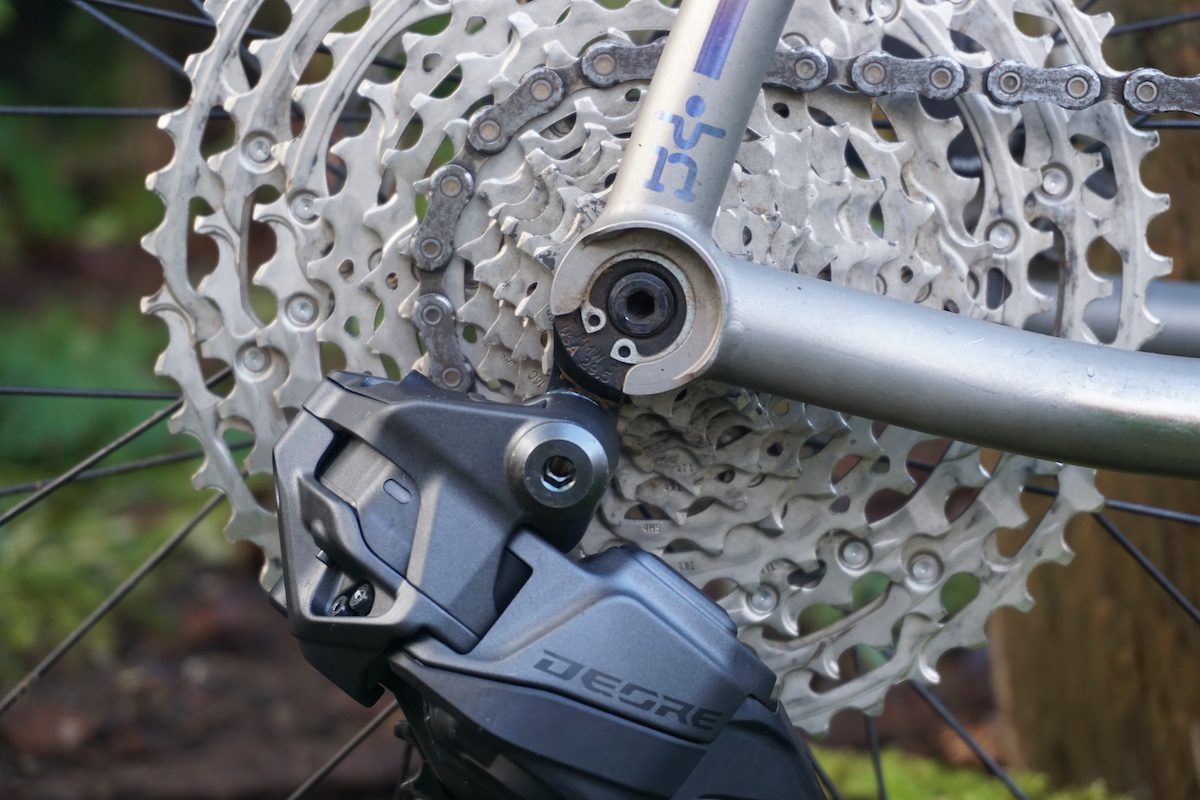 Deore Di2 bringing a “forever” frame into the wireless future. And yes, I probably should have left that chain in the past. So far, Deore Di2 is still making it shift just fine.
Installing Deore Di2 Upgrade Kit
Getting Deore Di2 out of the box and onto the bike is a little different than installing a good old cable-actuated derailleur, and a little the same. The first step for installing Di2 is to charge the battery, instead of fishing a cable and housing through the frame. From there on, it’s pretty straight-forward.
If you’re familiar with the process from mechanical, installing Di2 is much the same. As a mildly amusing bonus, if you hold off installing the controller, you can hold it in your hand while adjusting the limit screws so that process no longer requires an awkward reach.
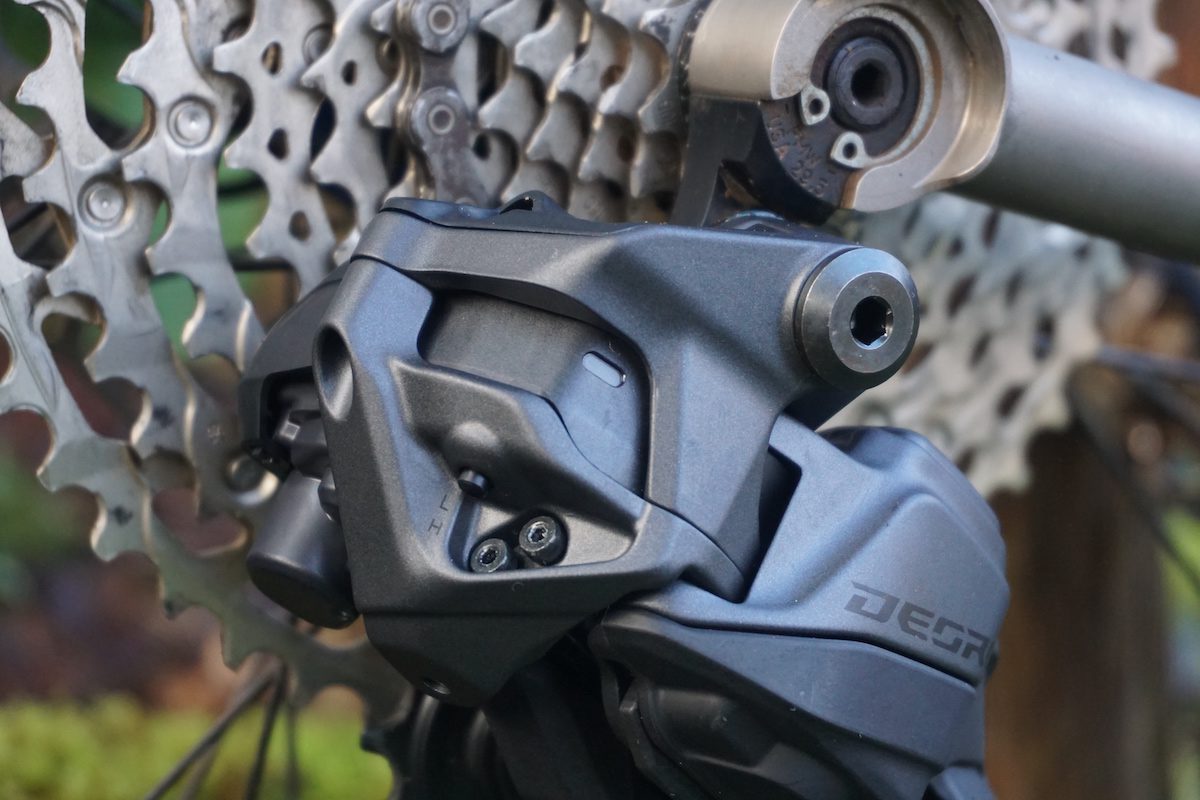 Limit screws still work and are still reasonably easy to work with. Easier, arguably, than with mechanical as there’s no cable tension to factor in.
Shimano relies on the same derailleur mount and trio of adjustment screws (B-tension, high and low limit) that have worked for decades. That means I was able to install it on a custom Ti Naked that isn’t that old, but still pre-dates UDH ever so slightly. (Yes, original SRAM AXS would work on this frame. No, T-Type will not). With this being just an upgrade kit, I could drop it into the current drivetrain and keep the Race Face Era cranks I’m currently running (without ended up with an extra set of cranks).
One note: If you’re upgrading an existing Shimano drivetrain, you’re good to go. If you’re switching a bike from SRAM’s new T-Type to Di2, you’ll need a derailleur hangar for your frame. That is not included in the upgrade kit. But, on that front, you can install Di2 on both UDH and non-UDH compatible frames.
All in, installing the Di2 is quite a bit easier than a cable drivetrain. While most of the steps are similar, not having to run a cable through a frame or get cable tension just right makes it easy enough that even moderately mechanically inclined riders should be able to do it just fine.
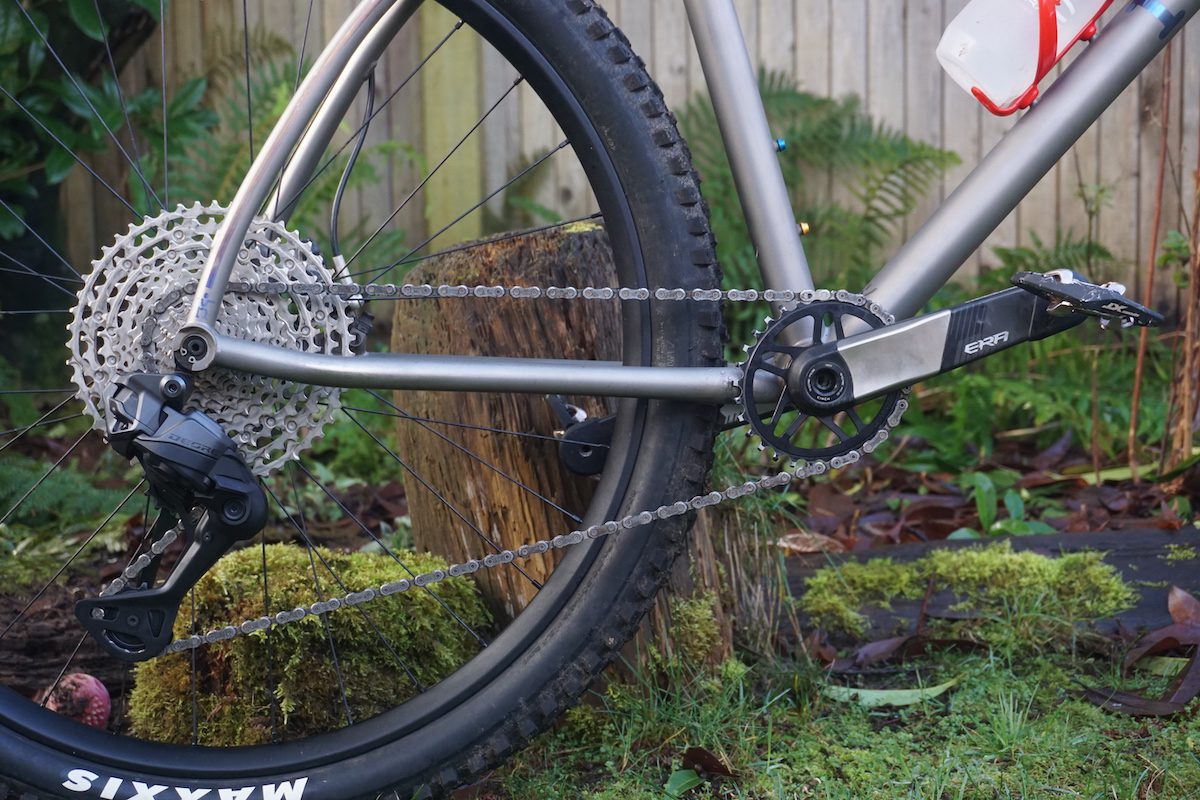 Upgrade kits are a great option if you’re already invested in other upgrades, like fancy cranks or other bits
Deore versus the rest
As we’ve talked about quite a bit already, Deore is mostly the same as the higher end Di2 groups. But there are some differences. It’s also quite a bit different than SRAM’s approach to wireless shifting.
The biggest difference compared to XT and XTR is that it’s only available as an upgrade kit. XT and XTR were full group and brake releases. Deore is just the shifter and derailleur. Everything else carries over from the mechanical Deore 6100 group. It also has a different finish than XT or XTR, though that’s just aesthetic.
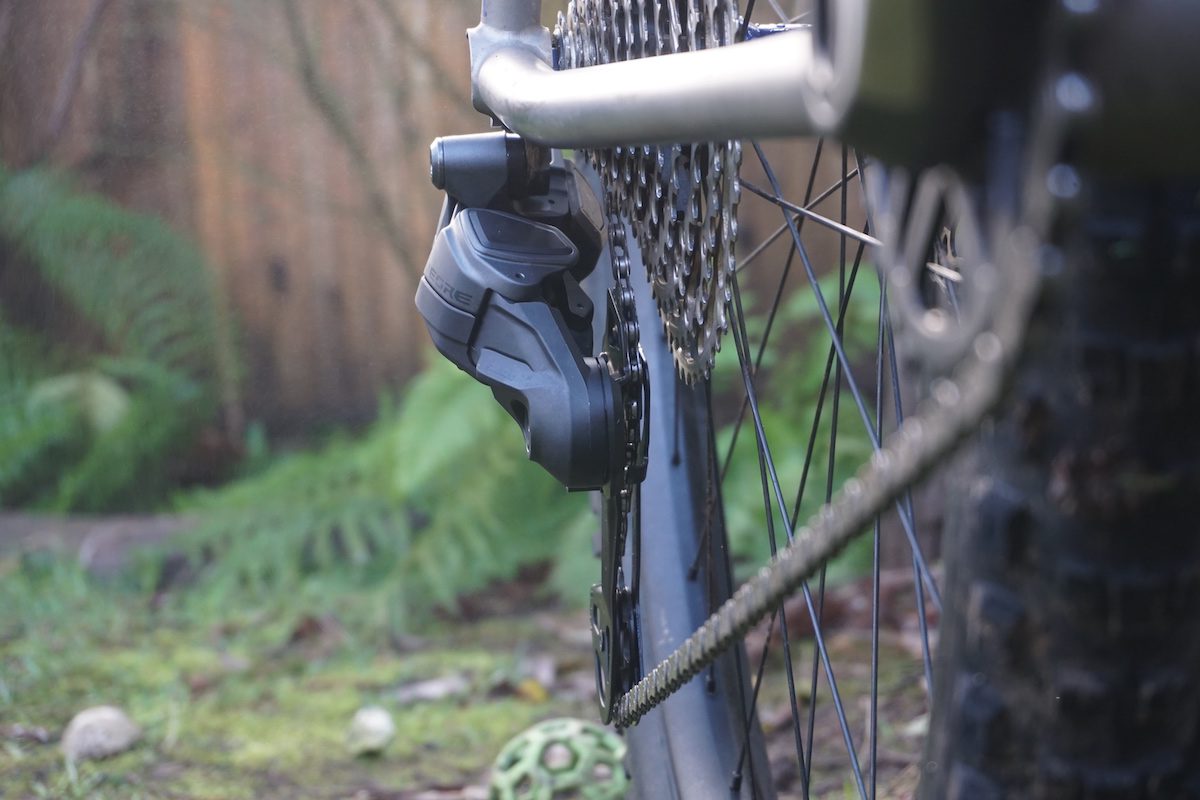 Deore follows XT and XTR away from the Shadow+ clutch. the Di2 profile is much slimmer than current T-Type options.
As for functional differences, Deore is slightly heavier and quite a bit less expensive. XTR rear derailleur is 391g ($899), XT is 454g ($769) and Deore is 497g ($636). Since function is the same at this end, those price differences mostly reflect the materials used to make the higher end groups lighter.
There are bigger differences at the shifter end. Deore is actually the lightest, at 85g ($202). But that’s because it does not have the same adjustable shift paddles that XT or XTR do. Deore also only has single and multi-shift functions. There’s no double-shift option. You can still use Shimano’s app to program the shift speed.
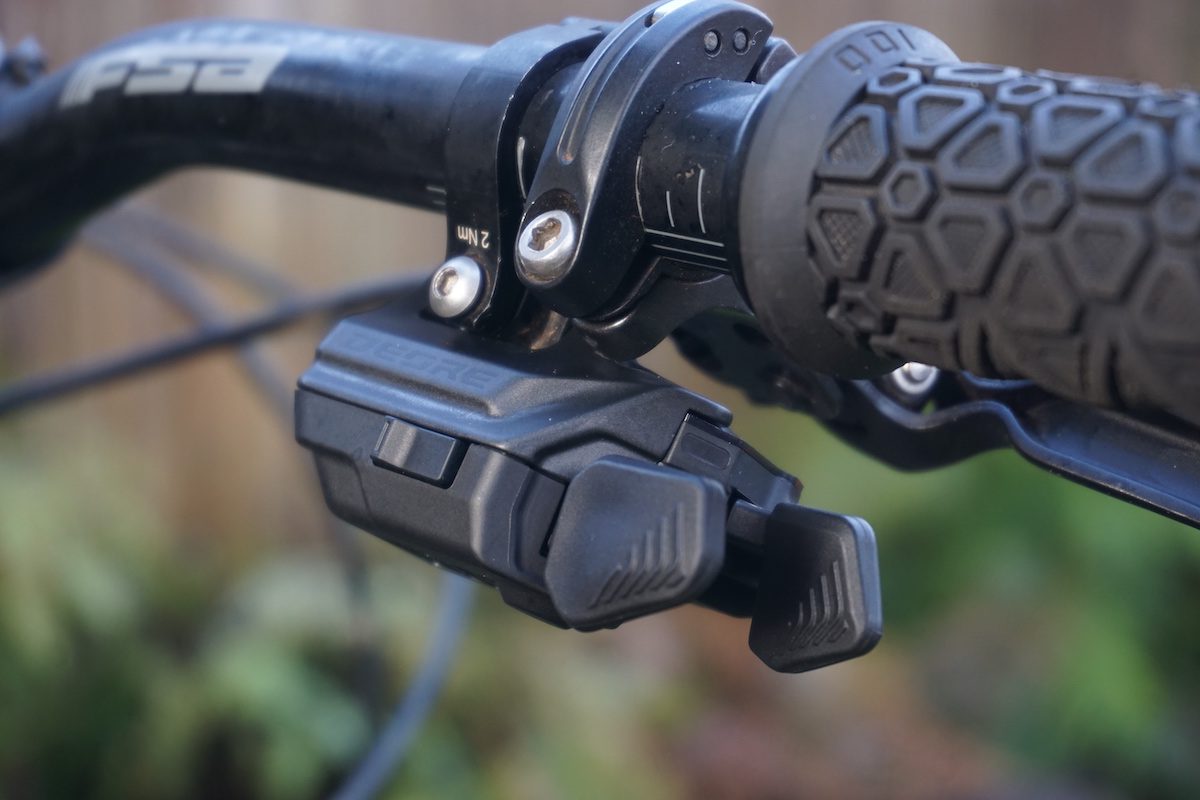 Shimano offers Upgrade Kits with the choice of iSpecEV or band clamp mounts. I’m currently using a band clamp to move the shifter further inboard. But that’s just personal preference.
Ride impressions: Deore Di2 delivers better-than-Deore performance
Deore’s claim to fame has always been that it works better than it should, and does so for a long time. On the first point, Deore Di2 carries on the tradition. Other than a little extra weight, and a few less options at the shifter end, there’s very little to separate this from XT or even XTR Di2 derailleurs and shifters. On both XT and XTR I’ve had the shift paddles set near the limit of their adjustment range, so I’m curious to see if I can get the Deore shifter in a comfortable position. It’s already significantly better than SRAM’s Pod shifter, though. The battery is exactly the same, so battery life should be similarly good.
Like its mechanical predecessor, Deore Di2 is also significantly less expensive than those higher end groups, while providing that impressive performance. Deore Di2 is just under a grand in CAD, at $989, verus $1,160 for XT or $1,334 for XTR Di2. That is also quite a bit more expensive than Deore without the Di2 but, if you’re interested in wireless, cutting cables is going to come at a cost no matter what brand or group you go with.
Long term performance will be key to determining Deore’s value. Both XT and XTR Di2 have stood up to months and months of abuse through all four seasons. If Deore can do the same, it will be a big addition to Shimano’s line.