

Thanks for reading the Her Hoop Stats newsletter. We’re excited to announce a new partnership with Hudl. Hudl’s industry-leading tools – Sportscode, Instat, and Fastmodel – elevate the preparation, performance, and player development of WNBA and NCAA teams. We appreciate their support and look forward to working with them to help bring more insight about the women’s game to you.
You can find me on Bluesky and HHS on Bluesky, Twitter, YouTube, Facebook, and Instagram.
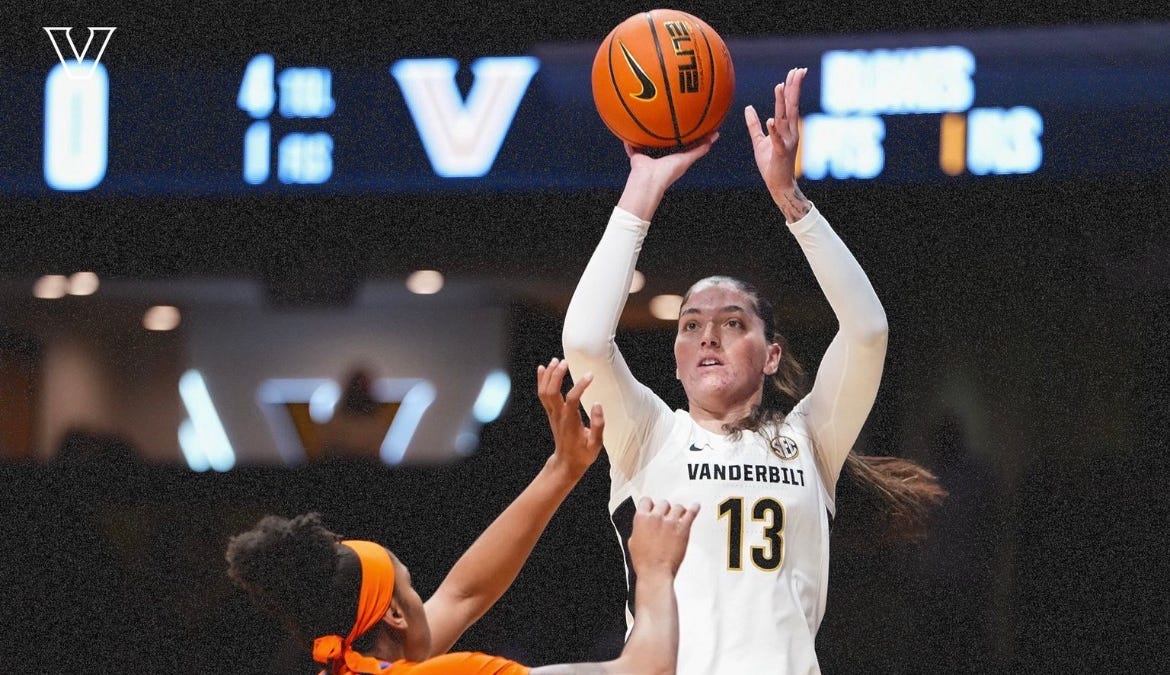
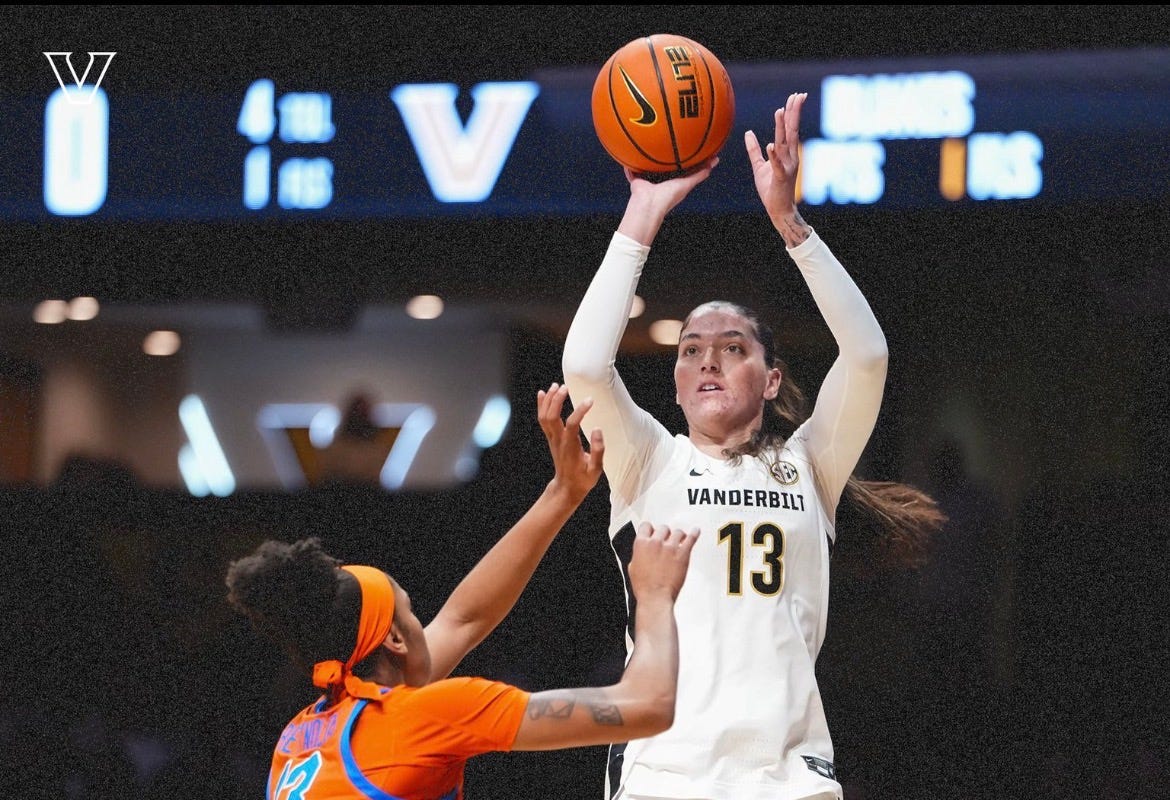 Photo courtesy of Vanderbilt University Athletics
WNBA teams are increasingly placing a premium on the ability to play positionless basketball and rostering versatile athletes who can defend across multiple positions, compete on the glass, and provide meaningful floor spacing. The 2026 draft class features a solid pool of prospects equipped with the size, mobility, and shooting prowess needed to bridge the gap between the frontcourt and the perimeter, which could help them persevere in the pros.
Mid-major players are often overlooked for the next level, but this 6-foot-2 forward has kept herself on the radar of several WNBA teams by playing with a fearless approach against top competition and filling the stat sheet all season long. The reigning Atlantic 10 Player of the Year is leading her team in points (22.3 ppg), rebounds (8.2 rpg), and blocks (1.1 bpg) and has delivered several impressive outings, including a 48-point, 13-rebound performance in Richmond’s 91-84 triple-overtime win against Davidson last month. Beyond the numbers, Doogan has built a reputation for being a high-IQ point-forward, capable of operating as a secondary playmaker who reads the floor well, understands how to navigate screening actions, and finds open teammates with precision. Her combination of length, efficiency in knocking it down from deep (42.0% on 6.8 3PA per game), and knack for finishing inside makes her a compelling option for WNBA teams seeking a versatile, multi-level scoring threat.
When trying to project her success to the WNBA, the primary questions center around her ability to contain more explosive wings and hold her ground against stronger, more physical forwards. Although she’s shown she can be effective on help-side and disruptive in passing lanes, her one-on-one defense against elite athleticism remains an area of growth. Some have also questioned whether her first step off the dribble is sufficient to create separation against the league’s top defenders. But as Doogan continues to invest in developing more strength, quickness, and physicality, she could further substantiate her two-way potential, shed any “offensive specialist” labels, and solidify her case for a roster spot at the next level.
Even on a team filled with WNBA prospects, the 6-foot-4 forward has been a valuable contributor for the Bruins off the bench, averaging 9.3 points, 5.2 rebounds, and 1.9 assists per game this season. Her coveted blend of size, court vision, and proficiency from beyond the arc (37.3% on 2.4 3PA per game) exemplifies the stretch-4 archetype that professional teams are routinely seeking. This season, she’s also become much more prolific around the rim, which has helped boost her effective field-goal percentage (59.8%) and player offensive rating (113.6) to career-highs. Defensively, she’s been excellent at leveraging her length and understanding of the game to disrupt passing lanes, execute timely defensive rotations, and position herself for well-timed blocks. Her draft stock is also elevated by her international experience with the Serbian national team, which includes Olympic appearances and a EuroBasket gold medal.
To solidify her place at the professional level, Dugalić must continue to enhance decision-making against aggressive defenses (averaging 2.0 turnovers per game) and hunt her shot with greater consistency. While she’s a credible scoring threat from beyond the arc, scouts have noted the need for greater assertiveness to be relied on as a true floor-spacer at the next level. But if she can increasingly demonstrate she can be counted on to make smart decisions and deliver crucial shots in pivotal moments, she could be an excellent pickup for a franchise in need of a lengthy and versatile scoring option.
After somewhat of a slow start to her senior season from beyond the arc, the 6-foot-3 guard has looked increasingly comfortable in Maryland’s offensive flow and seems to have reestablished herself as one of the premier floor-spacers in this draft class. Now shooting 40.9% on 7.0 3-point attempts per game, her ability to hit contested 3-pointers or pull up for a mid-range jumper makes her a constant offensive threat. In addition to her valuable length and shooting talent, Garzon possesses great court awareness and the passing accuracy of a point guard, averaging three or more assists per game across all four seasons of her career. She often operates as a point-forward who can facilitate out of the pick-and-roll with elite pocket passes or find cutters from the high post.
Garzon’s future in the league largely hinges on how well she can hold up defensively against WNBA athletes. Although she’s improving her strength and using her size well, her foot speed remains a concern when tasked with containing shiftier opponents or navigating screens at the point of attack. In addition, her ability to create her own shot against more agile defenders, particularly off the dribble, is a work in progress. But if Garzon’s precision from deep carries through postseason play and she can show improvement as a scoring threat off the bounce, her length, shooting gravity, and playmaking ability should keep her on many draft boards as a reliable option come draft night.
The No. 11 nationally-ranked recruit by ESPN has experienced an up-and-down collegiate journey of fighting through adversity and finding the right fit. Even after transferring to Vanderbilt after her freshman year, Pissott’s progress hasn’t always been linear. But she seems to have finally found her footing, locking down a starting role on one of the top-ranked teams in the country and developing into much more than a 3-point specialist. While the 6-foot-4 forward still earns over three-quarters (78.8%) of her points from beyond the arc with incredible efficiency (44.8% on 6.7 3PA per game), she’s also shown significant growth across nearly every other facet of her game, posting career bests in rebounds (4.5 rpg), assists (2.4 apg), player efficiency rating (20.3), and player offensive rating (126.8). These impressive stats, combined with her size, live-ball decision-making, and ball-handling ability, make her a dangerous cover and a legitimate offensive weapon who can score over almost any defender.
Pissott’s transition to the professional level will largely depend on her ability to continue rounding out her game beyond shooting, particularly on the defensive end. While she’s made tangible strides in containing quicker guards, further growth is still needed in terms of handling physicality, improving her lateral agility, and ramping up her aggressiveness. Offensively, refining her finishes around the rim and increasing her offensive assertiveness would help diversify her scoring profile and solidify her value as a multi-dimensional rotation piece rather than just a situational shooter. Still, if her elite perimeter efficiency holds and her team remains among the nation’s top contenders, Pissott is likely to stay firmly on the radar of several WNBA GMs and could reward a team willing to invest in her upside as a floor-spacing forward with room to grow.
The 6-foot-3 forward opened the season in impressive form, averaging 18.6 points over the first 15 games while knocking down 41.2% from three on 6.5 attempts per game. That early stretch highlighted her potential as a modern stretch-4 and caught the attention of WNBA scouts, who began to move her up on draft boards based on her combination of size, effectiveness on the glass, and offensive versatility. As the calendar turned to January, however, Suárez experienced a mid-season lull that tested her overall efficiency. The dip not only showed up in her perimeter shooting percentage, but also in her decision-making and ball security, all of which became more pronounced as defenses keyed in on her as a primary threat.
But while her recent downturn has been noticeable, it could just be part of her ongoing developmental arc. Over the course of her college career, Suárez has shown herself to be a reliable rebounder, a steadily improving defender, and an increasingly efficient offensive contributor. She’s also displayed a remarkable ability to change games in high-pressure moments, demonstrating a poise and confidence that translate well to late-game situations. Her experience competing with the Spanish national team at multiple FIBA levels further strengthens her professional profile, providing valuable experience against physicality, pace, and schematic complexity that could help her more easily adjust to the WNBA. If she can continue to recapture her early-season form, hone her offensive processing, and sustain a high level of 3-point proficiency through the rest of the season, her physical tools and clutch reputation could push her back into early-round draft conversations.
After completing an accolade-filled junior season at Saint Joseph’s, which included recording over 500 points, 300 rebounds, and 100 assists, setting a program scoring record with 43 points against Loyola Chicago, racking up 19 double-doubles, and earning finalist honors for the Becky Hammon Mid-Major Player of the Year, the 6-foot-2 Danish forward transferred to Louisville to test her game against a higher caliber of competition. Carrying great momentum into the season, Ziegler landed on both the Naismith Trophy and the Lisa Leslie Award watch lists and has continued to prove her ability to impact the game at a more demanding level. Embracing a variety of roles and showcasing her willingness to do whatever her team needs to help it win, she’s been a prolific rebounder, a confident 3-level scorer, a capable high-post facilitator, and a regular initiator of the Cardinals’ offense, making her an intriguing fit for WNBA rosters.
Ziegler’s ultimate draft position will largely be determined by her ability to improve her consistency from the perimeter as her team pushes through postseason play. While she’s shown legitimate range from beyond the arc (36.0% on 3.7 3PA per game), her 3-point shooting has been streaky. Evaluators will also be closely following how she holds up defensively against more athletic forwards in space in high-level matchups. Still, the gains she’s made this year, including career highs in effective field-goal percentage (52.5%) and assist-to-turnover ratio (1.93), speak to her ability to impact the game with reduced minutes after quickly adjusting to a new team and style of play. That combination of versatility, efficiency, and role acceptance positions Ziegler as a strong late-round option and a player WNBA teams might want to bet on as a dependable rotation piece.
All of these prospects have shown they can consistently knock down shots and have the size and skill required to play at the next level. As they continue to develop their strength and athleticism and show they can compete on both ends as they go up against elite physicality through postseason play, their late-season success will help determine their final draft position and how quickly they can secure a meaningful role in the professional game.
Thanks for reading the Her Hoop Stats newsletter. We’re excited to announce a new partnership with Hudl. Hudl’s industry-leading tools – Sportscode, Instat, and Fastmodel – elevate the preparation, performance, and player development of WNBA and NCAA teams. We appreciate their support and look forward to working with them to help bring more insight about the women’s game to you.
You can find me on Bluesky and HHS on Bluesky, Twitter, YouTube, Facebook, and Instagram.