
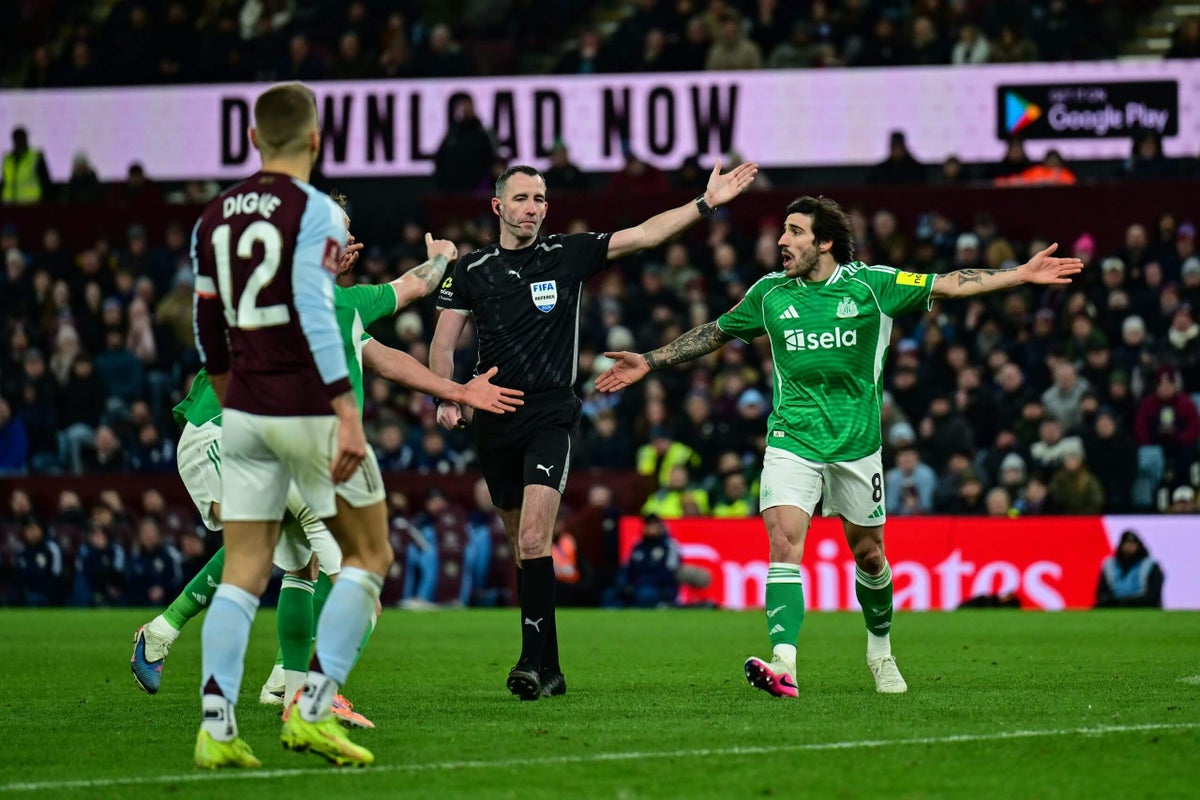
Isn’t it nice to have a weekend without VAR, where we can all simply focus on the football and refereeing does not have to dominate the narrative?
This just in: that is not how football works.
“Have we finally found the game that might turn you in favour of VAR?” presenter Kelly Cates teased a wound-up Alan Shearer in the BBC studio at half-time of his beloved Newcastle United’s FA Cup fourth-round meeting with Aston Villa on Saturday.
“No, I’d just like the officials to do their job properly, that’s all,” pundit Shearer replied, smiling tightly. “Not too much to ask, is it?”
That exchange followed a first half in which, with no Video Assistant Referee (VAR) as they are not used in the competition’s early rounds, Newcastle conceded a Tammy Abraham goal that appeared to be offside, had a handful of penalty appeals waved away, and saw Lucas Digne escape with only a yellow card for a studs-up challenge on Jacob Murphy. It felt as though the first time they got the rub of the green was when Villa goalkeeper Marco Bizot was sent off in stoppage time for charging off his line and taking down Murphy.
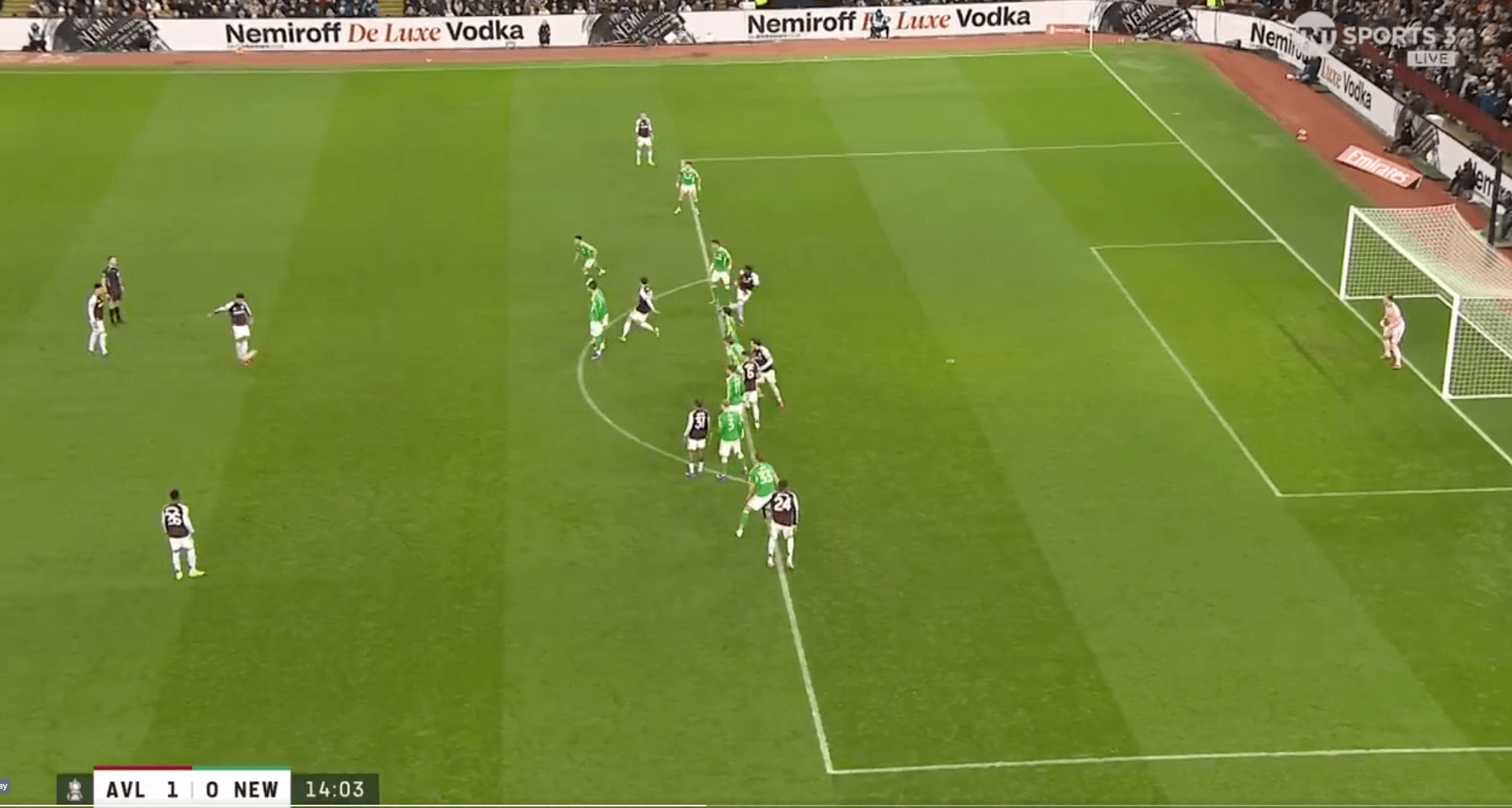
Abraham appears to be offside as Douglas Luiz takes the free-kick (TNT)
After an incident-free start to the second half, chants of ‘You’re not fit to referee’ rang out from the away end again in the 61st minute, when Digne blocked a cross with his arms above his head inside the box — only for a free kick outside it, not a penalty, to be given.
This is football without VAR, in all its spontaneity, uninhibited celebration, lack of delays — and, sometimes, mistakes. Is it what you want?
Everyone has their own opinion. Some will, of course, say yes. You may well think the human errors and injustices are a price worth paying to be able to fully and wildly celebrate a goal the second ball meets net — as Villa’s fans were able to revel in Abraham’s finish from Douglas Luiz’s delightful chipped free kick. For some, accepting mistakes is preferable to an interminable few minutes of scrolling through frames and drawing lines.
There might also be mystical souls who subscribe to the belief that these things work themselves out. No, Digne was not sent off for his challenge on Murphy in the 42nd minute — but Bizot was less than five minutes later. Newcastle will rightfully feel they should have had a penalty for Digne’s handball — but after a few minutes of fury at the officials, Sandro Tonali’s shot in the aftermath of the free kick was heavily deflected off Douglas Luiz and they were level anyway.
Of course, nobody wants to rely on karma in football — which brings us back to Shearer’s comments. He was right to call out referee Chris Kavanagh and his officiating team, who should have done better, especially with Digne’s handball. To spot the offence but not that it happened inside the penalty area is poor.
“If you ever needed any evidence of the damage that VAR has done to the referees, I think today is a great example of that,” Shearer said on the BBC after the match. “Because these guys, I think, looked petrified to make a decision today because they didn’t have a comfort blanket.”

Tonali celebrates his second goal of the game (Dan Istitene/Getty Images)
Newcastle head coach Eddie Howe agreed that players and officials switching between having VAR for league games and being without it in the FA Cup could have an effect.
“I think there’s an argument to say yes, because when VAR’s there, there’s always a, ‘Well, I won’t give that, but let’s check it’,” Howe said in his post-match press conference. “I think then your decision-making maybe isn’t as sharp as it may normally have to be, so maybe there’s a difference there.”
Officiating errors stand out more when they come in games where the officials and players involved are used to VAR — but they are not new. That is why football turned to technology in the first place.
Shearer’s perspective, lamenting the officials’ mistakes while still not turning in favour of VAR to help them, reflects the real riddle here. No, of course we don’t want this joy-killing, robotic, impersonal version of football — but we do want officials to reach a robotic, impersonal level of accuracy.
As everyone who remembers football without VAR — or still watches competitions without it, like most EFL or women’s games — will tell you, that is just not possible.
So then we have an unsolvable argument between the VAR abolitionists and the accuracy exponents. But wait, here come the centrists to solve the riddle!
‘Hey look, there must be a common-sense approach here where we get rid of the interminable delays and the toenail offsides and the endless apology tweets, but we can involve technology to sort out mistakes that are Just Common Sense.’ Of course, if you asked 10 of those common-sense campaigners to draw up their ideal system, you might well end up with 10 different plans. What is an ‘obvious’ offside? What is a ‘common sense’ handball?
Comeback complete 😮💨
Nick Woltemade seals @NUFC’s place in the #EmiratesFACup fifth round.
📺 Watch live on @BBCMOTD, @footballontnt and @discoveryplusUK pic.twitter.com/QM2GlVS6KO
— Emirates FA Cup (@EmiratesFACup) February 14, 2026
Officials with VAR in operation will make decisions you disagree with; officials without it will make decisions which, when they see a replay of the incident, even they disagree with.
A case study as short as the past four days shows that neither path is guaranteed to be popular. On Wednesday, when Newcastle’s Joe Willock had a goal against Tottenham Hotspur ruled out for an offside so tight he joked a haircut that morning would have seen it stand, fans might not have minded leaving such decisions to the human eye. Last night, when Abraham strayed offside for his opener, the technology would have saved Newcastle.
That is not to excuse that the offside was not spotted by officials, or to say Willock’s goal at Spurs ought to have stood — only to point out there is no silver bullet. Getting rid of VAR will not stop football endlessly chewing over refereeing decisions.
“I’m always torn on VAR. I’ve said this many times,” Howe said. “I still love the emotion, even tonight; when a goal’s given, or when a goal goes in, and you don’t see a flag or a referee, it’s a goal, and no one’s going to take it away from you. That sense and that emotion, that joy that you get in that moment, I still really love, and VAR takes it away.
“But then, on the other side, I was wishing there was VAR on the first goal against us, and probably throughout that game.”
Officiating is never going to be perfect, and what its ‘best version’ looks like is different for everyone. Is the ideal to give referees every resource possible to make the technically correct decision, even if that comes at the expense of some spontaneity? Or is it to accept the imperfections that come with a less stilted approach?
Whichever version of football you prefer is going to backfire on you sometimes. The best thing to do is make your peace with that — and step away from the keyboard.