
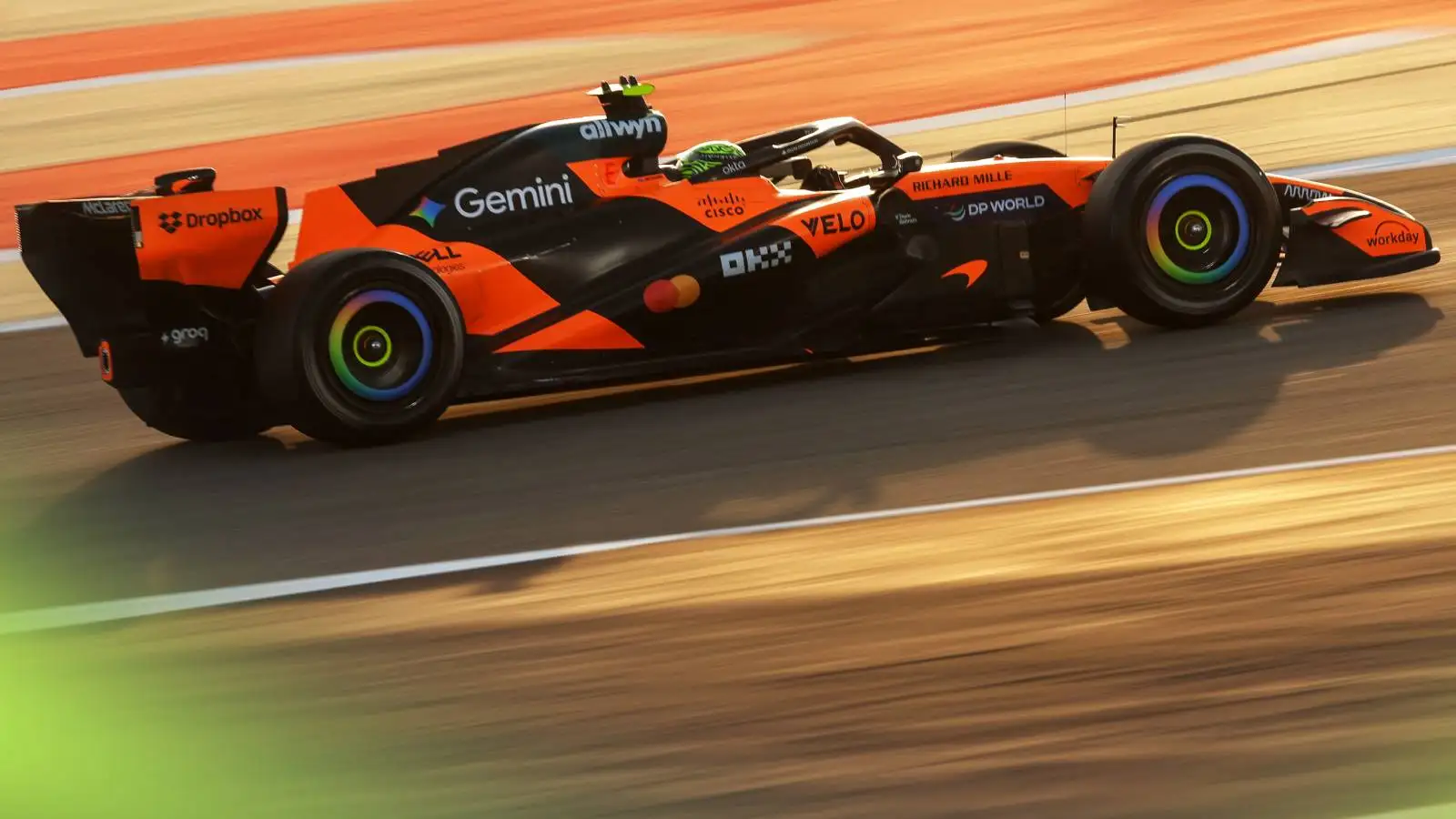
The introduction of active aerodynamics to cars in F1 2026 has created extra considerations for Pirelli in its 2026 tyre constructions.
With cars switching between low-drag straight-line configuration and high-downforce corner mode, the loads acting on the tyres are no longer linear, but dynamic and peaking in new ways.
How Straight-Line Mode has introduced new tyre force considerations
Want more PlanetF1.com coverage? Add us as a preferred source on Google for news you can trust.
F1 has itroduced lighter cars with a different aerodynamic philosophy in 2026, the tyres have remained broadly similar to last year, albeit smaller and lighter, while retaining the 18-inch diameter, the tyres are 25mm narrower at the front, and 30mm narrower at the rear.
After four years of ground-effect cars, F1 has moved to a more conventional aerodynamic philosophy that focuses on over-body airflow to generate downforce.
Alongside the changes to the power unit regulations, active aerodynamics have been introduced, which expands upon the DRS concept that was used as an overtaking aid for the last 15 years.
From this year, the cars have what’s called ‘Straight Line Mode’, in which the front and rear wings flatten going down the straights. This reduces drag and lowers downforce to enable higher straight-line speed, before the wings pop back up into ‘Corner Mode’ and restore the downforce.
It’s a fundamental change in driving dynamics for the drivers to learn to adjust to, while Pirelli has also had to engineer a tyre construction capable of handling the increased acceleration forces produced as a result of the increased torque from the electrical output of the 1.6-litre V6s.
Pirelli’s 2026 tyres were homologated on December 15, 2025, following an extensive testing programme, but this was carried out before any 2026 cars became a physical reality – instead, the tyre manufacturer had to rely on simulation data and mule cars from the teams in order to prepare for the engineering challenge of ’26.
With two tests worth of real-world data now to examine, Pirelli’s Mario Isola said a clearer picture will be formed as the teams ramp up performance at the final test next week, but all the forces being generated are in line with what had been accounted for in the tyre’s construction.
“At the moment, we’re quite aligned, but I believe that teams are not pushing at the limit,” he said in response to a question from PlanetF1.com after Friday’s running in Bahrain.
“So I’m expecting to see forces increasing for the next session.
“Obviously, the car is completely different compared to last year. So, last year, the main issue was at the end of the straight where you had the maximum load. So we were monitoring a lot at the end of straight for the load, the camber, and trying to understand which was the highest level of stress.
“Talking in general, because, if you go to Silverstone or Suzuka, it is a lot more important the speed in high-speed corners, rather than the straight itself.
“Now, on the straight, they don’t push the tyres a lot into the ground. The speed is higher so, in terms of standing waves, we have also to consider the speed, but the load is less.”
However, the spike in downforce when the front and rear wings switch from straight-line to corner mode is not insignificant.
Indeed, from PlanetF1.com’s own observances from the end of the back straight in Bahrain, a violent vertical shockwave is clearly visible as the downforce suddenly piles back onto the front and rear axles of the car.
“When they close the straight mode, the load on the car is much higher,” Isola said.
“So there is a peak when they close it and this additional load is through the corner.
“When we defined the prescriptions, we had to consider all that.”
It’s therefore theoretically possible that the prevalence of lock-ups seen in Bahrain could be as a consequence of the standing wave introduced by the sudden peak moment of force as the drivers lift off or brake for a corner, or the effects on the pitch of the car.
More from Bahrain pre-season testing
Telemetry exposes dramatic speed loss in new-for-2026 F1 cars
Winners and losers from the first Bahrain test
Could broken active aerodynamics cause tyre issues?
With the cars now designed fully around the active aerodynamics and the linear reduction in downforce as the cars accelerate down a straight, an unknown at this point is what may happen in the event of a systems failure of the active aero mode.
While DRS failures were few and far between, the use of DRS was optional and merely used as an aid, rather than being a fundamental facet of the car’s lap-after-lap design ethos.
Structurally, a failure would not be dangerous in terms of the car itself, but the question mark is regarding whether the tyres could take the increased forces introduced.
For instance, a car stuck in Corner Mode would be producing peak downforce at all times – including while powering down long straights such as in Saudi Arabia, Baku, or Las Vegas.
The tyres would thus be being pressed into the tarmac for far longer durations of time, at higher speeds, than the regulations have expected and, while Pirelli has designed its constructions and compounds with an eye to the teams development of more downforce throughout the year, there is the possibility that a systems failure of the straight-line mode could be far in excess of the peak demands of a functioning car even in a later stage of development.
“There is another complication that is if the system is closed, or only partially open, in case of wet conditions,” Isola said.
“So, when we define the prescriptions, we have to consider both the option with the system that is working and the system that is not working.
“Clearly, what we are doing now is to consider the system on for slick tyres and the system not working for the intermediate and wet.
“Teams are not obliged to use the straight mode also with the slick tyres. If they don’t want to open it, they can do that.
“Obviously they are not going to do that, because the risk is that they would catch the track with the floor, so I am not expecting a situation where someone is running with the system closed.
“But what happens if you have a system that is not functioning correctly? Is the driver going to stop in the pits? I don’t think so.
“If you have 10 laps to the end and the driver is running with 30-seconds advantage to the one behind, and he’s in the points, he’s not going to stop.
“If the system is not working, we have to consider that you have an additional load.
“Now I don’t want to consider all the cases we can face during the championship, just to tell you that we are working harder to understand which are the right prescriptions in order to give them a good tyre, with the level of performance expected, the level of degradation expected, in order to have mixed strategies as it was in the past.
“Everything is new and also for us, we need to understand what they are going to invent in order to protect ourselves with the right prescriptions.”
Asked whether a straight-line mode failure could trigger a driver being shown the black-and-orange flag, out of concern for the effects it could have on the tyres over a cumulative number of laps, Isola said this may need to be looked at if the active aerodynamics do prove less reliable than forecast.
“We never had a discussion about that. So honestly, I don’t know what to answer on that, but it’s also not clear,” he said.
“I believe the system is going to work 99 per cent of the time, so I’m not sure if we need to consider that as an option.
“But, obviously, if we see after the first couple of races that this percentage is much lower, and we have an issue with the system not working, we need to speak about that for sure.
“I believe they used the system during these days of testing, and I didn’t hear any report that the system was not working.
“Hopefully, we don’t need to consider emergency solutions, but we will monitor the situation, that’s for sure, because the load on tyres is quite different with the system closed and not closed.”
Want to be the first to know exclusive information from the F1 paddock? Join our broadcast channel on WhatsApp to get the scoop on the latest developments from our team of accredited journalists.
You can also subscribe to the PlanetF1 YouTube channel for exclusive features, hear from our paddock journalists with stories from the heart of Formula 1 and much more!
Read Next: Charles Leclerc warns of ‘extremely difficult’ overtaking under F1 2026 regulations