
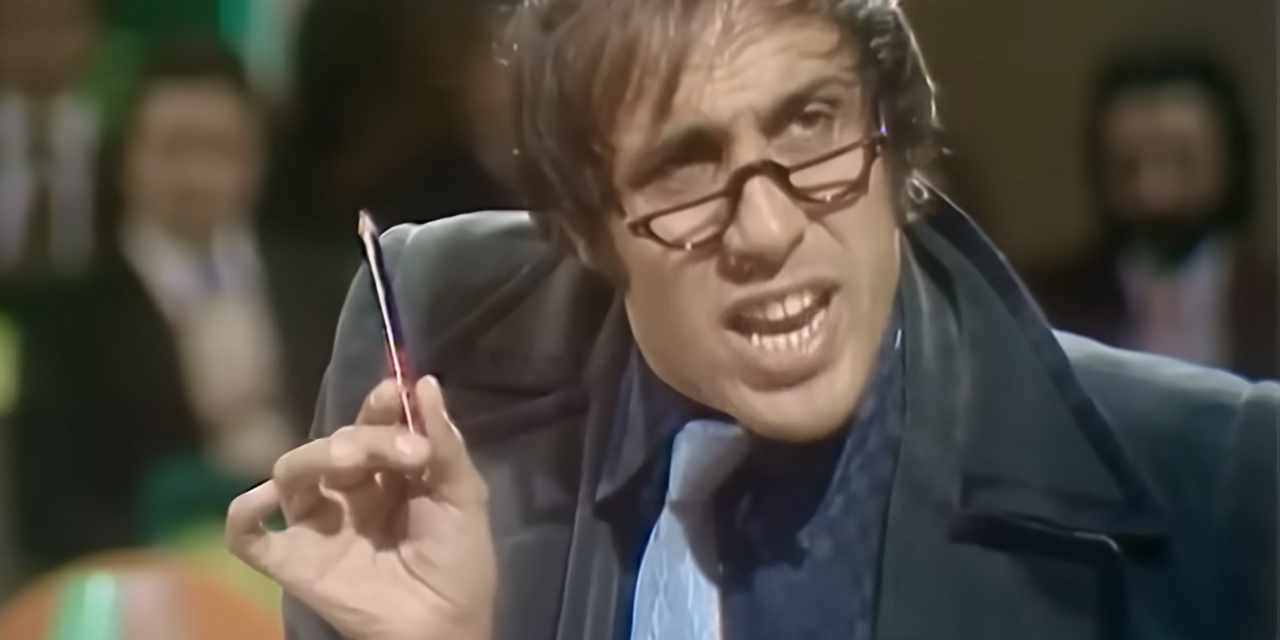
Milano is in the spotlight right now, halfway through hosting the Winter Olympics, and the world is watching Italy do what it does best—turn everything into an occasion for style, energy, and a bit of theatre. So this week on Sunny Side Up, from Wolfgang Bachschwöll’s A Little Soul collection, we’re celebrating with a song that captures the Italian spirit better than almost anything else. We’re playing Milan-born Adriano Celentano’s „Prisencolinensinainciusol“ from 1972.
If you’ve never heard it, prepare yourself. The title alone looks like someone fell asleep on a keyboard. The lyrics? Complete gibberish. Not Italian gibberish or English gibberish—just sounds strung together to mimic what American English sounds like to someone who doesn’t speak it.
„Oll raigth!“ Celentano shouts at the start, and off we go into four minutes of pure phonetic chaos that somehow became a number one hit in Italy and has refused to die ever since.
Adriano Celentano was born in 1938 in Milan’ Gluck Street, a street named after a revolutionary German-Bohemian composer. Mama and Papa Celentano to parents had moved north from Apulia looking for work. Before he became a star, he fixed watches. Then Elvis Presley happened, and Celentano brought rock and roll to Italy with a springy dance style that earned him the nickname „il molleggiato”—the bouncy one. He sold 150 million records, appeared in 39 films (mostly comedies where his rubber-faced expressions made him a box-office king), and became a legend. Fellini cast him in “La dolce vita“.
But „Prisencolinensinainciusol“ was something else entirely. In 1972, Celentano walked into his recording studio with an idea: he wanted to write a song about the inability to communicate, about language barriers and how frustrating it is when you can’t understand someone. His solution? Don’t use real language at all. He created a four-beat drum loop, grabbed the microphone, and started improvising sounds that felt like English without actually being English. He didn’t write anything down. He just let it flow.
The result is hypnotic. That drum loop locks in immediately—minimal, repetitive, relentless. Horns punctuate in short stabs. Celentano’s voice rides the rhythm like he’s rapping, except rap as we know it didn’t exist yet. He’s conversational, urgent, playful, switching between what sounds like phrases and what sounds like pure rhythm. The backing vocals chant „Oll raigth!“ like a mantra. There’s a breakdown. There’s call and response. It grooves harder than most funk records of the era.
Music critics have pointed out that Celentano accidentally predicted hip-hop—the looped drums, the looped horns, the freestyle flow over a beat. This was 1972, years before the Bronx invented the form. He was just following his instincts, and those instincts were a gold as top place on an Olympic podium.
The song hit number one in Italy and became a cult classic across Europe. Decades later, it keeps popping up—in the Coen Brothers’ „Fargo“, in the TV series „Trust“, in „Ted Lasso“, even in a 2026 EasyJet commercial. Every few years, a new generation discovers it and asks the same question: what on earth is he saying? The answer is nothing, and that’s the point. It’s a song that works in every country because it belongs to none of them. It’s universal precisely because it refuses to commit to meaning anything.
And it’s joyful. That’s what makes it so perfectly Italian, so perfectly suited to this moment when Milano is hosting the world. There’s no cynicism here, no irony. Celentano is having a blast, his band is locked in, and the whole thing just makes you want to move. It’s playful, confident, a little bit ridiculous, and completely irresistible.
We’re playing „Prisencolinensinainciusol“ on Sunny Side Up this week because it reminds us that music doesn’t need to make sense to make you feel something. Celentano proved that rhythm, energy, and a great groove can transcend every barrier. Fifty-three years later, as Milano lights up the Olympic stage, his gibberish still sounds like the most honest thing in the world.
Oll raigth!