
Written for Daily Hive Urbanized by Margareta Dovgal, who is a West End renter, a member of the City of Vancouver’s Renters Advisory Committee, and a public policy commentator.
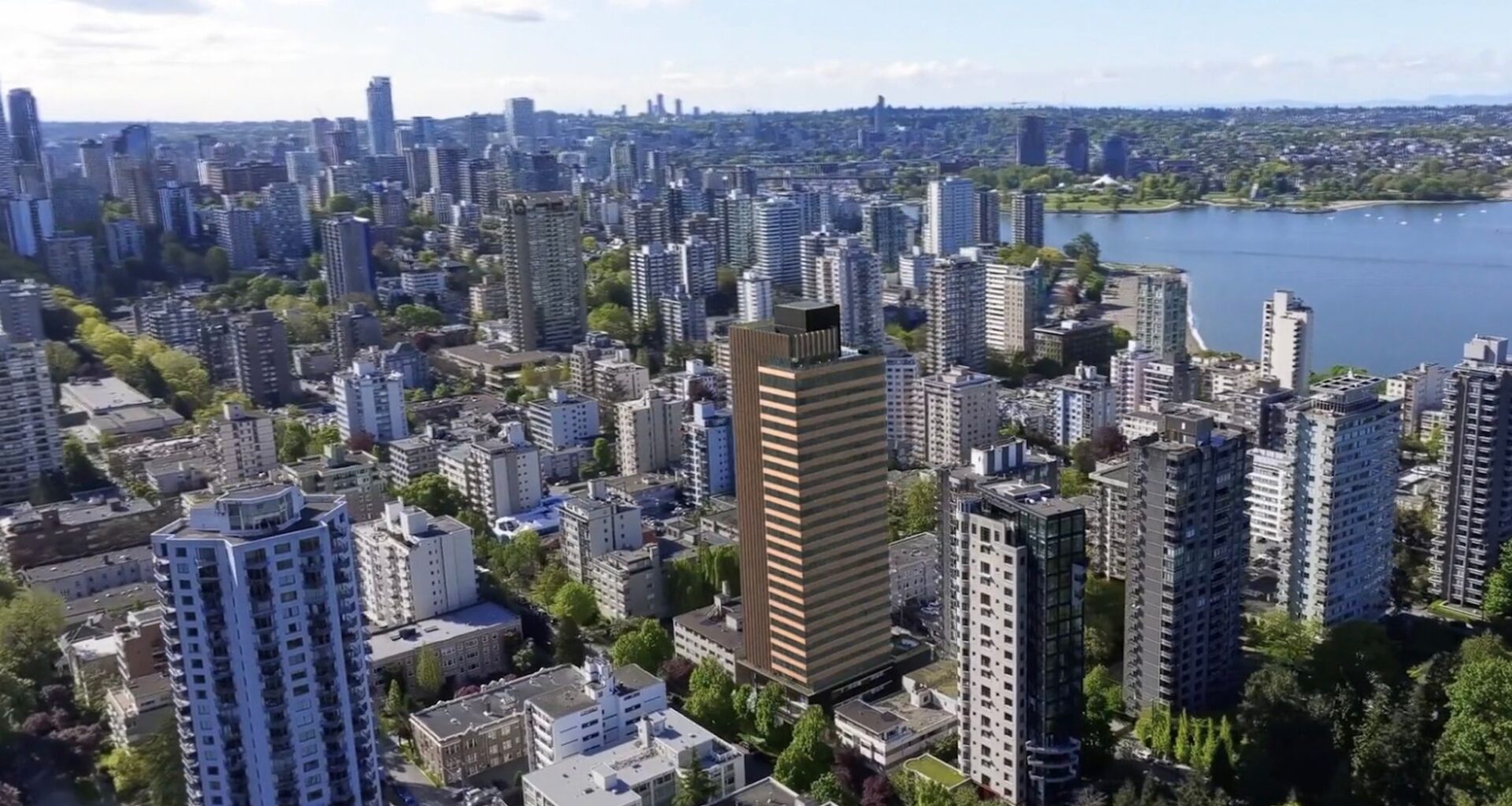
As a resident of the West End neighbourhood of downtown Vancouver, I’ve been watching recent hubbub about a proposed hotel redevelopment at the end of Barclay Street with something between fascination and frustration.
For all of its sincerity, I feel that opposition has been almost entirely disconnected from the material conditions that renters in this neighbourhood actually live with, and what’s causing the real issues we face.
I was born at St. Paul’s Hospital and I live nearby today. In fact, my parents were renting on Barclay right next to Stanley Park when I was born. I’m a single renter in my late 20s, paying what friends outside Vancouver consider an unconscionable amount of money each month. I know this neighbourhood in my bones and I’d like to pull the conversation back to earth.
Vancouver is short roughly 10,000 hotel guest rooms. That shortage didn’t materialize overnight. It steadily built for decades. While Vancouver continues to be a gem to visit (and there’s no evidence that that’s going to change), the shortage will not resolve itself. It has also steadily, and entirely predictably, fuelled a massive proliferation of short-term rentals.
In the absence of enough legitimate options for visitors, the market didn’t politely wait for Vancouver City Council to act. It routed around the problem and entire buildings were bought out and listed on Airbnb. That’s in large part why the provincial government cracked down on short-term rentals across B.C.
But as my neighbours and I can attest, there are still many units that should be housing people but are instead being rented out to visitors on the sly. Better enforcement won’t get us out of this problem when it’s really about the fundamental economics.
Failing to build enough legitimate hotels has created the phenomenon we see today of ghost hotels operated by absentee landlords.
We need those very apartments doing what apartments are supposed to do: housing young professionals, small families, and elderly couples who want to age in their neighbourhood.
Most of our city rents. That’s a rare statistic in a country with some of the highest home ownership rates in the world.
We know what happens when demand outpaces supply in housing. Prices rise and vacancy rates decrease, squeezing renters. The same causal mechanism applies to hotels, but it also spills over into the housing market. Every unit siphoned into the short-term rental market is a unit removed from our already strained rental housing stock. Every year we fail to build adequate hotel capacity is another year we incentivize sneaky maneuvers to get around short-term rental restrictions.
The project at 2030 Barclay St. directly addresses this. It will replace an existing small hotel that has been on the site since 1959, and it will add roughly 250 guest rooms, the majority of which are long-term stay units designed for extended visitors and business travellers. In short, that’s more new accommodation options, while displacing zero rental housing and removing no residents.
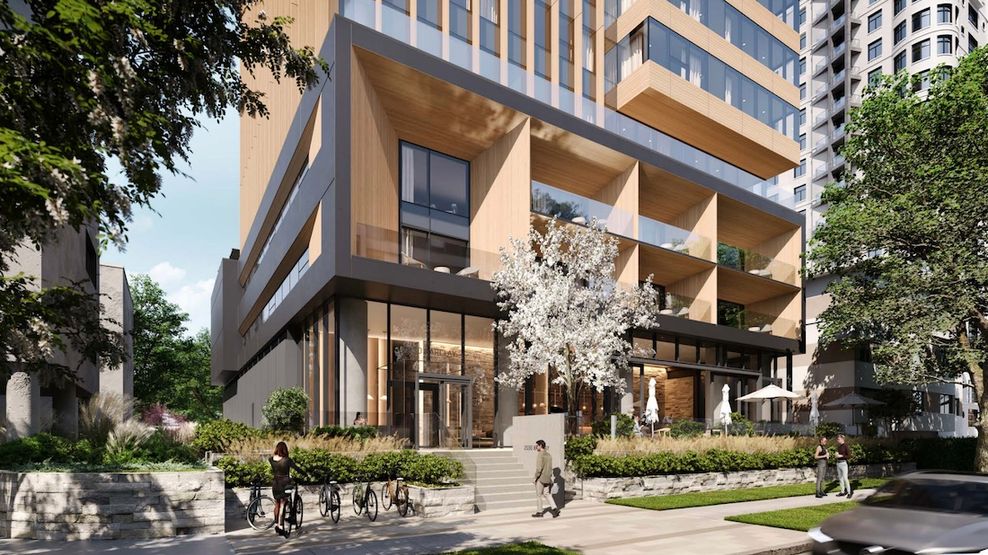
May 2025 revised concept of the hotel at 2030 Barclay St., Vancouver. (Henriquez Partners Architects/Marcon Developments)
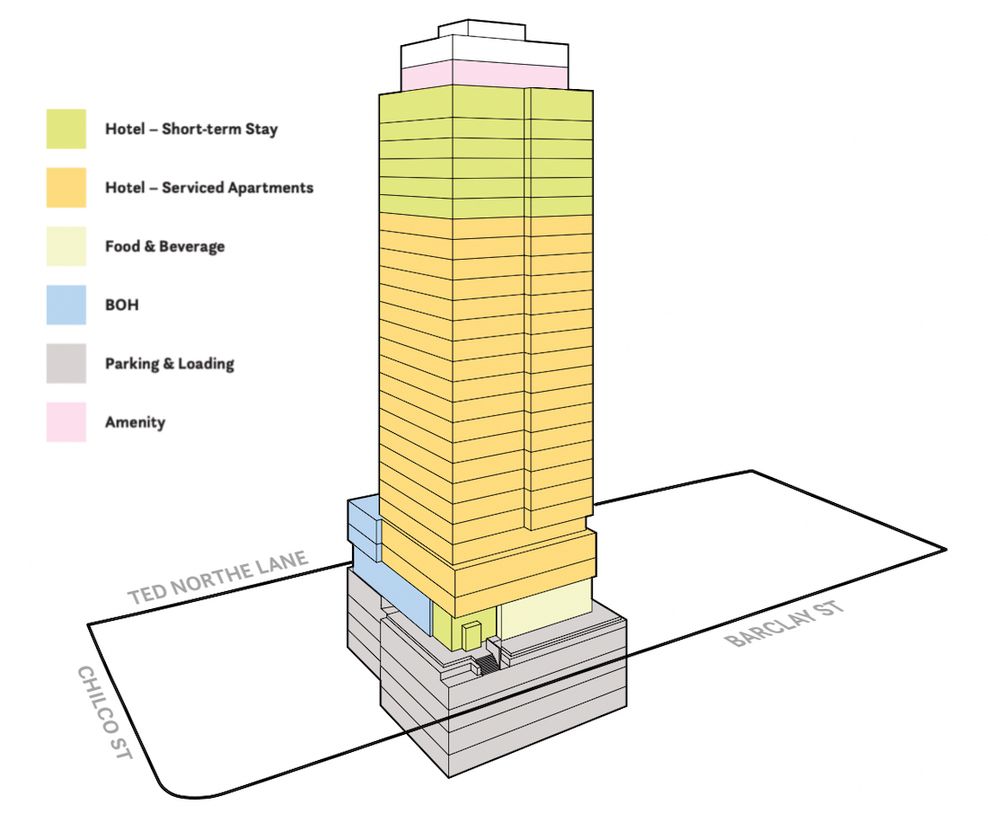
May 2025 revised concept of the hotel at 2030 Barclay St., Vancouver. (Henriquez Partners Architects/Marcon Developments)
And on a more personal note: I would also love to offer visiting friends and family something better than the air mattress I stuff between my couch and coffee table. When family visits from out of town, when parents come to help with a new baby, or when a friend from university wants to spend a weekend, we all need somewhere nearby for them to stay. Adequate hotel space is neighbourhood infrastructure, and in the West End today it is sorely needed.
Vancouver’s tourism economy continues to grow. The 2026 FIFA World Cup is a great example. The most entrepreneurial neighbours I know are already making plans to get out of town this June to rake in considerable cash.
Whether driven by major sporting events or routine summer traffic, the demand side of this equation is only going to intensify.
Our options are simple. We can build out accommodation capacity to meet that demand with proper, regulated, purpose-built hotels, generating local jobs and tax revenues. Or we can keep doing nothing, and keep watching the short-term rental market chip away at housing.
There is no third path where we build nothing and everything gets fixed like magic.
I understand that change is uncomfortable. A 25-storey building is taller than what currently sits on the site, and I say this as someone living next to a soon-to-be construction site myself. But that’s urban life, and discomfort with change is not the basis for good urban policy.
The status quo is not protecting renters: it’s failing us. The West End deserves a neighbourhood that plans for the people who live in it. That requires being pragmatic about the pressures that come from being a world-class tourism destination, and building accordingly.
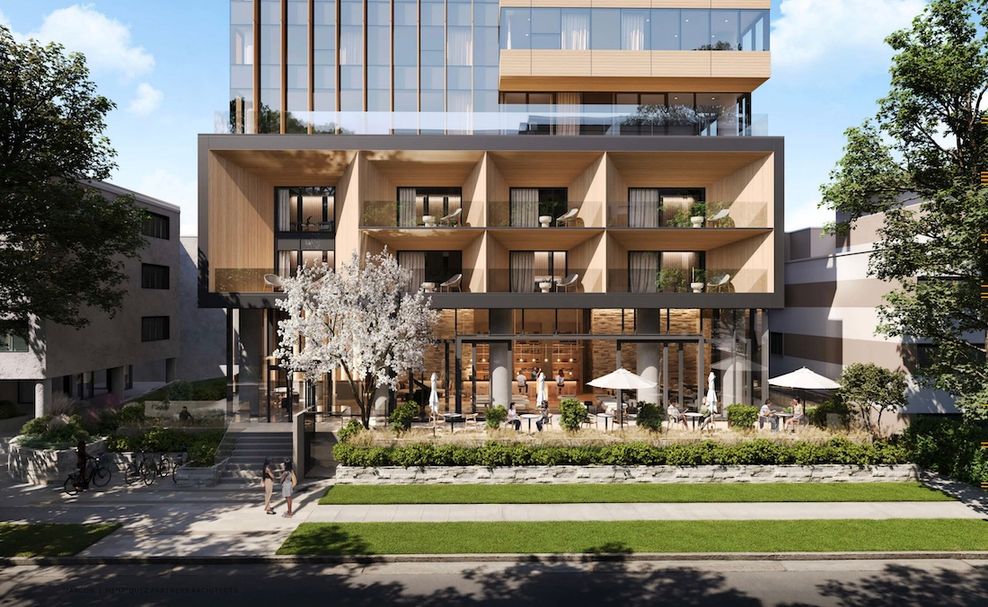
May 2025 revised concept of the hotel at 2030 Barclay St., Vancouver. (Henriquez Partners Architects/Marcon Developments)