
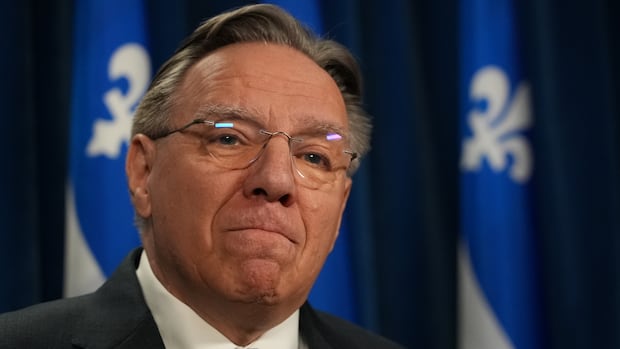
The Coalition Avenir Québec (CAQ) leadership race has clouded the future of Quebec’s immigration pathways and the expected release of the provincial budget.
While the Quebec Liberals have announced their new leader, the race between former CAQ cabinet ministers Christine Fréchette and Bernard Drainville won’t be finalized until April 12.
Outgoing Premier François Legault said in January that he would resign after serving as the head of the CAQ — the party he co-founded — since its inception.
Here’s why immigration and the provincial budget remain up in the air while the party chooses its next leader — and the next Quebec premier.
Why are economic immigrants in limbo?
Applicants for the Quebec Experience Program (PEQ) — a pathway to permanent residency for economic immigrants — remain in limbo as CAQ leadership candidates debate whether to grant exemptions or temporarily reopen the program.
The Legault government abolished the PEQ in November 2025, making the Skilled Worker Selection Program (PSTQ) the only route for those wishing to settle in Quebec for economic reasons.
Quebec said it would continue to process PEQ applications received before the fast-track program ended, but they would be evaluated based on criteria for the PSTQ.
Officials from Montreal, Quebec City, and Vaudreuil-Soulanges, Que., called on the provincial government to make an exception for pending PEQ applicants, especially much-needed skilled workers, since they have already joined the workforce.
Jean-François Blanchard, president of the Association of Private Long-Term Care Facilities of Quebec, said at a news conference last Wednesday that the PEQ uncertainty has shaken 655 workers of the association’s facilities.
“It is truly a shame to cause such anxiety for a population that stepped up to help us, especially after COVID,” Blanchard said.
He and elected officials, including mayors of big cities, have expressed concern over these workers leaving Quebec for Ontario — where their residency application might be processed faster.
Will the government revive the PEQ?
Former Quebec economy minister Christine Fréchette said if she becomes leader, she would reopen the PEQ for two years to exempt applicants who were in Quebec before the government abolished the program. She also said she would reduce invitations under the PSTQ by the same number to respect the province’s immigration targets.
Meanwhile, Bernard Drainville — Quebec’s former environment minister — promised to exempt French-speaking skilled workers in health care, education, construction and specialized manufacturing who settled in Quebec before the program’s end.
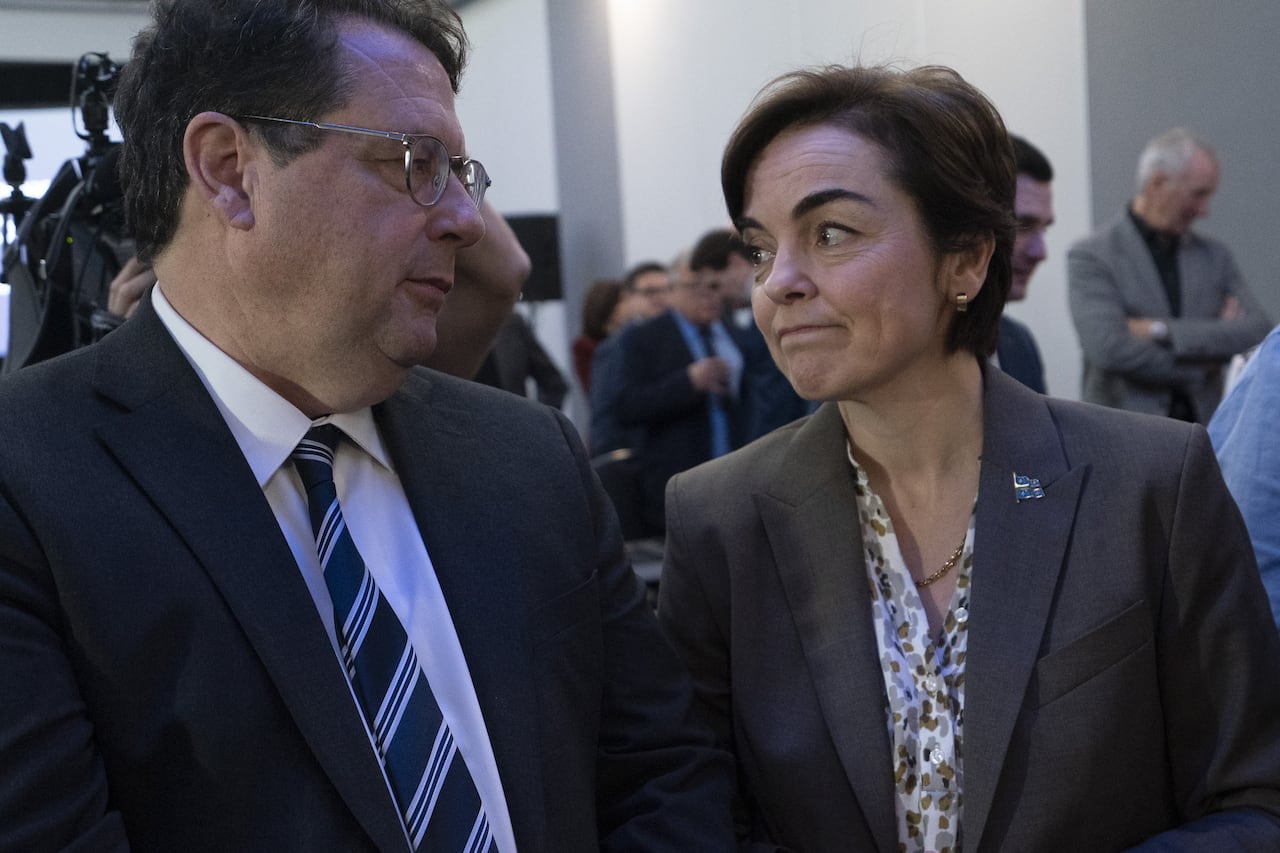 Bernard Drainville and Christine Fréchette facing each other at the CAQ caucus on Jan. 27, 2026. (Ivanoh Demers/Radio-Canada)
Immigration Minister Jean-François Roberge has said he ordered a study of the “various transitional measures” for economic immigration pathways in Quebec in light of his ministry abolishing the PEQ.
Findings would be presented to the next CAQ leader and premier, he said.
When will the government table the budget?
Since the CAQ came to power in 2018, Finance Minister Eric Girard has tabled the annual provincial budget between March 10 and March 25 — at least a week before the government’s March 31 fiscal year end.
However, with the CAQ leadership race underway, Girard has remained tight-lipped about when to expect the 2026-27 budget.
Depending on when Girard tables the budget, any delay could push back nonprofits’ fiscal planning since many rely on government funding to maintain essential services for Quebecers.
For instance, Food Banks of Quebec (BAQ) — a network of 33 members that supply food to nearly 1,400 local community organizations throughout the province — was granted $25.5 million this past year specifically for food purchases.
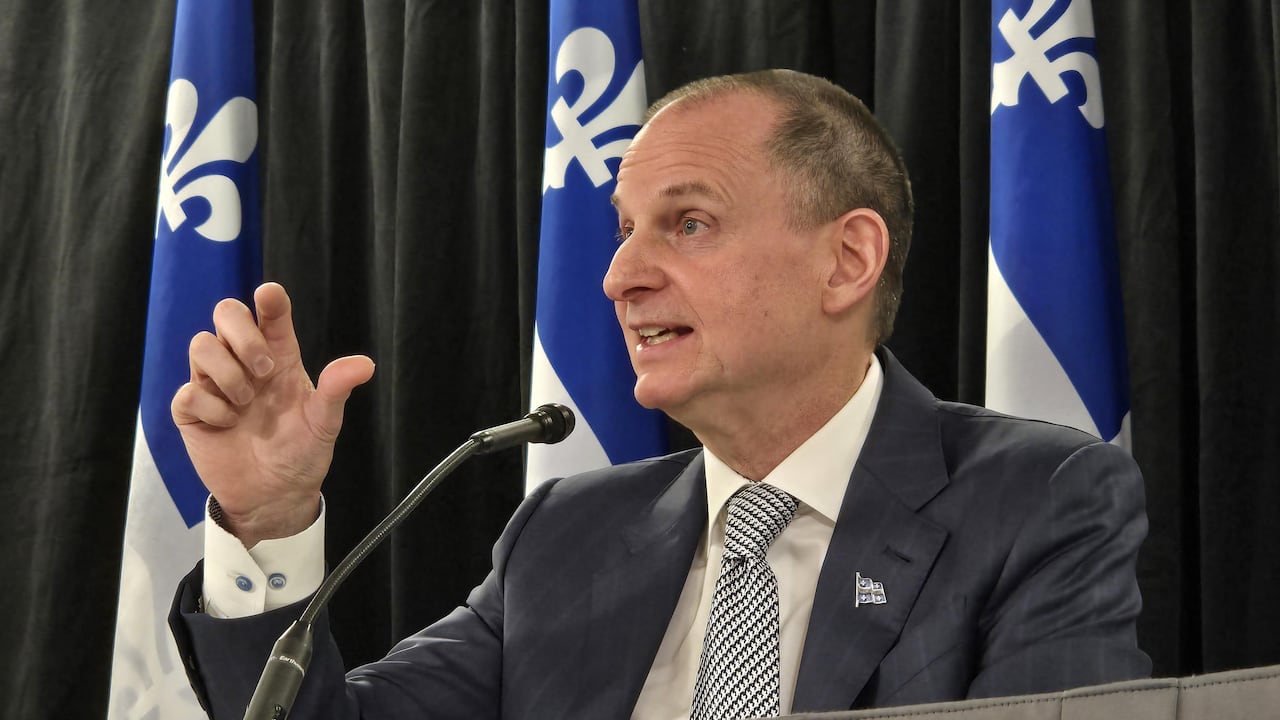 Quebec Finance Minister Eric Girard presents the province’s economic update on Tuesday, Nov. 25, 2025. (Jean-Michel Cloutier/Radio-Canada)
Vėronique Beaulieu-Fowler — director of philanthropy for the BAQ — says that while the network has set aside roughly $8.5 million to assist their members at the beginning of the year, the sooner the provincial budget is tabled, the sooner local food banks can plan their annual purchases and spare Quebecers from food shortages.
About 20 per cent of households that used food banks listed employment as their main source of income, according to the BAQ’s 2025 Hunger Count report — an annual compilation of data on food assistance services during the month of March.
“That means that even with a job, people can’t make ends meet,” Beaulieu-Fowler said, noting that demand for emergency food help has jumped since the COVID-19 pandemic.
The report highlights that within a month, food assistance requests surpassed three million — a 6.6 per cent increase from 2024 and a 37 per cent increase since 2022.
Passing the buck
The government appears to be weighing whether to table a budget before the CAQ elects its new leader, or to wait until after Legault’s successor is chosen.
At a scrum last Friday, Girard would not confirm when this coming budget would be presented.
“We’re fully aware that there are important needs in society and we always respond,” Girard said.
Tabling the budget after the April leadership vote would more firmly link the new CAQ leader to the government’s fiscal plan.
If the budget lands well, it could give the incoming leader momentum ahead of the October election. But a bleak fiscal outlook could burden a new premier with difficult optics, particularly in a government still defined by Legault’s long shadow.
WATCH | How the CAQ leadership race is impacting government: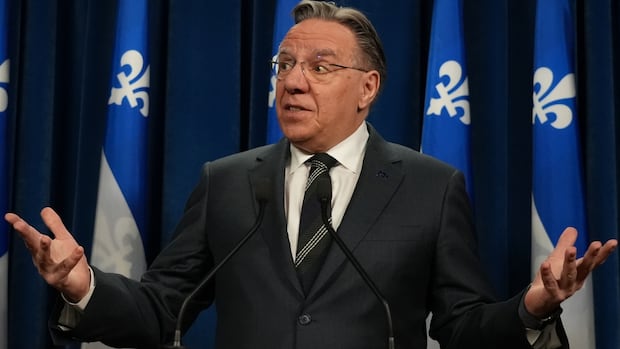
With Legault on his way out, who’s in charge of Quebec now?
Two former members of Quebec Premier François Legault’s cabinet are running to take over the province’s leadership. But with legislation in process around defining issues for the party, who’s steering the government ship?
Should Girard table the budget before a successor is chosen, the outgoing premier would be left to defend both Quebec’s strained public finances and the spending plan of an administration he is preparing to exit.
Quebec’s deficit for 2025-26, as defined by the Balanced Budget Act, is $12.4 billion, according to the November 2025 economic update.