
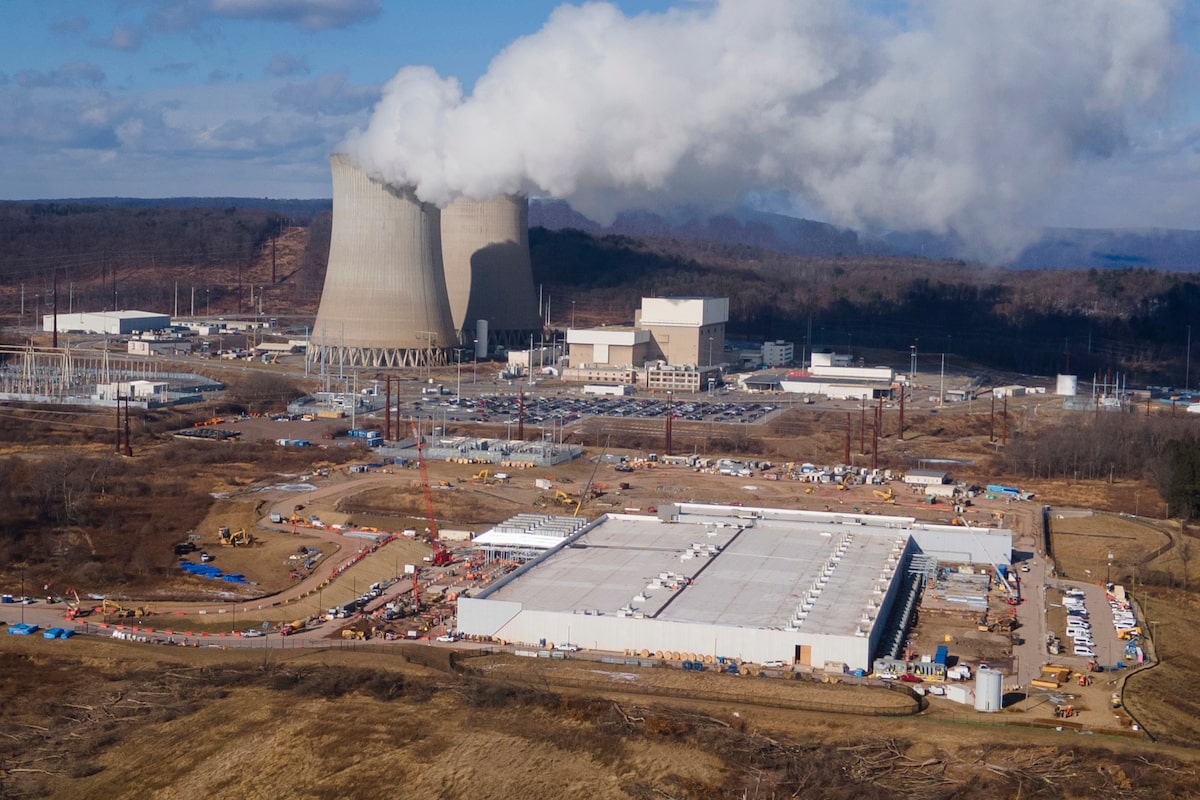
A data centre owned by Amazon Web Services under construction next to the Susquehanna nuclear power plant in Berwick, Pa.Ted Shaffrey/The Associated Press
Gus Carlson is a U.S.-based columnist for The Globe and Mail.
A power infrastructure crisis emerging in Ohio provides a chilling look ahead at one of the biggest downsides of the proliferation of artificial intelligence – and perhaps an opportunity for Canada, both commercially and politically.
A concentration of AI data centres in Ohio – about 200 exist there now – has put enormous strain on local and regional power grids and pushed up rates for residents in some areas by almost 15 per cent already. More hikes are expected as these power-hungry centres come online.
The proposed solutions are far from ideal. In one instance, Hilliard, a suburb of the state capital, Columbus, which worked hard to attract an Amazon data centre a few years ago, has now filed suit to block the e-tailer’s plan to install more than 200 natural-gas-fed fuel-cell units in town, an electrochemical food source for its ravenous 142-acre data centre there.
The company also wants permission to create a section of the data centre campus to house more than 150 backup diesel generators, a proposal that has residents up in arms about the environmental impact of the installation.
Meta begins construction of $10-billion data centre in Indiana
The situation has become so acute, state officials have rallied to stop the bleeding and get control of a legal and political firestorm.
What’s happening in Ohio is a cautionary tale for other communities as data centres, the so-called brain cells of AI, proliferate. And it’s a two-edged sword.
While the data centres create jobs and economic energy, there are myriad downsides. The strain on existing power grids and resulting rate increases is just one.
Many residents of areas with high concentrations of data centres fear environmental effects – among them, air, water and noise pollution – that some suggest have already led to higher rates of health issues, including miscarriages and rare forms of cancer.
Some have philosophical issues with the roles their communities might be playing in helping AI replace existing jobs, and what that shift will do to employment prospects and the general health of their local economies in the long run.
OpenAI eyes artificial intelligence data-centre capacity in Canada
And there is growing resentment in many communities about the juicy tax incentives many companies have received to locate data centres there.
In Ohio, for example, over the last decade, state and local governments have lured data centres with an estimated US$2.5-billion in incentives, including an estimated state sales tax exemption of US$143-million in 2026.
The sting of incentives in towns such as Hilliard is particularly sharp. There, in an effort to land the Amazon centre in 2019, the town offered the company a 15-year, 100-per-cent property tax abatement.
Now, with the controversial fuel-cell and backup diesel generator farm under consideration, what seemed like a good idea at the time isn’t so much any more.
So where might Canada fit into the equation? As a net exporter of electric energy to the United States, there may be an opportunity for Canada to take a leadership role here – and generate some political leverage as well.
Editorial: The right way to win the race for data centres
The major exporting provinces are Quebec, Manitoba, British Columbia and Ontario, with Hydro-Québec and the Manitoba Hydro-Electric Board being among the biggest exporting utilities.
As the AI boom continues, and the demand for data centres increases, it seems clear that the U.S. does not have the capacity to meet the anticipated need, even in the short run.
And, if the Ohio crisis is any indication of the future, the alternative solutions such as fuel-cell farms with diesel backups are fraught with political, social and environmental roadblocks.
Canada has the power to offer a solution – and realize some commercial benefit in the process. And in that solution may lie another kind of power: political.
The caveat is that Canada’s power generation face its own issues, too. BC Hydro faces a demand bump of 15 per cent by 2030. In Ontario, electricity demand is set to grow by 75 per cent in the next decades. In Quebec, it’s set to double by 2050. Provinces are scrambling to boost their own electricity capacity.
Natural Resources Minister heads to Poland to promote Canada’s nuclear energy expertise
But this remains Canada’s strong suit. This country is the world’s third-largest hydroelectricity producer. Sixty per cent of Canada’s power comes from hydroelectricity, and there is untapped potential of double the current output. Canada is among just a handful of countries with their own nuclear-reactor technology. Notably, Canada’s Candu design can use unenriched uranium, of which this country is the world’s second-largest producer.
Power capacity is a hugely valuable Canadian asset that the U.S. simply doesn’t have in the same way but desperately needs if it seeks to be a leader in the AI revolution. In short, Canada has what the U.S. desperately craves.
As this country sets about expanding its power production, can Canada use this unique position as a bargaining chip to exert leverage elsewhere in the foreign trade agenda of U.S. President Donald Trump?
Maybe Ohio is a test case. If exported Canadian energy can save the AI canary in a coal mine there, it might be a new twist on the art of the deal.