
When Assistant Professor Yonatan Kahn joined the Faculty of Arts & Science’s Department of Physics in 2024, U of T gained more than just his expertise in the search for dark matter, the yet-to-be-discovered particles that make up some 80 per cent of the mass of the universe.
“At my previous institution, the University of Illinois, I was a principal investigator for the Superconducting Quantum Materials & Systems Center (SQMS), one of the U.S. Department of Energy’s five National Quantum centres,” says Kahn.
“The funding for this centre has now been renewed — $125 million over five years — and since the renewal coincided with my move here, U of T has been added as a partner institution of SQMS with me as its PI.”
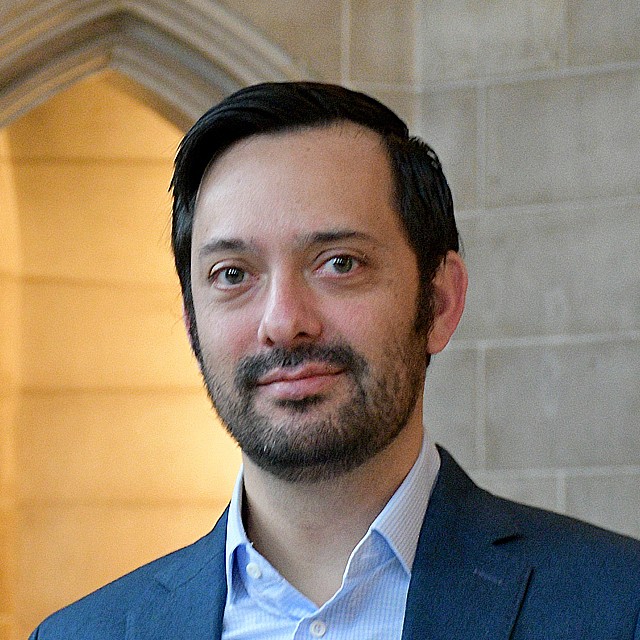 Yonatan Kahn. Photo: Diana Tyszko.
SQMS is led by the Fermi National Accelerator Laboratory and is part of a national initiative to develop and deploy the world’s most powerful quantum computers and sensors.
The multidisciplinary collaboration includes experts in quantum information science, material science, applied and theoretical superconductivity, computational science, particle and condensed matter physics, cryogenics, microwave devices and more.
“This is a huge, well-funded U.S.-based program in quantum information science,” says Kahn. “There are very few international partners outside the U.S. and only one other Canadian partner, the University of Waterloo’s Institute for Quantum Computing. So it’s a significant achievement that U of T is included.”
According to Anna Grassellino, director of SQMS, “This renewed funding allows us to build on our existing foundation and take the next leap: moving from discovery to deployment. Together with our partners across national labs, universities and industry, we’re poised to scale quantum systems to a level that will unlock powerful new tools for science, technology and society.”
The search for dark matter
According to recent estimates, there is five to six times as much dark matter in the cosmos as there is the visible matter we see in planets, stars and galaxies. As its name suggests, we haven’t directly observed dark matter; instead, we know of its presence because of the gravitational force it exerts on visible matter.
Leading candidates for dark matter include a variety of fancifully named particles: dark photons; right-handed neutrinos; Weakly Interacting Massive Particles, or WIMPs; primordial black holes; and low-mass and low-energy particles called axions.
Kahn believes discovering the identity of dark matter is the most pressing question in particle physics today and in his search for this cosmic phantom, uses techniques developed at SQMS.
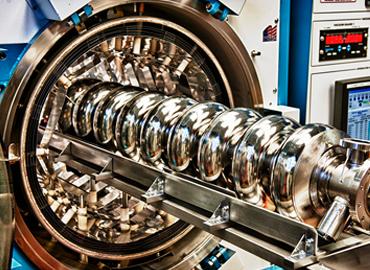
“For example, one of the centre’s strengths is in developing a type of device known as a superconducting cavity,” says Kahn. “Basically, that’s a big metal box that can contain an electric field inside it for a very long time. Even though they were developed for applications that have nothing to do with quantum mechanics, we can use them as dark matter detectors.
“Another example is quantum magnetometry — a technology with applications in medicine. One of my collaborations with SQMS involves using quantum magnetometry to precisely measure extremely weak magnetic fields which can ultimately lead to determining the mass of an axion.”
Kahn isn’t the only researcher in the Department of Physics searching for dark matter. Another team is taking part in the hunt as part of the Super Cryogenic Dark Matter Search, or SuperCDMS, an experiment operating in SNOLAB near Sudbury, Ont.
“The kind of dark matter one looks for with SuperCDMS is likely not the same kind of dark matter I would discover using superconducting cavities, so we’re very much conducting complementary searches,” says Kahn.
What’s more, his research with SQMS strongly dovetails with research being conducted not just by the faculty’s Centre for Quantum Information & Quantum Control (CQIQC), but with efforts in quantum information and quantum computing across the faculty and the country.
“The fact that U of T is now a member of SQMS builds a valuable bridge between Canadian quantum research and the fundamental physics and dark matter searches that are already ongoing.”
Kahn also points out that countries around the world are investing in artificial intelligence and quantum sciences at a faster rate than in any other fields.
“In Canada, the quantum ecosystem has been growing enormously over the past decade. So, to be part of the $125 million SQMS investment just adds to all of the investments that Canada is already making in quantum science.”
With files from Fermi National Accelerator Laboratory.