
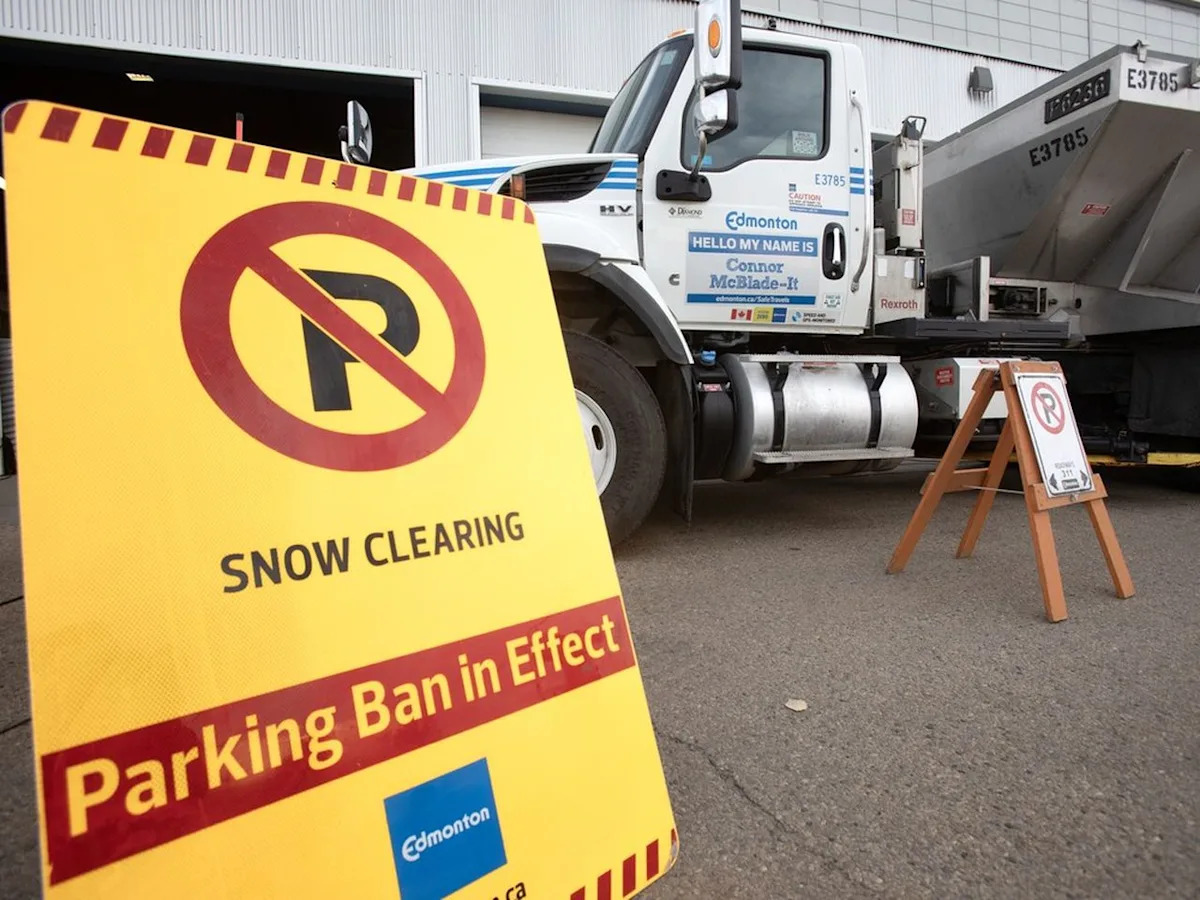
With snow swirling and a week-long deep freeze underway, Edmonton’s snow and ice brigade is determined not to be caught out, enlisting a fleet of private graders and putting a Phase 1 parking ban in place.
“We are starting our snow response early, ahead of the snow event ending,” said Valerie Dacyk, general supervisor for the infrastructure field operations that manages snow and ice removal.
As the blustery snow storm set in, a fleet of private contractors were recruited to join the all-hands-on-deck efforts. City crews have been working 24-7 since Monday night, expanding the snow-busting power of 20 big, yellow graders to 120 graders.
They join the city’s fleet of about 120 truck-plows, with front- and under-body-mounted blades.
“We will still be ensuring that the roadways are fully cleared after the snow stops, but additional resources have been brought in early to try and get the roads ready earlier and quicker for residents to travel on,” Dacyk said.
“We do feel quite confident that we’ll be able to get the roadways cleared and ready to go in a very short period of time. Additionally, with that, bringing in contractors early, we’ll see the impact on the roadways much quicker.”
By rush hour Wednesday morning, drivers should notice the improvement, she said.
“Very quickly after that, all of them will be ready to go for regular road use,” she said.
It helps, too, that so far the amount of snow is less than initially predicted.
“This time, the predicted weather forecast was actually for more than what we’re seeing fall out there,” Dacyk said.
Parking ban starts Wednesday
The city’s Phase 1 parking ban will come into effect on Wednesday at 7 a.m., restricting parking on all major roadways and arterials, collectors and transit routes.
The ban is expected to last three to five days so crews can work 24-7 in priority order to get main roads clear.
“On Friday, after the snow accumulation has come to the majority of an end, we will be doing an evaluation on residential rows to determine whether or not we will proceed into residential at that time, if it’s needed,” Dacyk said.
“Only at that time will we be able to tell if we’re going to go into a Phase 2 parking ban or not,” she said.
Phase 1 bans are generally more compliant than Phase 2, just because of the types of roadways they cover, Valerie Dacyk said.
The city faced an avalanche of criticism and scathing dirty looks over how long it took to clear snow and ice in earlier snow events, with reports that an astonishing 90 per cent of motorists were ignoring the Phase 2 parking ban.
Reports of incivility and even physical attacks on city snow clearing equipment were reported.
However, things got better, Dacyk said.
“We saw a great improvement in the compliance with the parking ban near the end of the Phase 2 parking ban that we saw in January,” she said.
With foul weather clobbering the city again, Dacyk is hoping for a more warm-hearted response from civilians as city workers clear snow around the clock.
“We’re hoping to see that continued compliance from residents, because it definitely makes our jobs a little bit easier without having private vehicles on the roadways,” she said.
“As always, we just ask for residents to have patience and give our crews room to work. Everyone’s goal is the same out there. We want to get those roads clear and ready for use as soon as possible, and the best way to do that is just let our operators do their job. They know what they’re doing and they’re out there and they’re ready to work. Just give them the space to do so and the courtesy to do so, and we’ll all be getting to where we need to go much faster,” Dacyk said.
Review planned
Every four years, the city conducts a snow and ice standard procedure review. That’s expected at the end of summer.
In 2023, the city shaved millions off its snow removal budget, going to $63.7 million in the winter of 2023-2024 from $72 million. But like its population, the city’s infrastructure continues to grow, including bike lanes, which must also be cleared, even though deep winter usage is a fraction of the summer’s peaks.
The full budget effects of the snows will be calculated after the event, and then the end of the snow season.
“At this time, there’s a lot of snow and ice conversations happening. So I can’t speak to what will happen in the future, but definitely a review of the equipment and the snow and ice program is underway, and we will see what happens when those conversations happen,” Dacyk said.