
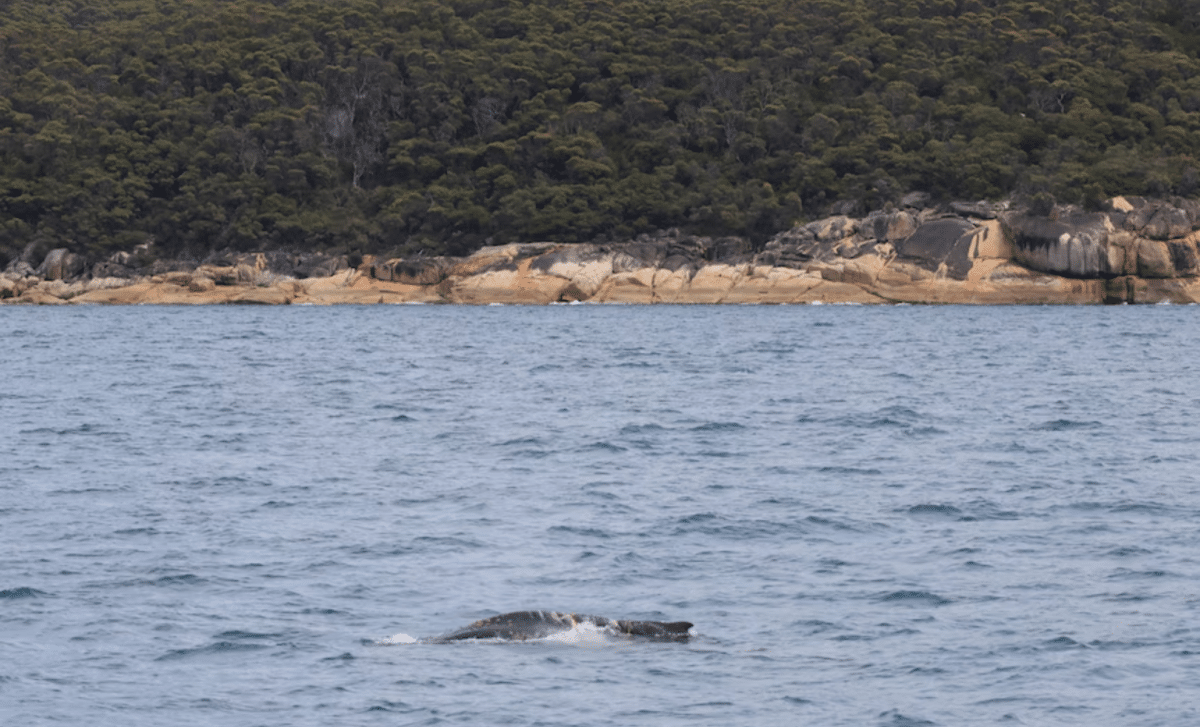
A rare and distressing sighting off the coast of Victoria, Australia, has left experts and wildlife observers concerned for the future of a juvenile humpback whale. Struggling and abandoned by its mother, the whale was discovered tangled in fishing ropes near Wilsons Promontory. This unusual sighting, which marks a break from typical migration patterns, is raising alarms among researchers and environmentalists. The whale’s struggle for survival, compounded by deep wounds and possible starvation, has sparked a coordinated search to locate the animal and determine the best course of action. While efforts continue, many are questioning whether this is another sign of climate change disrupting natural whale migration patterns.
The Unusual Timing of the Sighting
The sighting of a juvenile humpback whale in distress during the month of February is considered highly unusual by experts. Typically, these majestic creatures follow a strict migration schedule, leaving the Southern Ocean near Antarctica and traveling to warmer waters during the winter months. However, a spokesperson from the Organisation for the Rescue and Research of Cetaceans in Australia (ORRCA), Craig Ryan, explained to Yahoo News that this whale’s appearance at this time is “odd” since the peak southern migration season generally occurs in winter.
Ryan noted,
“Usually we start seeing numbers drop off in spring, and by the time it gets to October, we’re seeing less and less.” The timing of this sighting raises questions about the whale’s movements, but Ryan added, “But there’s no rule, they’re an animal, and they’ll just follow whatever instinct they want.”
This unpredictability in animal behavior highlights the complexity of migration patterns, especially for a species like the humpback whale, whose migratory journey spans vast distances.
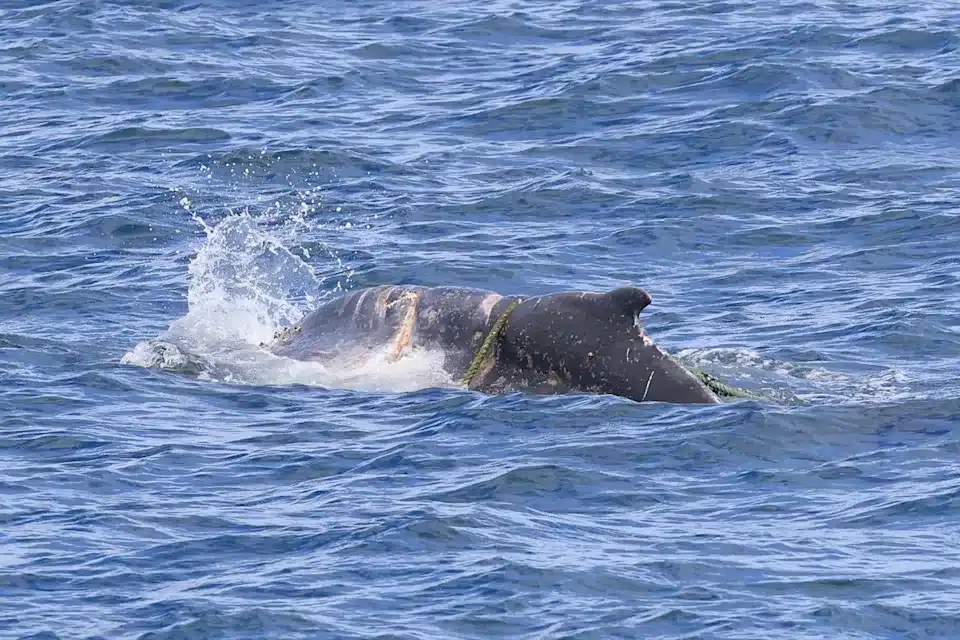 Deep lacerations of between 5 and 10cm deep were seen in the whale’s flesh. Source: Graeme Burgan/Wildlife Coast Cruises
The Struggle of the Juvenile Whale
On Saturday afternoon, Graeme Burgan, a crew member at Wildlife Coast Cruises, was on a tour off Wilsons Promontory when he spotted the struggling whale at Refuge Cove. Burgan, who also serves as a science officer for the organization, immediately recognized the whale’s distress. “The thing about the ocean is you can never predict what’s going to happen. I always expect the unexpected,” he told Yahoo News. His observations of the whale revealed deep wounds and visible signs of starvation.
Despite being close to the struggling animal, Burgan was unable to intervene directly due to strict wildlife protection laws. He reflected,
“I was thinking, how can I help it? But other than reporting it, I had to resist the temptation to cut it loose.”
The regulations prevent direct human intervention unless authorized, and Burgan’s emotional response underscores the difficulty of witnessing such a dire situation without being able to offer immediate help.
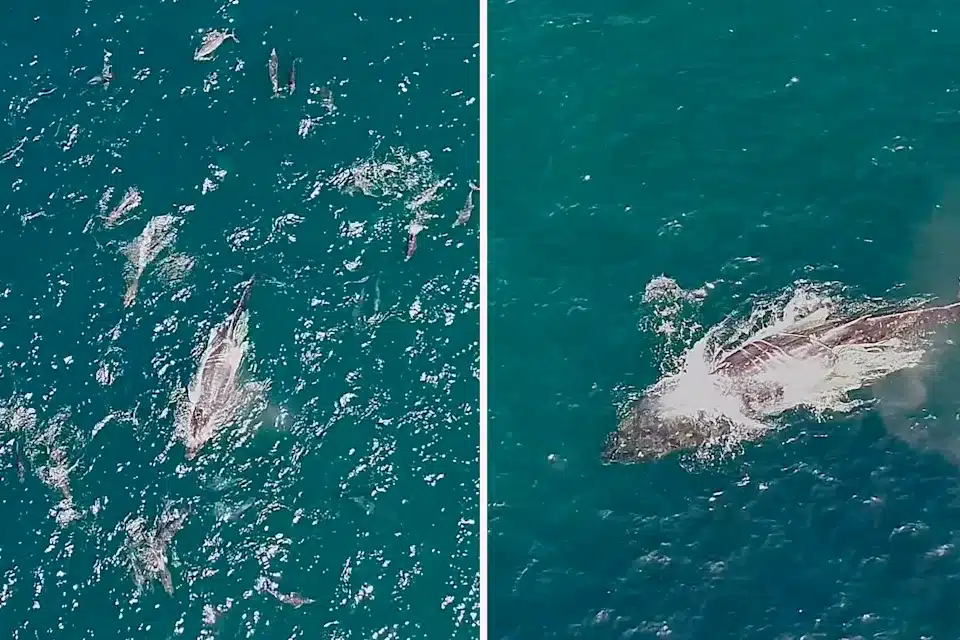 The same lacerations were clearly visible when the animal was filmed with a drone at Jervis Bay earlier in February. Source: Terry Dixon via ORRCA
Concerns About the Whale’s Survival
The juvenile whale’s condition is dire, with visible lacerations on its back and a noticeable decline in its physical state. Burgan, after closely observing the whale, expressed his grave concerns for its future. “Ultimately, it’s going to die,” he said, noting that the whale’s mother had likely abandoned it. Without the support of its mother, the calf would be unable to find food, which, combined with the physical injuries it sustained from the fishing ropes, makes its survival unlikely.
“Its mother has abandoned it, so it’s probably not been able to get food. It’s losing weight, and I could see its rib cage vertebrae,” Burgan added.
The whale’s weakened state raises questions about how human activities, such as fishing and shipping, may be exacerbating the threats faced by marine life. While humpback whale populations have rebounded since whaling was banned in the 1970s, these mammals are still vulnerable to human-induced dangers, including entanglement in ropes and pollution.
Search and Rescue Efforts Underway
In response to the whale’s sighting, the Victorian Department of Environment, Energy, and Climate Action (DEECA) has launched a search operation to locate the animal and assess its condition. The department confirmed that it would be sending a crew to search the coastline for the whale. The presence of distinctive lacerations on the whale’s back, which were seen during earlier sightings, makes the animal easier to identify. DEECA has also urged the public to report any further sightings of the whale to its Whale and Dolphin Emergency Hotline.
The search efforts are critical not only to locate the whale but also to provide any assistance that could help mitigate its suffering. While direct intervention is often difficult, wildlife experts hope to prevent further harm to the animal and gather valuable data on its condition. The situation also serves as a reminder of the challenges posed by climate change, pollution, and human activity to marine life.