

Listen to this article
Estimated 3 minutes
The audio version of this article is generated by AI-based technology. Mispronunciations can occur. We are working with our partners to continually review and improve the results.
At a meeting on Friday, the Prince Albert Grand Council (PAGC) called for changes to address what it calls systemic failures in contracted and privatized hospital security.
The meeting was held in response to two recent incidents involving hospital security officers in Saskatchewan’s health-care system.
In December, Brydon Lafaver was filmed being wheeled out of Victoria Hospital in Prince Albert by security officers and left in the snow during extreme winter conditions. Weeks later, in January, cancer patient Trevor Dubois died after an altercation with security at Royal University Hospital in Saskatoon.
“I’m tired of you know, getting the videotapes … of people now, how they’re treated,” Grand Chief Brian Hardlotte told reporters.
He said the focus of Friday ’s session was not on individual workers, but on fixing the systems that allowed these incidents to happen.
The meeting was attended by leaders from the Saskatchewan Health Authority (SHA), Prince Albert Police Chief Patrick Nogier, corporate representatives from private security firms, the First Nations Health Ombudsperson and others.
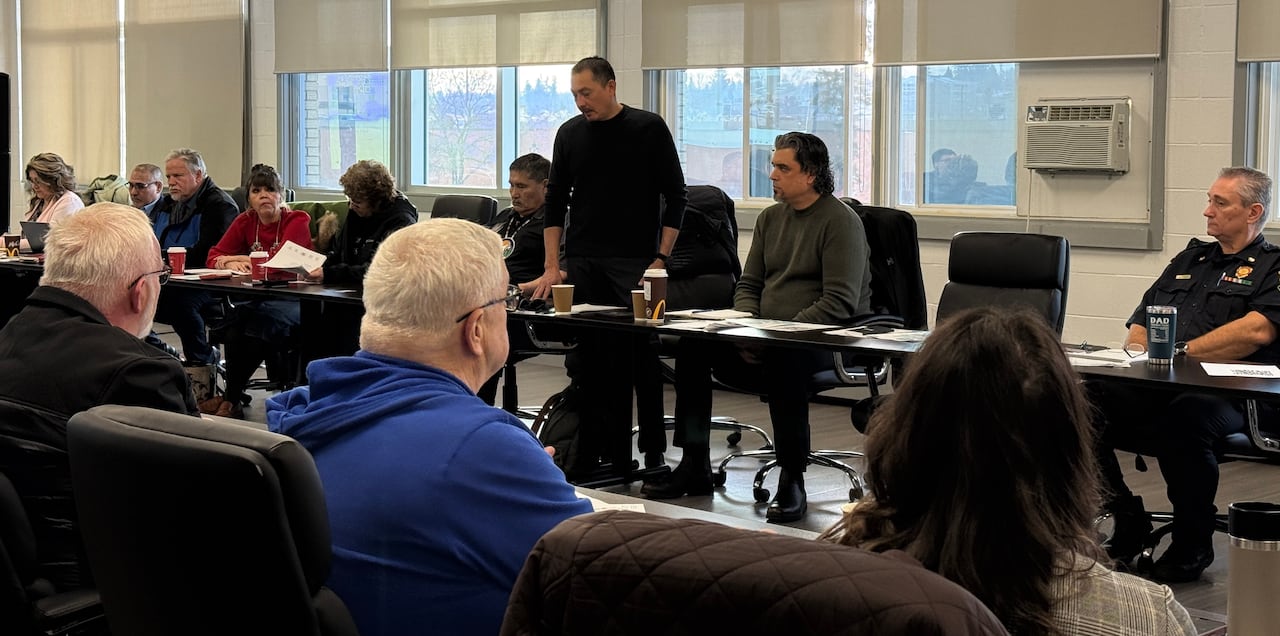 The Prince Albert Grand Council (PAGC) held a meeting on Friday with security companies, police, the Saskatchewan Health Authority and others to discuss the behaviour of security guards in Saskatchewan. (Travis Reddaway/CBC)
Hardlotte said more empathy and cultural and de-escalation training are needed for security staff.
Vice Chief Joseph Neyanitawwatasick recounted an example of a late-night scene in the emergency room of Victoria Hospital when an exhausted mother with her three-year-old was asked by a clerk, “Why did you come here?”
In a vacuum, that’s a simple intake question. But in the context of generational trauma and systemic racism, it was more than that, Neyanitawwatasick said.
“The lady took it as, ‘What do you mean? I’m allowed to be here,’” he said. The result was chaos — not because of a medical crisis, but because the mother felt she was being policed rather than helped, he said.
The security perspective
Lions security company CEO Leo Ekhaguere said private security guards are dealing with all kinds of dangers such as used needles, makeshift knives and modified guns. He described a recent incident when a man with no legs allegedly brandished a knife and threatened to kill an officer at the South Hill Mall in Prince Albert.
“You are not dealing with the individual,” Ekhaguere told the meeting. “You are dealing with the addiction — to drugs, to alcohol. You must know exactly what to do to ensure you are not hurt in the long run.”
The meeting ended not with a resolution, but with a deadline. The PAGC is demanding more than just “respectful dialogue” — it wants a fundamental shift in the “tools in the toolbox,” the group heard.
“We kindly ask the security companies to respect our people, our Indigenous women and men that are out there that are struggling with addictions. There’s no need for violence,” Neyanitawwatasick said.