
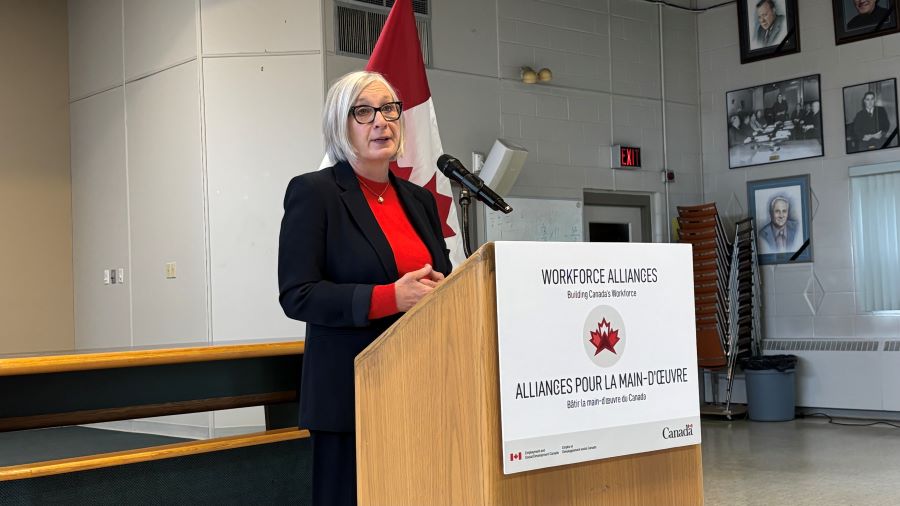
The federal government is creating what’s being called Workforce Alliances to help address the talent needs of Canadian employers while ensuring the skills development meets those needs.
During a news conference Tuesday at the Unifor union hall on Turner Road in Windsor, Minister of Jobs and Families Patty Hajdu announced five additional workforce alliances for priority sectors.
Along with a Workforce Alliance in Advanced Manufacturing announced February 5 by Prime Minister Mark Carney, the new alliances will focus on housing and construction, transportation and supply chains, energy and electricity, mining and minerals, and the care economy.
Hajdu says the high-priority sectors were chosen because of their contribution to the GDP.
“Often times what we’ve heard is that people will pursue skills training through an institution, come out the other end, and employers are saying they just don’t have the right set of skills,” she says. “People find it a very hard way to start their career when they can’t actually land, and then if they can’t land quickly, their skills become outdated very quickly.”
The alliances will include employers, unions, educational institutions, and industry associations coming together to identify and address labour market challenges while coordinating public and private investments in skills development to realign investments in training to meet industry needs.
Hajdu says they hope to get better data.
“Hopefully really urgently, the idea is we will have a better sense of what employers need versus what is being trained for and then better labour market attachment, where people are reporting that they’re able to find jobs more quickly and that employers are reporting that people are showing up to take those jobs with the actual skills that are current and needed by the sector,” she says.
Hajdu says it’s very proactive and will push training partners to think about how they’re delivering training.
“We go for these college programs because we anticipate it’s going to make it easier for us to find a job,” she says. “What we don’t want is for people to get discouraged or to find themselves working, maybe, in a sector that pays less, that doesn’t require any skill, and then all of their skills that they’ve spent years and money achieving actually go stale.”
The leadership and top priorities for all six Workforce Alliances are expected to be announced in the coming weeks.
Hajdu also announced that the government is now accepting applications for the new Worker Retention Grant for Work-Sharing Employers.
Work sharing lets businesses avoid layoffs by letting eligible workers share work by reducing their hours, so everyone continues to be employed while claiming employment insurance (EI) for lost hours.
Employers can apply to the $102.7 million grant to get funding to top up employee income for those who take training while also taking part in work sharing, allowing them to maintain their income during lost work time at levels closer to normal wages, up to 70 per cent of full-time pay.