
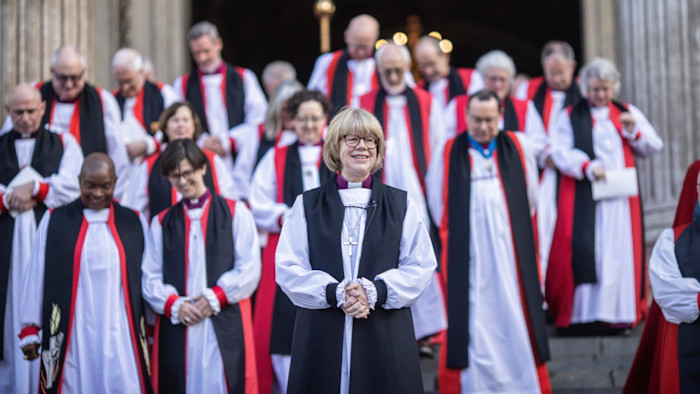
The new Archbishop of Canterbury, Dame Sarah Mullally, faces big challenges to make the 500-year-old Church of England work for the second quarter of the 21st century. And, as always with the Church, money plays a big part.
But the good news is that paying clergy defined benefit pensions, a real problem for many years, won’t be keeping the new archbishop awake at night.
Clergy pensions earned before 1998 are paid directly by the Church Commissioners from the Church’s centrally-held assets. But, after disastrous property losses first reported by the FT in 1992, it set up a separate scheme in 1998, the Church of England Funded Pensions Scheme (CEFPS). This is funded by contributions from individual dioceses and local parishes, and with no member contributions.
The CEFPS has 25,000 members including 11,000 pensioners, and £2.6bn of assets at December 2024. It is now finalising its 2024 three-year actuarial valuation, with the December 2023 update showing a healthy £840mn surplus.
This is a very long way from 2008 and 2011, when the Church cut the annual value of new pensions earned to manage costs and control the deficit. The definition of pensionable salary and the annual accrual rate were both cut, and the normal pension age was increased from 65 to 68.
 The Archbishop of Canterbury, Dame Sarah Mullally, addresses this month’s meeting of the General Synod © Jordan Pettitt/PA Wire
This improvement isn’t down to good management, but rather to the 2022 “mini-Budget” crisis that prompted higher interest rates, thereby slashing all defined benefit pension liabilities.
The Church is now so confident about pensions that the February meeting of the governing General Synod gave its final agreement to reverse most of the cuts, with many members seeing a big pension boost from April 2026.
For serving clergy, pensions earned since 2011 will increase by a whopping 61 per cent, according to the Church Times. For retired clergy serving after 2011, pensions earned since 2011 will be increased by about 38 per cent.
Is the Church right to be solidly confident about pensions, or is it storing up future problems?
The December 2023 liabilities are calculated using the “expected return on assets”. Applying the Pensions Regulator’s new “funding code” requiring schemes to calculate liabilities at a discount rate of gilts plus 50bp increases liabilities by around £190mn, still leaving a very comfortable £650mn surplus.
The trouble is that today’s surplus could easily become tomorrow’s deficit, because unlike virtually all other private sector pension schemes, the Church has chosen not to match assets and liabilities.
The Church is still taking huge risks, holding 70 per cent of assets in equities, private equity, infrastructure and private loans, with an assumed return of gilts plus 3.5 per cent. The 2025 Pension Protection Fund report shows the average pension holding in these assets is just 22 per cent, with the balance in bond-like assets to match pension liabilities — so the CEFPS is a real outlier.
By holding 70 per cent in “risky” assets, the Church seems to be playing a dangerous game of double or quits, just like betting money at the casino. Would hard-pressed parishioners be happy if they knew what was going on with their donations?
And the Church’s bets don’t stop there. The CEFPS uses leverage through “gilt repos”, a complex form of borrowing, allowing it to make even bigger bets. Against £2.6bn of assets it has borrowed another £600mn through “gilt repos”, 20 per cent of net assets.
The Church should lock in the current surplus by shifting out of risky equity-type assets to matching long-dated bonds, and unwinding the £600mn “gilt repos”. Locking in the surplus, and getting rid of borrowing, gives the Church certainty that pensions, including the new increases, will be paid, regardless of financial markets. This would protect dioceses and parishioners from the risk of future deficit contributions, and serving clergy from the risk of future benefits being cut again.
The only losers are the Church’s pension advisers — who charge for complexity — and the gaggle of fund managers whose fees would be slashed.
If the Church wants to continue the dangerous game of double or quits, then in estimating the surplus it really has, it should apply a cushion to absorb any losses from equity underperformance.
Applying, say, a 20 per cent haircut to the risky assets reduces the surplus to around £300mn, a very long way from the £850mn headline. We don’t know if this is enough to pay for the new pension increases, especially as the surplus is already being used to allow a partial contribution holiday for regular contributions.
When the 2025 CEFPS annual report is published later this year we may see that the Church has already locked in the surplus by moving to bonds, and unwound the “gilt repos”, but don’t hold your breath.
I hope the new archbishop faces up to the Church’s pension risks, unlike her disgraced predecessor, Justin Welby. How she addresses them will show both her fundamental integrity and management competence.
John Ralfe is an independent pensions consultant. X: @johnralfe1