
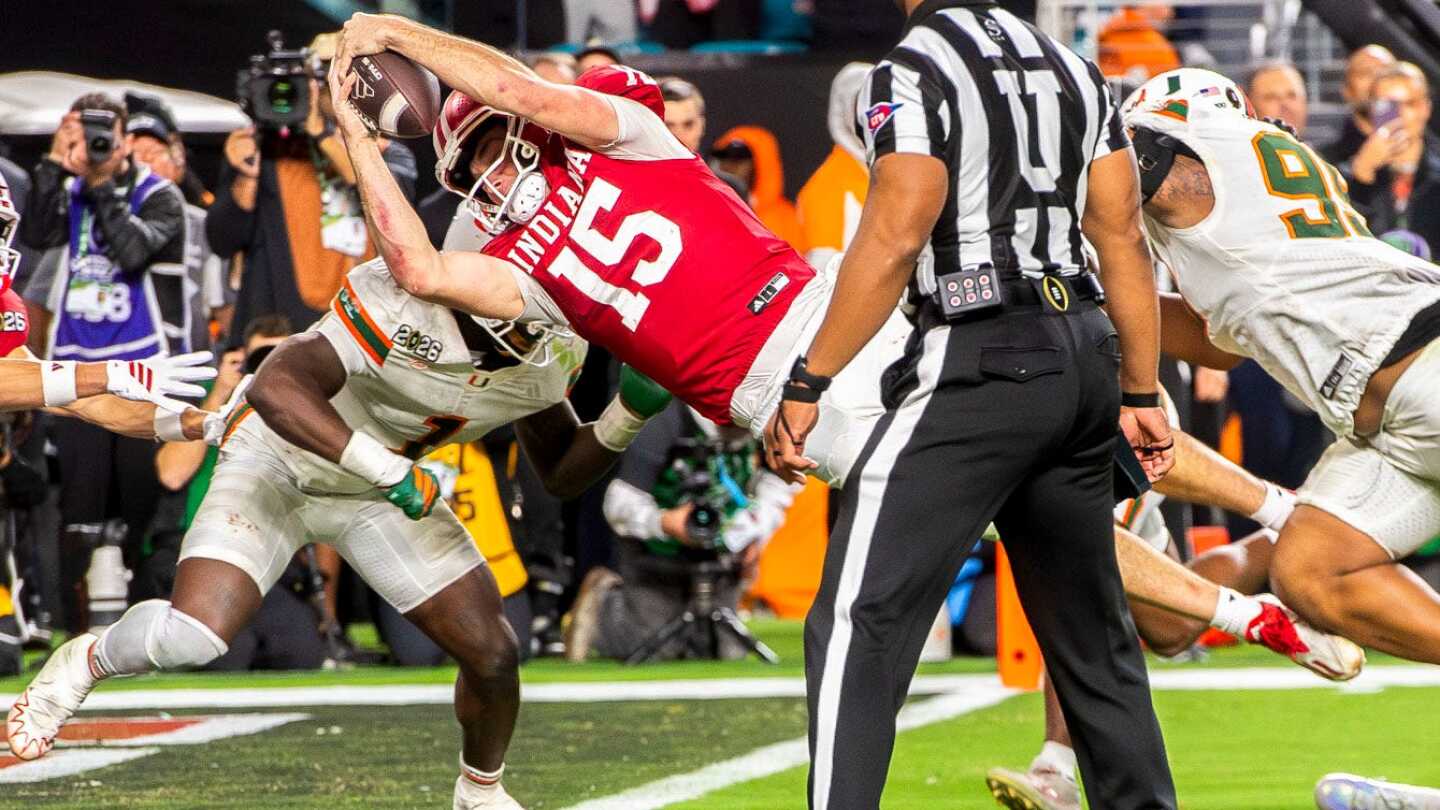
The Heisman Trophy winner, Fernando Mendoza, will be the top pick in the upcoming NFL Draft. Barring a windfall being thrown at the Raiders, the signal-caller for the national champion Indiana Hoosiers is all but assured of wearing the Silver& Black this season. After Mendoza, it will be interesting to see when quarterbacks get selected and in what order.
While it may be a questionable class, how should they be ranked?
NBC Sports’ College Football and NFL Draft expert Eric Froton (@CFFroton) continues his breakdown of the top skill position draft-eligible players with a look at this year’s quarterbacks.
Quarterback No. 8 – Diego Pavia
Diego Pavia (5’9 7/8th, 198) is one of the most volatile quarterback evaluations in the 2026 draft cycle. Vanderbilt’s dual-threat catalyst erupted in 2025 with a 92.2 overall PFF grade and 90.7 passing grade, throwing for 3,527 yards and 29 touchdowns against just eight interceptions while averaging a blistering 9.3 yards per attempt. The former New Mexico State playmaker struggled with downfield consistency, completing 35.6% of 20+ yard throws (52nd-of-80), but still dialed up a 34.3% big-time throw rate on deep attempts (3rd in FBS), which is elite territory by any standard. When kept clean, Pavia looks like an NFL distributor, posting a 93.1 passing grade with 10.7 yards per attempt and 23 touchdowns. The volatility surfaces under pressure, where his passing grade drops to 61.6 and his pressure-to-sack rate hovers around 13.3%, forcing evaluators to separate scheme creation from sustainable pocket skill. Pavia’s mobility is an asset, but his lack of size and arm strength, coupled with a freewheeling style that is difficult to replicate in the NFL. His tape and play style reminds me of Taylor Heinecke and I think he goes in the 6th-7th round.
Quarterback No. 7 – Cole Payton, North Dakota State
Payton (6’3/233) enters the 2026 NFL Draft as one of the most explosive small-school efficiency profiles in the class, blending vertical shot-play dominance with legitimate dual-threat juice. In 2025, Payton completed 71.2% of his passes for 2,719 yards and 16 touchdowns against just four interceptions, averaging an absurd 12.0 yards per attempt while earning a 94.7 PFF passing grade and a 96.0 overall offensive grade. The deep-ball profile is borderline outrageous — on throws of 20+ yards he produced a 99.9 passing grade, 22.3 yards per attempt, eight touchdowns and only one interception, with a massive 43.9% big-time throw rate. His aggression isn’t reckless, either, posting just a 2.0% turnover-worthy play rate despite a 12.3 average depth of target. When kept clean, Payton delivered a 94.4 passing grade with 12.1 yards per attempt and 14 touchdowns, showing the ability to layer vertical concepts and attack isolated matchups. Even under pressure he maintained a 90.4 passing grade and 11.7 YPA, though his 19.6% pressure-to-sack rate is a clear NFL swing trait that must tighten up. Add in a 90.0 rushing grade and you’re looking at a quarterback who stresses the defense structurally and athletically. The FCS-to-NFL translation question looms, but the statistical dominance and Senior Bowl/Combine invites validate legitimate pro interest.
Quarterback No. 6 – Cade Klubnik, Clemson
Cade Klubnik enters the 2026 NFL Draft cycle as Clemson’s multi-year starter and one of the more vertically efficient passers in the class, officially listed as the Tigers’ QB1 before declaring for the draft in January 2026. In his 2024 breakout, Klubnik threw for 3,642 yards and 36 touchdowns against just six interceptions on 492 attempts, earning an 87.7 PFF passing grade with a controlled 2.3% turnover-worthy play rate. The defining trait is his downfield aggression paired with efficiency, on throws of 20+ yards he produced 1,240 yards, 16 touchdowns, and a 93.5 deep passing grade with a massive 31.4% big-time throw rate. Where Klubnik separates is timing and anticipation. He shows comfort throwing before receivers come out of breaks, particularly in the 10–19 yard window where his 91.5 passing grade signals high-level intermediate processing. His 15.0% pressure-to-sack rate is serviceable but needs trimming, while his 2024 77.8 passing grade under pressure is the highest mark of any FBS QB from the last two seasons, and a feather in his cap. Klubnik occasionally drifts in the pocket rather than climbing with urgency. He must speed up his internal clock against disguised coverages and sharpen ball placement on quick-game throws to minimize stalled drives. After a statistical dip in 2025 (2,946 yards, 16 TD), the evaluation hinges on whether teams view 2024 as the true baseline for his NFL projection. Klubnik has some Sam Howell to his game as a Day 3 prospect.
Quarterback No. 5 – PSU QB Drew Allar
Drew Allar (6’5/235) enters the 2026 NFL Draft cycle as one of the more physically developed passers in the class, pairing prototype size with steadily improving efficiency inside a pro-style structure. He sustained a lower leg injury this year, but in 2024, Allar completed 66.5% of his passes for 3,327 yards, 24 touchdowns and eight interceptions while earning a 79.1 PFF passing grade across 394 attempts. His vertical production was respectable at 38-of-94 (40.4%) with 21 touchdowns and just three interceptions, flashing both arm strength and willingness to challenge tight windows. When able to operate with a clean pocket, he delivered an 81.9 passing grade with 8.9 yards per attempt and 22 touchdowns, underscoring the rhythm distributor traits. His turnover-worthy play rate has remained manageable (around 2.1%), reflecting a quarterback who is aggressive but not reckless. Allar’s main limitation is his clunkiness through his route progressions, and tendency to get frazzled when the pocket gets muddied. The Penn State signal caller’s arm strength is capable, but his ability to stay composed and consistently make good decisions trump his arm-based evaluation. He has some Ryan Tannehill elements to his game and should hear his name called by the 5th round.
Will there ever be load management in the NFL?
Chris Simms explains why there will never be load management in the NFL, if the Raiders will trade Maxx Crosby, what the Steelers will do at quarterback, how the Patriots can rebound after their Super Bowl loss and more.
Quarterback No. 4 – Carson Beck, Miami
Carson Beck (6’4/220) enters the 2026 NFL Draft conversation as one of the more battle-tested pocket passers in college football, blending a blue chip starting pedigree with high-volume production. In 2025, Beck threw for 3,813 yards and 30 touchdowns on 72.1% completions, averaging 8.1 yards per attempt while earning a 75.6 PFF passing grade across 469 attempts. His profile is built on clean-pocket distribution, when kept clean he posted an 81.0 passing grade with 27 touchdowns and a 75.4% completion rate — showcasing timing, anticipation, and intermediate layering that translate to Sunday structure. The deep ball production was a notable trouble spot however, as he earned a disappointing 78.6 deep grade (56th-of-80 FBS QBs) on 63 attempts of 20+ yards, with a FBS-worst 7 deep interceptions. His passing grade dipped to 48.8 under duress with a pressure-to-sack rate near 18%, creating volatility when protection collapses. Beck’s 2.2% turnover-worthy play rate is manageable given his vertical appetite, but the 12 interceptions show the fine line he walks between aggression and overexposure. Structurally, he wins from the pocket with a structured short-to-intermediate game and rhythm-based footwork, not second-reaction chaos. The post-UCL elbow surgery narrative will remain part of his medical evaluation, but Beck’s 2025 volume and efficiency suggest his overall arm strength remains intact. He has some Mac Jones to his profile as a relatively unathletic distributor.
Quarterback No. 3 – Garrett Nussmeier, LSU
Garrett Nussmeier (6’1/205) enters the 2026 NFL Draft cycle as one of the SEC’s most aggressive vertical distributors after piloting LSU’s offense through a 4,043-yard, 29-touchdown breakout campaign that earned an 84.5 PFF grade in 2024. The Tigers’ gunslinger pairs NFL bloodlines with functional arm strength, showing a willingness to attack downfield that materialized in a 90.2 passing grade on throws 20+ yards with a blistering 28.9% big-time throw rate on deep attempts. His intermediate game is where the offense truly breathes with an 83.1 grade from 10-19 yards and 8.8 yards per attempt, flashing timing and anticipation against both man and zone coverage. When kept clean, Nussmeier delivered an 82.1 passing grade with a 72.4% completion rate, underscoring the rhythm passer profile NFL coordinators can work with. The swing trait is pressure response, where his grade dips to 55.9 with sub-50% completion under duress, placing pocket management and sack mitigation at the center of his draft projection. His 6.7 YPA and 77.1 overall grade early in 2025 suggest some statistical regression, but some of that can be attributed to an abdominal injury suffered early on that he tried to play through but ultimately ended his final collegiate season. How Nussmeier performs at the Combine and his pro day workout will determine whether he is selected on Day 2 or slips to Round 4. He lacks prototypical NFL QB size dimensions and reminds me of a more pocket-oriented Gardner Minshew.
Quarterback No. 2 – Ty Simpson, Alabama
Alabama QB Ty Simpson enters the 2026 NFL Draft cycle as a productive, structure-driven distributor who quietly put together one of the more efficient Power Four seasons in the country. Simpson completed 306-of-474 passes (64.6%) for 3,561 yards and 28 touchdowns against just five interceptions, earning an 83.1 overall grade and an 81.4 passing grade (12th among Power Four quarterbacks). His 30 big-time throws tied for the most in the FBS, showcasing a willingness to challenge windows vertically, though his 17 turnover-worthy plays highlight the fine line he walks between aggression and control. Simpson is at his best from a clean pocket, where he posted a 91.0 passing grade and consistently operated as a rhythm-based point guard, particularly off play action (83.7 grade). The pressure splits are the evaluative hinge: his grade dipped to 45.7 under duress with a 48.7% completion rate and an 18.3% pressure-to-sack rate, revealing pocket discomfort when the structure breaks down. Mechanically, his delivery features a slight hitch, and he occasionally guides the ball downfield, leading to some erratic placement on throws beyond 20 yards despite a few well thrown deep shots. With adequate arm strength when he properly engages his lower half, Simpson profiles as a timing-based pocket passer whose NFL ceiling will depend on speeding up his internal clock and maintaining accuracy when forced off platform.
Quarterback No. 1 – Fernando Mendoza
Fernando Mendoza (6’5/225) put together a Heisman-winning campaign, completing 72.3% of his passes for 3,349 yards with a 41–6 TD-INT ratio while posting an elite 9.5 yards per attempt and an 89.5 Total QBR. He paired accuracy with aggression, averaging 13.0 yards per completion and generating a remarkable 58.4% passing success rate despite operating in a fairly vertical offense. From a grading standpoint, Mendoza earned a 91.6 overall offensive grade and a 91.0 passing grade, consistently limiting negative plays with just a 2.5% turnover-worthy play rate. He was especially lethal when kept clean, completing 78.1% of his throws for 9.9 yards per attempt with a 92.7 offensive grade, though his efficiency understandably dipped under pressure where his completion rate fell to 51.3%. Conceptually, Mendoza thrived outside of play action, producing 31 touchdowns and a 10.3 YPA on non-play-action throws while maintaining his elevated accuracy and decision-making. As a runner, he added value despite looking a little reckless at times, rushing for 284 yards and six scores with a 69.6% success rate and an impressive 51.8% first-down rate, underscoring his ability to stress defenses both structurally and when flushed. He is bold when throwing downfield and had several pinpoint back-shoulder throws on his tape this season. Mendoza will almost assuredly be the 1st player taken in the 2026 NFL Draft and has more upside than 2025 #1 overall QB Cam Ward in my opinion.
The Best of the Rest:
9 – Taylen Green, Arkansas (6’6/235)
10 – Sawyer Robertson, Baylor (6’4/230)
11 – Luke Altmyer, Illinois (6’2/215)
12 – Jalon Daniels, Kansas (6’0/220)
13 – Mark Gronowski, Iowa (6’2/235)
14 – Behren Morton, Texas Tech (6’2/210)
15 – Joe Fagnano, UConn (6’4/225)
Previous Breakdowns from Eric Froton (@CFFroton):
Wide Receivers 1-10
Wide Receivers 11-20
Tight Ends 1-10
Running Backs 8-15
Running Backs 1-7
Enjoy the day and good luck as you prep for your team’s draft in 2026.